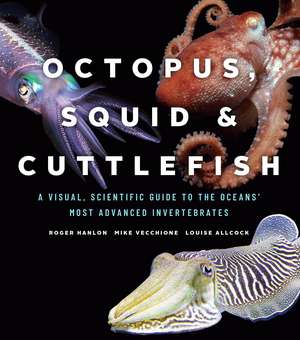
Octopus, Squid, and Cuttlefish: A Visual, Scientific Guide to the Oceans’ Most Advanced Invertebrates
Autor Roger Hanlon, Mike Vecchione, Louise Allcocken Limba Engleză Hardback – 31 oct 2018
"Cephalopods are often misunderstood creatures. Three biologists set the record straight."—Science News
Largely shell-less relatives of clams and snails, the marine mollusks in the class Cephalopoda—Greek for “head-foot”—are colorful creatures of many-armed dexterity, often inky self-defense, and highly evolved cognition. They are capable of learning, of retaining information—and of rapid decision-making to avoid predators and find prey. They have eyes and senses rivaling those of vertebrates like birds and fishes, they morph texture and body shape, and they change color faster than a chameleon. In short, they captivate us.
From the long-armed mimic octopus—able to imitate the appearance of swimming flounders and soles—to the aptly named flamboyant cuttlefish, whose undulating waves of color rival the graphic displays of any LCD screen, there are more than seven hundred species of cephalopod. Featuring a selection of species profiles, Octopus, Squid, and Cuttlefish reveals the evolution, anatomy, life history, behaviors, and relationships of these spellbinding animals. Their existence proves that intelligence can develop in very different ways: not only are cephalopods unusually large-brained invertebrates, they also carry two-thirds of their neurons in their arms.
A treasure trove of scientific fact and visual explanation, this worldwide illustrated guide to cephalopods offers a comprehensive review of these fascinating and mysterious underwater invertebrates—from the lone hunting of the octopus, to the social squid, and the prismatic skin signaling of the cuttlefish.
Largely shell-less relatives of clams and snails, the marine mollusks in the class Cephalopoda—Greek for “head-foot”—are colorful creatures of many-armed dexterity, often inky self-defense, and highly evolved cognition. They are capable of learning, of retaining information—and of rapid decision-making to avoid predators and find prey. They have eyes and senses rivaling those of vertebrates like birds and fishes, they morph texture and body shape, and they change color faster than a chameleon. In short, they captivate us.
From the long-armed mimic octopus—able to imitate the appearance of swimming flounders and soles—to the aptly named flamboyant cuttlefish, whose undulating waves of color rival the graphic displays of any LCD screen, there are more than seven hundred species of cephalopod. Featuring a selection of species profiles, Octopus, Squid, and Cuttlefish reveals the evolution, anatomy, life history, behaviors, and relationships of these spellbinding animals. Their existence proves that intelligence can develop in very different ways: not only are cephalopods unusually large-brained invertebrates, they also carry two-thirds of their neurons in their arms.
A treasure trove of scientific fact and visual explanation, this worldwide illustrated guide to cephalopods offers a comprehensive review of these fascinating and mysterious underwater invertebrates—from the lone hunting of the octopus, to the social squid, and the prismatic skin signaling of the cuttlefish.
Preț: 335.25 lei
Puncte Express: 503
Carte indisponibilă temporar
Doresc să fiu notificat când acest titlu va fi disponibil:
Se trimite...
Specificații
ISBN-13: 9780226459561
ISBN-10: 022645956X
Pagini: 224
Ilustrații: Full color images throughout
Dimensiuni: 129 x 198 x 25 mm
Greutate: 1.04 kg
Ediția:First Edition
Editura: University of Chicago Press
Colecția University of Chicago Press
ISBN-10: 022645956X
Pagini: 224
Ilustrații: Full color images throughout
Dimensiuni: 129 x 198 x 25 mm
Greutate: 1.04 kg
Ediția:First Edition
Editura: University of Chicago Press
Colecția University of Chicago Press
Notă biografică
Roger Hanlon is a senior scientist at the Marine Biological Laboratory in Woods Hole, Massachusetts, and professor of ecology and evolutionary biology at Brown University. He is coauthor of Cephalopod Behavior. Mike Vecchione is director of the National Oceanic and Atmospheric Administration Fisheries National Systematics Laboratory and an adjunct faculty member at the Virginia Institute of Marine Science. Louise Allcock is a lecturer in zoology at the National University of Ireland, Galway, president of the Cephalopod International Advisory Council, and coordinator of the International Union for Conservation of Nature red data list for Cephalopoda.
Cuprins
Introduction
Chapter One: Cephalopod Anatomy
Advanced Invertebrates
Inside the Cephalopod
Chapter Two: Phylogeny & Evolution
500 Million Years of Evolution
Nautilus—Living Fossil?
Evolution of Coleoids
The Buoyancy Conundrum
Octopodiformes
Decapodiformes
Cephalopods & Fishes: Convergent Evolution
On Dwarfs & Giants
Evolution & Climate Change
Chapter Three: Peculiar Lifestyles
Reproduction
Development
Age & Growth
Locomotion
Cephalopods of Various Biomes
Migration
Chapter Four: Behavior, Cognition & Intelligence
Decision Making
Rapid Adaptive Coloration
Nature’s Best Camouflage
When Camouflage Fails
Super Fights for Mates
Sneaky Males & Sneakier Females
Evaluating Intelligence in Such Bizarre Animals
Chapter Five: Cephalopods & Humans
World Fisheries & Human Consumption
A Rich History of Biomedical & Biological Advances
Bio-inspired Materials Science & Engineering
Glossary
Resources
Notes on Contributors
Index
Acknowledgments
Chapter One: Cephalopod Anatomy
Advanced Invertebrates
Inside the Cephalopod
Emperor Nautilus
Giant Pacific Octopod
Pharaoh Cuttlefish 46
Bigfin Squid
Japanese Flying Squid
Rough Glass Squid
Giant Pacific Octopod
Pharaoh Cuttlefish 46
Bigfin Squid
Japanese Flying Squid
Rough Glass Squid
Chapter Two: Phylogeny & Evolution
500 Million Years of Evolution
Nautilus—Living Fossil?
Evolution of Coleoids
The Buoyancy Conundrum
Octopodiformes
Decapodiformes
Cephalopods & Fishes: Convergent Evolution
On Dwarfs & Giants
Evolution & Climate Change
Fuzzy Nautilus
Common Blanket Octopus
Vampire
Two-toned Pygmy Idiosepiid
Caribbean Reef Octopus
Flamboyant Cuttlefish
Analogous Bobtail Squid
Opalescent Inshore Squid
Eye-flash Squid
Common Blanket Octopus
Vampire
Two-toned Pygmy Idiosepiid
Caribbean Reef Octopus
Flamboyant Cuttlefish
Analogous Bobtail Squid
Opalescent Inshore Squid
Eye-flash Squid
Chapter Three: Peculiar Lifestyles
Reproduction
Development
Age & Growth
Locomotion
Cephalopods of Various Biomes
Migration
Humboldt Squid
Greater Argonaut
Striped Pyjama Squid
Thumbstall Squid
Agassiz’s Whiplash Squid
Pacific Warty Octopod
Balloon Dumbo Octopod
Greater Argonaut
Striped Pyjama Squid
Thumbstall Squid
Agassiz’s Whiplash Squid
Pacific Warty Octopod
Balloon Dumbo Octopod
Chapter Four: Behavior, Cognition & Intelligence
Decision Making
Rapid Adaptive Coloration
Nature’s Best Camouflage
When Camouflage Fails
Super Fights for Mates
Sneaky Males & Sneakier Females
Evaluating Intelligence in Such Bizarre Animals
Common Octopus
Day Octopus
Mimic Octopus
Common European Cuttlefish
Giant Australian Cuttlefish
Broadclub Cuttlefish
Long-finned Inshore Squid
Caribbean Reef Squid
Day Octopus
Mimic Octopus
Common European Cuttlefish
Giant Australian Cuttlefish
Broadclub Cuttlefish
Long-finned Inshore Squid
Caribbean Reef Squid
Chapter Five: Cephalopods & Humans
World Fisheries & Human Consumption
A Rich History of Biomedical & Biological Advances
Bio-inspired Materials Science & Engineering
Horned Octopod
Lesser Two-spotted Octopod
Southern Blue-ringed Octopus
Hawaiian Bobtail
Cape Hope Squid
Veined Squid
Jewel Squid
Sparkling Enope Squid
Lesser Two-spotted Octopod
Southern Blue-ringed Octopus
Hawaiian Bobtail
Cape Hope Squid
Veined Squid
Jewel Squid
Sparkling Enope Squid
Glossary
Resources
Notes on Contributors
Index
Acknowledgments
Recenzii
"Cephalopods are often misunderstood creatures. Three biologists set the record straight on the behaviors and evolution of these invertebrates of the sea."
"Octopus, Squid, and Cuttlefish celebrates these animals through beautiful pictures and an encyclopedic discussion of the animals’ evolution, biology, and behaviors. . . . After reading about the cephalopods’ abilities and behaviors, as well as their potential for advancing our lives, readers might think twice before ordering their next calamari appetizer."
"Informative and quite gorgeous."
"It’s hard to imagine anything much more comprehensive in the field, and the 150 high-quality photographs taken by many different underwater photographers underline graphically the diversity of species. . . . Their writing style is clear, consistent, and very easy for non-biologists to follow. Excellent illustrations and diagrams aid understanding where required. Whether you want to read from cover to cover, dip in, skim, or use for reference, in terms of reflecting the latest research you’re unlikely to do better than this book if you want to get the most from your next underwater encounter."
"Blocks of species accounts interleave text-rich chapters on cephalopod biology. The chapter topics—which include morphology, systematics, phylogeny, behavior, and human exploitation—feature clear diagrams, high-quality photographs, and narratives that will not challenge most adult readers. . . . The sum of these chapters provides a complete . . . introduction to cephalopods. The blocks of species accounts consist of colorful, full-page photographs and associated factoids of several octopus, squid, and cuttlefish species. . . . These accounts . . . sample the remarkable array of cephalopod diversity. . . . Recommended."