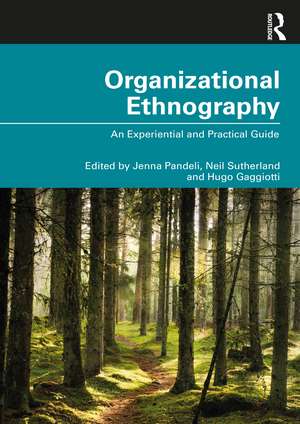
Organizational Ethnography: An Experiential and Practical Guide
Editat de Jenna Pandeli, Neil Sutherland, Hugo Gaggiottien Limba Engleză Paperback – 18 feb 2022
Students faced with the complexities of qualitative observational techniques and considerations, such as the scope of the research, the personal and professional intertwined life of the qualitative research or the decision of when to leave the field, will find the book an extremely useful, practical guide. A range of experiences from a variety of academics at different stages of their career, to highlight the differences in practices, approaches and encounters, are presented. The themes of the individual chapters cover three main areas: aspects to consider and reflect on before undertaking an ethnography, the process and experiences of conducting ethnographic work and considerations for after the fieldwork. Particular attention is given to appreciating the complexity and practicalities of ethnographic work, providing a more experience-driven text, and understanding perspectives from a range of different approaches to organizational ethnography.
This book should be a recommended text for advanced undergraduate and postgraduate students studying research methods within Business and Management. It is particularly important for all students and academics undertaking qualitative research, especially ethnography.
Preț: 484.59 lei
Puncte Express: 727
Carte tipărită la comandă
Livrare economică 17 noiembrie-01 decembrie
Livrare prin curier în România Termenul estimat este afișat lângă disponibilitate.
Transport gratuit pentru acest produs Plată online sau ramburs, în funcție de opțiunile comenzii.
Retur gratuit în 14 zile Comandă securizată și suport în română.
Specificații
ISBN-13: 9780367898687
ISBN-10: 0367898683
Pagini: 248
Ilustrații: 3 Tables, black and white
Dimensiuni: 174 x 246 x 25 mm
Greutate: 0.46 kg
Ediția:1
Editura: Taylor & Francis
Colecția Routledge
Locul publicării:Oxford, United Kingdom
ISBN-10: 0367898683
Pagini: 248
Ilustrații: 3 Tables, black and white
Dimensiuni: 174 x 246 x 25 mm
Greutate: 0.46 kg
Ediția:1
Editura: Taylor & Francis
Colecția Routledge
Locul publicării:Oxford, United Kingdom
V-ar putea interesa
-
 Doing Good Qualitative ResearchJennifer Cyr-19%Preț: 204.05 lei252.51 lei
 -
 -21%Preț: 477.11 lei603.36 lei
 -
 Messy Methods in Researching ReligionLinda Woodhead-33%Preț: 774.26 lei1147.30 lei
 -
 Writing Ethnographic Fieldnotes, Second EditionRobert M. EmersonPreț: 202.55 lei
 -
 Ethnography and the City: Readings on Doing Urban FieldworkRichard E. Ocejo-8%Preț: 560.31 lei609.02 lei
 -
 Preț: 379.89 lei
 -
 Doing Organizational EthnographyAnne Reff Pedersen-18%Preț: 1252.37 lei1527.28 lei
 -
 -18%Preț: 175.26 lei214.29 lei
 -
 Qualitative Research Ethics: Research MethodsDr. Rose Wiles-11%Preț: 130.58 lei146.01 lei
 -
 Video in Qualitative ResearchChristian Heath-8%Preț: 419.87 lei456.38 lei
 -
 EthnographyDavid FettermanPreț: 375.07 lei
 -
 -22%Preț: 655.89 lei840.88 lei
 -
 Naked Fieldnotes: A Rough Guide to Ethnographic WritingDenielle ElliottPreț: 234.47 lei
 -
 -19%Preț: 250.50 lei309.63 lei
 -
 Becoming a Reflexive Researcher - Using Our Selves in ResearchKim Etherington-24%Preț: 255.52 lei337.67 lei
 -
 Preț: 97.90 lei
 -
 Navigating the FieldMildred Oiza AjebonPreț: 386.26 lei
 -
 Transformative LearningFrode Soelberg-18%Preț: 1004.25 lei1224.70 lei
 -
 -18%Preț: 784.88 lei957.18 lei
Public țintă
Postgraduate and Undergraduate AdvancedCuprins
1. Outlining a practical, emotional and reflexive approach to Organisational Ethnography Part I: EMOTIONS, ETHNOGRAPHY AND FIELDWORK 2. Check Yourself Before You Wreck Yourself! Are you cut out for Ethnographic fieldwork? 3. Too close for comfort? The challenges and unexpected consequences of immersed ethnography 4. Removing the Rose-Tinted Glasses: Fear, Risk and Being Uncomfortable in Ethnographic Fieldwork 5. Choosing to reach beyond academic goalposts: Ethnographer as compassionate advocate inside an immigration detention centre Part II: ETHNOGRAPHY IN THE FIELD 6. Learning and doing autoethnography: resonance, vulnerability and exposure 7. Rapid ethnographies in organisations: ensuring rich data and timely findings 8. Deception as a Moral Project: Covert Research and the Construction of the Ethical Self 9. Ethnography on sensitive topics: children’s sexuality education in Spain 10. Reflexivity in Audio-Visual Ethnography: Thinking through Practice Part III: BEYOND THE FIELD 11. Exiting the field: when does an ethnography finish? 12. Jotting it down: Writing and analysing fieldnotes 13. Making sense of field material: from euphoria to despair and back 14. Learning to Fly: On Teaching the Ethnographic Craft 15. Futures of Organizational Ethnography: (Post) Pandemic Reflections and New Possibilities
Recenzii
Organizational Ethnography sets a new standard for scholarly reflection and theoretical inquiry. The editors have assembled a smart and engaging set of essays on ethnographic methods in diverse organizational contexts. Readers will find traditional topics assessed with a fresh lens, as well as some issues—exiting the field, studying sensitive issues—that have received far less attention than they deserve. For newcomers to the craft as well as seasoned practitioners, this volume on "hanging out" in organizations is a must read.
'Organizational Ethnography sets a new standard for scholarly reflection and theoretical inquiry. The editors have assembled a smart and engaging set of essays on ethnographic methods in diverse organizational contexts. Readers will find traditional topics assessed with a fresh lens, as well as some issues – exiting the field, studying sensitive issues – that have received far less attention than they deserve. For newcomers to the craft as well as seasoned practitioners, this volume on "hanging out" in organizations is a must read.'
Sudhir Venkatesh, Columbia University, USA
'This is a carefully edited collection of fresh and lively accounts of various phases and stages of ethnographic research in contemporary organizational settings – from planning a study, to carrying it out, to exiting the field, to writing it up. Central to each of the selections are the troubles a particular ethnographic stance presents to the researcher – many unseen at the outset of a study – and the disparate ways researchers have come up with in dealing with these vexing difficulties. These are personalized stories about the practical doing of ethnography – tales that are typically elided from the rather condensed and sanitized renderings of how a given study was accomplished that appear in print. That canonical ethnographic means and ends are necessarily strained and stretched in the flickering, messy, chaotic, emotionally laden and initially unknown surroundings and circumstances that a study seeks to tame is a reoccurring theme in these accounts. This is a work that will appeal to seasoned as well as novice researchers interested how the ethnographers of various backgrounds have dealt with the inherent uncertainties of their trade.'
John Van Maanen, Emeritus Professor, MIT (Work and Organization Studies Group), USA
'Ethnographic research is flourishing in a wide variety of social settings, and in an equally diverse range of disciplines. With a broad understanding of organisational ethnography, this collection of essays amply displays all that variety. It also captures the remarkable range of approaches – methodological and personal – that characterise contemporary field research. The contributing authors are frank in acknowledging the personal, ethical and intellectual challenges of ethnographic fieldwork, but they also convey the immense satisfaction to be gained from such research. They offer a close look under the bonnet, to see some of the things that lie behind published ethnographic research. Readers will be engaged, informed and confronted by the essays in this collection. It will be an invaluable resource for students and more experienced ethnographers alike.'
Paul Atkinson, Emeritus Professor, Cardiff University, UK
- Sudhir Venkatesh, Columbia University, USA
'Organizational Ethnography sets a new standard for scholarly reflection and theoretical inquiry. The editors have assembled a smart and engaging set of essays on ethnographic methods in diverse organizational contexts. Readers will find traditional topics assessed with a fresh lens, as well as some issues – exiting the field, studying sensitive issues – that have received far less attention than they deserve. For newcomers to the craft as well as seasoned practitioners, this volume on "hanging out" in organizations is a must read.'
Sudhir Venkatesh, Columbia University, USA
'This is a carefully edited collection of fresh and lively accounts of various phases and stages of ethnographic research in contemporary organizational settings – from planning a study, to carrying it out, to exiting the field, to writing it up. Central to each of the selections are the troubles a particular ethnographic stance presents to the researcher – many unseen at the outset of a study – and the disparate ways researchers have come up with in dealing with these vexing difficulties. These are personalized stories about the practical doing of ethnography – tales that are typically elided from the rather condensed and sanitized renderings of how a given study was accomplished that appear in print. That canonical ethnographic means and ends are necessarily strained and stretched in the flickering, messy, chaotic, emotionally laden and initially unknown surroundings and circumstances that a study seeks to tame is a reoccurring theme in these accounts. This is a work that will appeal to seasoned as well as novice researchers interested how the ethnographers of various backgrounds have dealt with the inherent uncertainties of their trade.'
John Van Maanen, Emeritus Professor, MIT (Work and Organization Studies Group), USA
'Ethnographic research is flourishing in a wide variety of social settings, and in an equally diverse range of disciplines. With a broad understanding of organisational ethnography, this collection of essays amply displays all that variety. It also captures the remarkable range of approaches – methodological and personal – that characterise contemporary field research. The contributing authors are frank in acknowledging the personal, ethical and intellectual challenges of ethnographic fieldwork, but they also convey the immense satisfaction to be gained from such research. They offer a close look under the bonnet, to see some of the things that lie behind published ethnographic research. Readers will be engaged, informed and confronted by the essays in this collection. It will be an invaluable resource for students and more experienced ethnographers alike.'
Paul Atkinson, Emeritus Professor, Cardiff University, UK
Notă biografică
Jenna Pandeli is a senior lecturer at University of the West of England (UWE), Bristol, UK.
Neil Sutherland is a senior lecturer at UWE, Bristol, UK.
Hugo Gaggiotti is a professor at UWE, Bristol, UK.
Neil Sutherland is a senior lecturer at UWE, Bristol, UK.
Hugo Gaggiotti is a professor at UWE, Bristol, UK.
Descriere
This textbook explores practices, first-hand experiences and emerging ideas within organizational ethnography, providing a toolkit that prepares ethnographers for the uncertainties and realities of fieldworking.