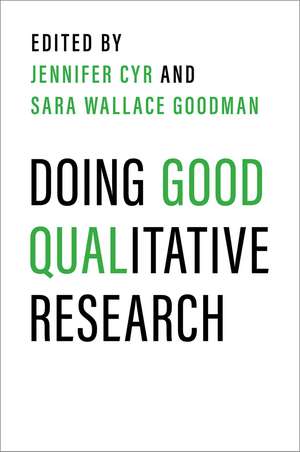
Doing Good Qualitative Research
Editat de Jennifer Cyr, Sara Wallace Goodmanen Limba Engleză Paperback – 29 aug 2024
Preț: 209.08 lei
Preț vechi: 256.04 lei
-18%
Puncte Express: 314
Carte disponibilă
Livrare economică 12-18 noiembrie
Livrare express 27-31 octombrie pentru 94.63 lei
Livrare prin curier în România Termenul estimat este afișat lângă disponibilitate.
Transport gratuit de la 400.00 lei Plată online sau ramburs, în funcție de opțiunile comenzii.
Retur gratuit în 14 zile Comandă securizată și suport în română.
Specificații
ISBN-13: 9780197633144
ISBN-10: 0197633145
Pagini: 504
Dimensiuni: 170 x 244 x 33 mm
Greutate: 0.86 kg
Editura: Oxford University Press
Colecția OUP USA
Locul publicării:New York, United States
ISBN-10: 0197633145
Pagini: 504
Dimensiuni: 170 x 244 x 33 mm
Greutate: 0.86 kg
Editura: Oxford University Press
Colecția OUP USA
Locul publicării:New York, United States
Recenzii
At last! Social researchers have long needed a single, comprehensive, and up-to-date introduction to the intimidating field of qualitative methods. This volume fulfills that need with stunning success, delivering engaging and accessible contributions of the highest quality. Doing Good Qualitative Research is the place to start for any scholar thinking about using qualitative methods.
In this highly useful book, more than forty experts provide accessible overviews of qualitative methods in the social sciences, ranging from field research to content analysis, discourse analysis, ethnography, focus groups, network analysis, mixed methods, and process tracing. Each chapter identifies theoretical and practical research challenges and best practices for addressing them, with examples and recommended readings. This is the best single-volume introduction to such a diverse range of qualitative methods for both graduate and undergraduate courses.
Doing Good Qualitative Research is wonderfully conceived, organized, and executed. Cyr and Goodman have assembled a tour de force of some of the best scholars doing qualitative work today. Each chapter offers concrete suggestions and valuable insights for scholars interested in conducting a wide range of qualitative research and for anyone who reads and evaluates qualitative work. The book is much needed and long overdue! It will become a handbook for any graduate student conducting qualitative research.
In the age of rapid technological evolution and fast computation, Doing Good Qualitative Research is a much-needed addition to scholarship by providing a centralized toolbox to a broad audience who is interested in conducting, reviewing, and learning qualitative investigations.
In this highly useful book, more than forty experts provide accessible overviews of qualitative methods in the social sciences, ranging from field research to content analysis, discourse analysis, ethnography, focus groups, network analysis, mixed methods, and process tracing. Each chapter identifies theoretical and practical research challenges and best practices for addressing them, with examples and recommended readings. This is the best single-volume introduction to such a diverse range of qualitative methods for both graduate and undergraduate courses.
Doing Good Qualitative Research is wonderfully conceived, organized, and executed. Cyr and Goodman have assembled a tour de force of some of the best scholars doing qualitative work today. Each chapter offers concrete suggestions and valuable insights for scholars interested in conducting a wide range of qualitative research and for anyone who reads and evaluates qualitative work. The book is much needed and long overdue! It will become a handbook for any graduate student conducting qualitative research.
In the age of rapid technological evolution and fast computation, Doing Good Qualitative Research is a much-needed addition to scholarship by providing a centralized toolbox to a broad audience who is interested in conducting, reviewing, and learning qualitative investigations.
Notă biografică
Jennifer Cyr is Associate Professor of Political Science at Universidad Torcuato Di Tella in Buenos Aires, Argentina. She is the author of The Fates of Political Parties: Institutional Crisis, Continuity, and Change in Latin America and Focus Groups for the Social Science Researcher. She has also published in a wide variety of journals, including Comparative Political Studies, Comparative Politics, PS: Political Science and Politics, Quality & Quantity, Studies in Comparative International Development, Sociological Methods and Research, and Revista de Ciencia Política, and has several chapters in edited volumes. Sara Wallace Goodman is a Chancellor's Fellow and Dean's Professor of Political Science at the University of California, Irvine (UCI). She is the author of Citizenship in Hard Times: How Ordinary People Respond to Democratic Threat, co-author of Pandemic Politics: The Deadly Toll of Partisanship in the Age of COVID, and author of Immigration andMembership Politics in Western Europe, which received the Best Book Award from the European Politics and Society section of the American Political Science Association. Her work has also appeared in various journals including the American Political Science Review, Journal of Politics, World Politics, Comparative Political Studies, International Organization, and other venues.