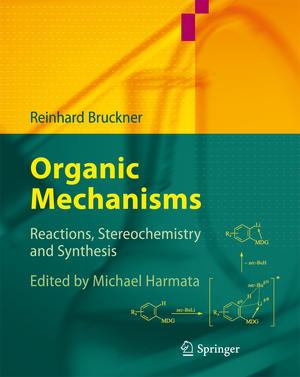
Organic Mechanisms: Reactions, Stereochemistry and Synthesis
Autor Reinhard Bruckner Editat de Michael Harmata Cuvânt înainte de Paul Wender Ilustrat de Wolfgang Zettlmeieren Limba Engleză Hardback – 20 ian 2010
Destinat studenților de la nivel de masterat și doctorat, precum și cercetătorilor din domeniul sintezei chimice, Organic Mechanisms de Reinhard Bruckner oferă un cadru riguros pentru înțelegerea modului în care structurile moleculare interacționează și se transformă. Această a treia ediție, publicată de Springer, rafinează limbajul chimiei organice — un sistem de cunoștințe care, după cum notează Paul Wender în prefață, permite descrierea evenimentelor la nivel molecular cu o precizie estetică și științifică deosebită.
Notăm cu interes organizarea logică a materialului, care progresează de la reacțiile de substituție radicalică și nucleofilă la atomul de carbon saturat, către mecanisme complexe precum adițiile electrofile, eliminările și substituțiile aromatice. Volumul extinde cadrul teoretic propus de Guidebook to Mechanism in Organic Chemistry de Peter Sykes prin integrarea unor capitole avansate dedicate chimiei enolaților de metale alcalino-pământoase, cicloadițiilor termice și alchenilărilor mediate de metale tranziționale. Spre deosebire de abordările introductive, lucrarea lui Bruckner pune un accent sporit pe conceptele de sinteză modernă, oferind o bază solidă pentru cei care doresc să stăpânească proiectarea reacțiilor.
Ilustrațiile realizate de Wolfgang Zettlmeier joacă un rol crucial în această ediție, facilitând vizualizarea deplasărilor de electroni și a stărilor de tranziție. Găsim în acest volum o rigoare academică similară cu cea din Advanced Organic Chemistry Part A de Francis A. Carey, însă cu o orientare didactică mai pronunțată spre mecanismele de reacție specifice și interconversia derivaților de acid carboxilic sau nitrili. Este o resursă care transformă memorarea reacțiilor în înțelegerea principiilor fundamentale de reactivitate.
Preț: 805.18 lei
Preț vechi: 981.93 lei
-18%
Carte disponibilă
Livrare economică 16-30 mai
Specificații
ISBN-10: 3642036503
Pagini: 800
Ilustrații: XXXII, 855 p.
Dimensiuni: 193 x 242 x 58 mm
Greutate: 2.04 kg
Ediția:2010
Editura: Springer Berlin, Heidelberg
Colecția Springer
Locul publicării:Berlin, Heidelberg, Germany
V-ar putea interesa
-
 -29%Preț: 579.82 lei821.07 lei
 -
 Exercises in Synthetic Organic ChemistryChiara Ghiron-35%Preț: 490.91 lei755.59 lei
 -
 Organic Chemistry: A Very Short IntroductionGraham PatrickPreț: 48.66 lei
 -
 Advanced Organic ChemistryFrancis A. Carey-17%Preț: 413.21 lei497.85 lei
 -
 -15%Preț: 519.81 lei611.54 lei
 -
 -23%Preț: 528.83 lei686.79 lei
 -
 Silver in Organic ChemistryMichael Harmata-9%Preț: 806.56 lei886.32 lei
 -
 Organosilanes in Radical ChemistryChryssostomos Chatgilialoglu-9%Preț: 1453.60 lei1597.37 lei
 -
 Guidebook to Mechanism in Organic ChemistryPeter Sykes-15%Preț: 512.09 lei602.45 lei
 -
 Organic Chemistry I For DummiesArthur WinterPreț: 110.17 lei
 -
 BIOS Instant Notes in Organic ChemistryGraham PatrickPreț: 244.06 lei
 -
 Modern Physical Organic ChemistryEric V. Anslyn-18%Preț: 930.48 lei1134.73 lei
 -
 Polymer Synthesis: Theory and PracticeDietrich Braun-15%Preț: 577.31 lei679.19 lei
Public țintă
GraduateDe ce să citești această carte
Recomandăm această carte studenților avansați care doresc să treacă de la simpla memorare la stăpânirea logicii mecanismelor organice. Prin cele 800 de pagini bogat ilustrate, cititorul câștigă o perspectivă profundă asupra sintezei moderne. Este un instrument esențial pentru pregătirea în cercetarea academică sau industrială, oferind claritate în explicarea reacțiilor mediate de metale și a rearanjărilor moleculare complexe.
Descriere scurtă
Cuprins
Recenzii
"The new edition of the textbook of R. Bruckner is accurate, all important modern mechanistic and synthetic concepts of organic chemistry are presented in a very didactic fashion, a superb book to put in the hands of all who would want to learn synthetic organic chemistry or refresh their knowledge."
Paul Knochel, Ludwig-Maximilians-University Munich
"Over its three editions, Professor Bruckner has significantly fine-tuned his outstanding textbook titled ‘Organic Mechanisms’, now available in English. This text is aimed squarely at students that have completed a typical one-year introductory course in organic chemistry and now wish to continue refining their understanding of the subject. At this level, the text is appropriately focused on providing the reader with an enhanced fundamental understanding of an ambitious range of organic reactions. Along with reminding the reader about fundamental principles necessary to understand the topic, Bruckner’s updated edition also provides a solid physical organic perspective on a wide range of processes. The text is not meant to be an exhaustive survey of reactions, but more of a sound introduction to the underlying principles that control reactivity in variety of transformations that chemistry students should be familiar with. The book, therefore, is particularly well suited for “intermediate” and “advanced” classes in organic chemistry, usually found in upper class electives and introductory graduate classes. The book will also serve as a valuable starting point for the more experienced chemist wishing to brush-up on organic transformations that they might be less familiar with.”
Marc L. Snapper, Boston College
This updated version of Professor Brückner’s ‘Organic Mechanisms’ provides a thorough overview of modern organic synthesis that is both comprehensive and accessible to chemists with all levels of experience.Detailed reaction mechanisms are illustrated with clear schemes that effectively convey the electronic and structural principles influencing reactivity and selectivity for the most common transformations used in organic synthesis. The pragmatic division of the material into introductory and more advanced sections enables the text to be used both as a teaching resource for both undergraduate chemistry students and researchers from allied disciplines and as a valuable text for experienced researchers. The book prompts the reader to readily grasp important concepts, while providing ample scope for extension and development of more advanced students of organic chemistry. ‘Organic Mechanisms’ is also a valuable resource for those involved in the application and practice of organic synthesis on a professional level. The range of topics discussed provides an up-to-date compendium of current methods, of relevance to both academia and industry, with the references at the end of each chapter providing a useful starting point for more detailed further reading. Overall, the new English edition of ‘Organic Mechanisms’ is an excellent single reference for those wishing to learn or better understand the complex practice of modern synthetic organic chemistry. It is long overdue and I look forward to having a copy readily available for my students.
Margaret Brimble, The University of Auckland
Having held in high regard the 1st English edition of Bruckner´s textbook Organic Reaction Mechanisms I have been waiting for years for an updated version to appear. This long-expected textbook is now available. It has been completely revised and considerably expanded and is a meticulously composed treatise at the interface between synthetic organic chemistry and mechanistic analysis. Every student of advanced organic chemistry will benefit from this book."
Koichi Narasaka, Nayang Technical University, Singapore.
“This English edition of the Germantextbook by Bruckner … is an excellent resource for advanced academic students. … The presentation is impressive, and clear illustrations appear throughout the book. … This makes the work a very interesting read and offers abundant opportunities for students to create new problem sets. … For graduate students and instructors, this work offers a wealth of information. The end-of-chapter references are comprehensive and thorough. Summing Up: Highly recommended. Graduate students, researchers/faculty, and professionals.” (S. Rajaraman, Choice, Vol. 48 (3), November, 2010)