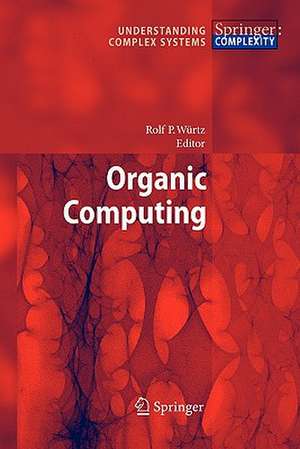
Organic Computing: Understanding Complex Systems
Editat de Rolf P. Würtzen Limba Engleză Paperback – 18 noi 2010
Din seria Understanding Complex Systems
- 18%
 Preț: 1080.00 lei
 -
 Preț: 439.80 lei
 - 18%
 Preț: 988.65 lei
 - 15%
 Preț: 661.12 lei
 - 18%
 Preț: 1170.06 lei
 - 18%
 Preț: 911.29 lei
 - 15%
 Preț: 667.19 lei
 - 15%
 Preț: 673.77 lei
 - 15%
 Preț: 675.52 lei
 - 18%
 Preț: 955.93 lei
 - 18%
 Preț: 990.14 lei
 - 15%
 Preț: 666.14 lei
 - 15%
 Preț: 663.50 lei
 -
 Preț: 442.26 lei
 - 15%
 Preț: 661.83 lei
 - 15%
 Preț: 677.28 lei
 - 15%
 Preț: 666.40 lei
 - 20%
 Preț: 674.28 lei
 - 20%
 Preț: 677.98 lei
 - 18%
 Preț: 982.53 lei
 - 18%
 Preț: 1150.57 lei
 - 18%
 Preț: 1280.17 lei
 - 15%
 Preț: 668.60 lei
 - 18%
 Preț: 983.43 lei
 - 15%
 Preț: 669.20 lei
 - 18%
 Preț: 1440.00 lei
 - 18%
 Preț: 990.35 lei
 -
 Preț: 414.85 lei
 - 18%
 Preț: 980.03 lei
 - 18%
 Preț: 1297.31 lei
 - 15%
 Preț: 666.97 lei
 - 5%
 Preț: 1465.64 lei
 - 18%
 Preț: 984.66 lei
 - 18%
 Preț: 982.96 lei
 -
 Preț: 402.76 lei
 - 20%
 Preț: 680.46 lei
 - 18%
 Preț: 1047.87 lei
Preț: 909.66 lei
Preț vechi: 1109.33 lei
-18%
Puncte Express: 1364
Carte disponibilă
Livrare economică 04-18 noiembrie
Livrare express 21-27 octombrie pentru 36.99 lei
Livrare prin curier în România Termenul estimat este afișat lângă disponibilitate.
Transport gratuit pentru acest produs Plată online sau ramburs, în funcție de opțiunile comenzii.
Retur gratuit în 14 zile Comandă securizată și suport în română.
Specificații
ISBN-13: 9783642096426
ISBN-10: 3642096425
Pagini: 368
Ilustrații: XI, 355 p.
Dimensiuni: 155 x 235 x 20 mm
Greutate: 0.56 kg
Ediția:Softcover reprint of hardcover 1st edition 2008
Editura: Springer
Colecția Understanding Complex Systems
Seria Understanding Complex Systems
Locul publicării:Berlin, Heidelberg, Germany
ISBN-10: 3642096425
Pagini: 368
Ilustrații: XI, 355 p.
Dimensiuni: 155 x 235 x 20 mm
Greutate: 0.56 kg
Ediția:Softcover reprint of hardcover 1st edition 2008
Editura: Springer
Colecția Understanding Complex Systems
Seria Understanding Complex Systems
Locul publicării:Berlin, Heidelberg, Germany
V-ar putea interesa
-
 Renormalization Methods: A Guide For BeginnersWilliam David McComb-12%Preț: 277.69 lei316.68 lei
 -
 Lectures on Complex NetworksSergey Dorogovtsev-11%Preț: 314.02 lei354.55 lei
 -
 -24%Preț: 669.91 lei882.52 lei
 -
 The Inflationary UniverseAlan GuthPreț: 179.95 lei
 -
 Perfectly Reasonable Deviations from the Beaten TrackRichard P FeynmanPreț: 130.25 lei
 -
 String Theory and Particle PhysicsLuis E. Ibáñez-11%Preț: 524.42 lei589.23 lei
 -
 Statistical Analysis of Circular DataN. I. FisherPreț: 458.59 lei
 -
 Nonequilibrium Quantum Field TheoryEsteban A. Calzetta-19%Preț: 414.81 lei515.12 lei
 -
 Statistical Physics of FieldsMehran Kardar-11%Preț: 688.23 lei773.29 lei
 -
 Statistical Physics of ParticlesMehran Kardar-8%Preț: 470.34 lei511.24 lei
 -
 A First Course in String TheoryBarton Zwiebach-8%Preț: 533.80 lei580.22 lei
 -
 The Kerr SpacetimeDavid L. Wiltshire-14%Preț: 1068.36 lei1242.28 lei
 -
 Quantum Field Theory and the Standard ModelMatthew D. Schwartz-8%Preț: 617.78 lei671.51 lei
 -
 Statistical PhysicsA. M. GuenaultPreț: 435.77 lei
 -
 Gauge Theories & Differential GeometryLance Bailey-27%Preț: 1525.22 lei2077.15 lei
 -
 Quantum Physics in MinutesGemma Lavender-26%Preț: 70.15 lei94.37 lei
 -
 A Modern Course in Statistical PhysicsLinda E. Reichl-14%Preț: 640.19 lei744.41 lei
Public țintă
ResearchCuprins
Introduction: Organic Computing.- The Organic Future of Information Technology.- Systems Engineering for Organic Computing: The Challenge of Shared Design and Control between OC Systems and their Human Engineers.- Controlled Emergence and Self-Organization.- Organic Computing and Complex Dynamical Systems – Conceptual Foundations and Interdisciplinary Perspectives.- Evolutionary Design of Emergent Behavior.- Genesis of Organic Computing Systems: Coupling Evolution and Learning.- Organically Grown Architectures: Creating Decentralized, Autonomous Systems by Embryomorphic Engineering.- Artificial Development.- Self-adaptive Worker-Helper Systems with Self-Organized Task Allocation.- Concepts for Self-Adaptive and Self-Healing Networked Embedded Systems.- An Artificial Hormone System for Self-Organizing Real-Time Task Allocation in Organic Middleware.- Bio-Inspired Networking — Self-Organizing Networked Embedded Systems.- Self-organized Evaluation of Dynamic Hand Gestures for Sign Language Recognition.- Subspace Image Representation for Facial Expression Analysis and Face Recognition and its Relation to the Human Visual System.
Textul de pe ultima copertă
Organic Computing is a research field emerging around the conviction that problems of organization in complex systems in computer science, telecommunications, neurobiology, molecular biology, ethology, and possibly even sociology can be tackled scientifically in a unified way. From the computer science point of view, the apparent ease in which living systems solve computationally difficult problems makes it inevitable to adopt strategies observed in nature for creating information processing machinery. In this book, the major ideas behind Organic Computing are delineated, together with a sparse sample of computational projects undertaken in this new field. Biological metaphors include evolution, neural networks, gene-regulatory networks, networks of brain modules, hormone system, insect swarms, and ant colonies. Applications are as diverse as system design, optimization, artificial growth, task allocation, clustering, routing, face recognition, and sign language understanding.
Caracteristici
Brings together the state of the art in organic computing Includes articles by Christoph von der Malsburg, Klaus Mainzer, or Richard Bellmanns (the inventor of dynamic programming) daughter Kirstie setting the foundations regarding brain-organization, emergence, and selforganization Demonstrates the mechanisms of "Learning from Nature" which is a founding principle of Organic Computing The presented projects are building on work done in brain theory, neural networks, evolutionary computation, optimization, and network theory Includes supplementary material: sn.pub/extras