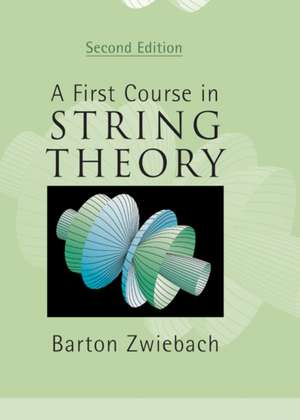
A First Course in String Theory
Autor Barton Zwiebachen Limba Engleză Hardback – 2009
În peisajul academic al fizicii teoretice, A First Course in String Theory ocupă o poziție strategică, fiind concepută special pentru a face tranziția de la mecanica cuantică de nivel licență la complexitatea teoriei corzilor. Notăm cu interes modul în care Barton Zwiebach își structurează materialul: prima parte a volumului demitizează conceptele fundamentale, precum dimensiunile suplimentare și corzile relativiste, fără a solicita o stăpânire prealabilă a teoriei cuantice a câmpurilor. Această abordare pedagogică, bazată pe dezvoltarea intuiției fizice înaintea formalismului matematic riguros, diferențiază lucrarea de alte manuale tehnice. Această a doua ediție extinde semnificativ orizontul de studiu, introducând subiecte de actualitate precum dualitatea T, corespondența AdS/CFT și supercorzile. Cartea completează perspectiva oferită de A Short Introduction to String Theory de Thomas Mohaupt, care se concentrează pe o prezentare concisă a relației dintre particule și câmpuri; spre deosebire de aceasta, lucrarea lui Zwiebach oferă o explorare mult mai detaliată și aplicată, susținută de peste 150 de exerciții noi. De asemenea, dacă Introduction to the AdS/CFT correspondence de Horațiu Năstase presupune deja cunoștințe de teoria câmpului, Zwiebach construiește aceste noțiuni progresiv. Experiența autorului la MIT, reflectată și în cealaltă lucrare a sa, Mastering Quantum Mechanics, se traduce aici printr-o claritate didactică remarcabilă. Structura celor 25 de capitole ghidează studentul de la relativitatea specială la termodinamica găurilor negre, oferind un fundament solid pentru cercetări ulterioare în fizica energiilor înalte. Este, în esență, un manual care transformă un subiect abstract într-un domeniu de studiu accesibil și structurat.
Preț: 533.80 lei
Preț vechi: 580.22 lei
-8%
Carte disponibilă
Livrare economică 09-23 noiembrie
Livrare express 24-30 octombrie pentru 74.68 lei
Specificații
ISBN-10: 0521880327
Pagini: 694
Ilustrații: 105 diagrams, 8 tables, 156 exercises
Dimensiuni: 183 x 260 x 42 mm
Greutate: 1.48 kg
Ediția:2nd edition
Editura: Cambridge University Pr.
Locul publicării:Cambridge, United Kingdom
V-ar putea interesa
-
 Multilayer Networks: Structure and FunctionGinestra Bianconi-23%Preț: 567.77 lei736.97 lei
 -
 Renormalization Methods: A Guide For BeginnersWilliam David McComb-12%Preț: 277.69 lei316.68 lei
 -
 Lectures on Complex NetworksSergey Dorogovtsev-11%Preț: 314.02 lei354.55 lei
 -
 Data Science and Complex Networks: Real Case Studies with PythonGuido Caldarelli-21%Preț: 446.65 lei566.92 lei
 -
 -24%Preț: 669.91 lei882.52 lei
 -
 Evolution of Networks: From Biological Nets to the Internet and WWWS. N. Dorogovtsev-23%Preț: 432.72 lei558.75 lei
 -
 A Modern Approach to Critical PhenomenaIgor HerbutPreț: 424.55 lei
 -
 Preț: 418.05 lei
 -
 Elements of String CosmologyMaurizio Gasperini-11%Preț: 512.50 lei575.83 lei
 -
 Self-Organised CriticalityGunnar Pruessner-11%Preț: 706.28 lei793.57 lei
 -
 Chaos and Coarse Graining in Statistical MechanicsPatrizia Castiglione-14%Preț: 948.67 lei1103.11 lei
 -
 Random Walks in BiologyHoward C BergPreț: 341.45 lei
 -
 Networks in Social Policy ProblemsBal Zs Vedres-11%Preț: 681.51 lei765.73 lei
 -
 -14%Preț: 1259.99 lei1465.11 lei
 -
 The Bethe WavefunctionMichel Gaudin-11%Preț: 704.46 lei791.53 lei
 -
 The Structure and Dynamics of CitiesMarc Barthélemy-11%Preț: 610.83 lei686.34 lei
 -
 Fractional Diffusion Equations and Anomalous DiffusionLuiz Roberto Evangelista-11%Preț: 660.32 lei741.92 lei
 -
 Perspectives on Statistical ThermodynamicsYoshitsugu Oono-11%Preț: 559.55 lei628.70 lei
 -
 Relativistic Figures of EquilibriumReinhard MeinelPreț: 392.06 lei
 -
 Statistical Mechanics of Nonequilibrium LiquidsDenis J. EvansPreț: 448.14 lei
 -
 Quantum Field Theory IEdouard B. Manoukian-15%Preț: 628.16 lei739.02 lei
 -
 Theoretical Frontiers in Black Holes and CosmologyRenata Kallosh-15%Preț: 667.86 lei785.72 lei
 -
 Quantum Field Theory IIEdouard B. Manoukian-15%Preț: 615.67 lei724.32 lei
 -
 Theoretical Physics 8Wolfgang Nolting-15%Preț: 630.56 lei741.84 lei
 -
 -15%Preț: 620.07 lei729.49 lei
 -
 A Bayesian Analysis of QCD Sum RulesPhilipp Gubler-15%Preț: 664.79 lei782.11 lei
De ce să citești această carte
Recomandăm această carte studenților la fizică și matematică ce doresc o introducere sistematică în teoria corzilor fără a fi copleșiți de formalismul avansat din primii pași. Cititorul câștigă o înțelegere profundă a modului în care corzile înlocuiesc particulele punctiforme, beneficiind de expertiza unui profesor de la MIT. Este resursa ideală pentru auto-studiu sau cursuri introductive, oferind un echilibru rar între rigoare și accesibilitate.
Despre autor
Barton Zwiebach este profesor de fizică la Massachusetts Institute of Technology (MIT) și o figură centrală în fizica teoretică contemporană. Este recunoscut la nivel mondial pentru contribuțiile sale fundamentale în teoria câmpurilor de corzi (String Field Theory), fiind autorul primelor lucrări despre construcția teoriei câmpului pentru corzile deschise și, ulterior, pentru cele închise. Cercetările sale acoperă, de asemenea, subiecte precum D-branele și condensarea tahionilor. Experiența sa pedagogică la MIT a fost esențială în modelarea acestui manual, transformând cercetarea de vârf într-un material didactic accesibil.
Descriere scurtă
Cuprins
Recenzii
'Barton Zwiebach has written a careful and thorough introduction to string theory that is suitable for a full-year course at the advanced undergraduate level. There has been much demand for a book about string theory at this level, and this one should go a long way towards meeting that demand.' John Schwarz, California Institute of Technology
'There is a great curiosity about string theory, not only among physics undergraduates but also among professional scientists outside of the field. This audience needs a text that goes much further than the popular accounts but without the full technical detail of a graduate text. Zwiebach's book meets this need in a clear and accessible manner. It is well-grounded in familiar physical concepts, and proceeds through some of the most timely and exciting aspects of the subject.' Joseph Polchinski, University of California, Santa Barbara
'Zwiebach, a respected researcher in the field and a much beloved teacher at MIT, is truly faithful to his goal of making string theory accessible to advanced undergraduates – the test develops intuition before formalism, usually through simplified and illustrative examples … Zwiebach avoids the temptation of including topics that would weigh the book down and make many students rush it back to the shelf and quit the course.' Physics Today
'… well-written … takes us through the hottest topics in string theory research, requiring only a solid background in mechanics and some basic quantum mechanics. … This is not just one more text in the ever-growing canon of popular books on string theory …' The Times Higher Education Supplement
'… the book provides an excellent basis for an introductory course on string theory and is well-suited for self-study by graduate students or any physicist who wants to learn the basics of string theory.' Zentralblatt MATH
'… excellent introduction by Zwiebach… aimed at advanced undergraduates who have some background in quantum mechanics and special relativity, but have not necessarily mastered quantum field theory and general relativity yet … the book … is a very thorough introduction to the subject … Equipped with this background, the reader can safely start to tackle the books by Green, Schwarz and Witten and by Polchinski.' Marcel L. Vonk, Mathematical Reviews Clippings