
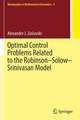
Optimal Control Problems Related to the Robinson-Solow-Srinivasan Model: Monographs in Mathematical Economics
Autor Alexander J. Zaslavskien Limba Engleză Hardback – 8 aug 2021
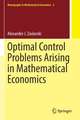
This book is devoted to the study of classes of optimal control problems arising in economic growth theory, related to the Robinson–Solow–Srinivasan (RSS) model. The model was introduced in the 1960s by economists Joan Robinson, Robert Solow, and Thirukodikaval Nilakanta Srinivasan and was further studied by Robinson, Nobuo Okishio, and Joseph Stiglitz. Since then, the study of the RSS model has become an important element of economic dynamics. In this book, two large general classes of optimal control problems, both of them containing the RSS model as a particular case, are presented for study. For these two classes, a turnpike theory is developed and the existence of solutions to the corresponding infinite horizon optimal control problems is established.
The book contains 9 chapters. Chapter 1 discusses turnpike properties for some optimal control problems that are known in the literature, including problems corresponding to the RSS model. The first class of optimal control problems is studied in Chaps. 2–6. In Chap. 2, infinite horizon optimal control problems with nonautonomous optimality criteria are considered. The utility functions, which determine the optimality criterion, are nonconcave. This class of models contains the RSS model as a particular case. The stability of the turnpike phenomenon of the one-dimensional nonautonomous concave RSS model is analyzed in Chap. 3. The following chapter takes up the study of a class of autonomous nonconcave optimal control problems, a subclass of problems considered in Chap. 2. The equivalence of the turnpike property and the asymptotic turnpike property, as well as the stability of the turnpike phenomenon, is established. Turnpike conditions and the stability of the turnpike phenomenon for nonautonomous problems are examined in Chap. 5, with Chap. 6 devoted to the study of the turnpike properties for the one-dimensional nonautonomous nonconcave RSS model. The utility functions, which determine the optimality criterion, are nonconcave. The class of RSS models is identified with a complete metric space of utility functions. Using the Baire category approach, the turnpike phenomenon is shown to hold for most of the models. Chapter 7 begins the study of the second large class of autonomous optimal control problems, and turnpike conditions are established. The stability of the turnpike phenomenon for this class of problems is investigated further in Chaps. 8 and 9.
| Toate formatele și edițiile | Preț | Express |
|---|---|---|
| Paperback (1) | 755.20 lei 6-8 săpt. | |
| Springer – 9 aug 2022 | 755.20 lei 6-8 săpt. | |
| Hardback (1) | 760.52 lei 6-8 săpt. | |
| Springer – 8 aug 2021 | 760.52 lei 6-8 săpt. |
Preț: 760.52 lei
Preț vechi: 927.46 lei
-18% Nou
Puncte Express: 1141
Preț estimativ în valută:
134.57€ • 158.02$ • 118.12£
134.57€ • 158.02$ • 118.12£
Carte tipărită la comandă
Livrare economică 27 ianuarie-10 februarie 26
Preluare comenzi: 021 569.72.76
Specificații
ISBN-13: 9789811622519
ISBN-10: 9811622515
Pagini: 360
Ilustrații: XI, 348 p. 1 illus.
Dimensiuni: 160 x 241 x 25 mm
Greutate: 0.71 kg
Ediția:1st ed. 2021
Editura: Springer
Seria Monographs in Mathematical Economics
Locul publicării:Singapore, Singapore
ISBN-10: 9811622515
Pagini: 360
Ilustrații: XI, 348 p. 1 illus.
Dimensiuni: 160 x 241 x 25 mm
Greutate: 0.71 kg
Ediția:1st ed. 2021
Editura: Springer
Seria Monographs in Mathematical Economics
Locul publicării:Singapore, Singapore
Cuprins
1.Introduction.- 2.Infinite horizon nonautonomous optimization problems.- 3.One-dimensional concave RSS model.- 4.Turnpike properties for autonomous problems.- 5.The turnpike phenomenon for nonautonomous problems.- 6.Generic turnpike results for the RSS model.- 7.The turnpike phenomenon for the Robinson–Shinkai–Leontief model.- 8.Discrete dispersive dynamical systems.
Textul de pe ultima copertă
This book is devoted to the study of classes of optimal control problems arising in economic growth theory, related to the Robinson–Solow–Srinivasan (RSS) model. The model was introduced in the 1960s by economists Joan Robinson, Robert Solow, and Thirukodikaval Nilakanta Srinivasan and was further studied by Robinson, Nobuo Okishio, and Joseph Stiglitz. Since then, the study of the RSS model has become an important element of economic dynamics. In this book, two large general classes of optimal control problems, both of them containing the RSS model as a particular case, are presented for study. For these two classes, a turnpike theory is developed and the existence of solutions to the corresponding infinite horizon optimal control problems is established.
The book contains 9 chapters. Chapter 1 discusses turnpike properties for some optimal control problems that are known in the literature, including problems corresponding to the RSS model. The first class ofoptimal control problems is studied in Chaps. 2–6. In Chap. 2, infinite horizon optimal control problems with nonautonomous optimality criteria are considered. The utility functions, which determine the optimality criterion, are nonconcave. This class of models contains the RSS model as a particular case. The stability of the turnpike phenomenon of the one-dimensional nonautonomous concave RSS model is analyzed in Chap. 3. The following chapter takes up the study of a class of autonomous nonconcave optimal control problems, a subclass of problems considered in Chap. 2. The equivalence of the turnpike property and the asymptotic turnpike property, as well as the stability of the turnpike phenomenon, is established. Turnpike conditions and the stability of the turnpike phenomenon for nonautonomous problems are examined in Chap. 5, with Chap. 6 devoted to the study of the turnpike properties for the one-dimensional nonautonomous nonconcave RSS model. The utility functions, which determinethe optimality criterion, are nonconcave. The class of RSS models is identified with a complete metric space of utility functions. Using the Baire category approach, the turnpike phenomenon is shown to hold for most of the models. Chapter 7 begins the study of the second large class of autonomous optimal control problems, and turnpike conditions are established. The stability of the turnpike phenomenon for this class of problems is investigated further in Chaps. 8 and 9.
Caracteristici
Develops the turnpike theory for a new class of autonomous optimal control problems related to the RSS model Expands the turnpike theory also for a new class of nonautonomous optimal control problems related to the RSS model Studies the stability of the turnpike phenomenon for the new classes of optimal control problems