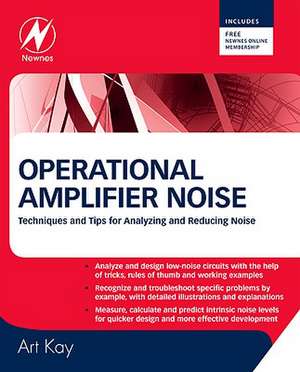
Operational Amplifier Noise: Techniques and Tips for Analyzing and Reducing Noise
Autor Art Kayen Limba Engleză Hardback – 23 feb 2012
Considerăm că analiza unui circuit de amplificare prin simulări în Tina Spice, așa cum este prezentată în capitolele aplicate ale acestei lucrări, reprezintă un punct de cotitură pentru orice inginer electronist. În loc să se piardă în capcanele teoretice ale derivărilor matematice infinite, Art Kay propune o abordare pragmatică: definirea conceptelor prin exemple concrete și utilizarea instrumentelor de simulare pentru a prezice cu acuratețe nivelurile de zgomot intrinsec.
Remarcăm o structură riguroasă care ghidează cititorul de la fundamentele statistice și fenomenele de zgomot, până la considerații de design complexe și exemple de calcul pentru ADC. Această progresie asigură faptul că informația nu rămâne la nivel abstract, ci este ancorată în realitatea laboratorului de testare. Stilul vizual, bazat pe o densitate mare de diagrame și scheme de circuit, permite absorbția rapidă a principiilor de proiectare pentru zgomot redus, textul servind drept explicație concisă pentru elementele grafice.
Ca și Bruce Carter în Op Amps for Everyone sau Walt Jung în Op Amp Applications Handbook, autorul distilează experiență reală în principii acționabile. Totuși, lucrarea de față se diferențiază prin focalizarea chirurgicală pe problematica zgomotului, oferind soluții specifice pentru interfațarea lumii analogice cu sistemele digitale de procesare. Suntem de părere că utilizarea regulilor empirice și a „trucurilor” de proiectare incluse transformă acest volum într-un instrument de lucru indispensabil pe masa oricărui proiectant de circuite analogice, facilitând tranziția de la prototip la un produs final performant.
Preț: 342.44 lei
Preț vechi: 481.90 lei
-29%
Carte tipărită la comandă
Livrare economică 16-30 noiembrie
Specificații
ISBN-10: 0750685255
Pagini: 248
Dimensiuni: 191 x 235 x 18 mm
Greutate: 0.6 kg
Editura: ELSEVIER SCIENCE
V-ar putea interesa
-
 Digital Signal ProcessingEmmanuel Ifeachor-20%Preț: 572.74 lei715.93 lei
 -
 -40%Preț: 622.22 lei1028.93 lei
 -
 Electromagnetic Compatibility EngineeringHenry W. Ott-23%Preț: 881.63 lei1144.97 lei
 -
 -24%Preț: 143.13 lei189.40 lei
 -
 The Art of ElectronicsPaul Horowitz-9%Preț: 702.87 lei772.39 lei
 -
 Class-D Audio Power Amplifier DesignRobert N. Buono-9%Preț: 714.91 lei785.61 lei
 -
 Small Signal Audio DesignDouglas Self-9%Preț: 699.27 lei768.43 lei
 -
 Circuit Analysis For DummiesJohn SantiagoPreț: 137.25 lei
 -
 -23%Preț: 909.18 lei1180.75 lei
 -
 -19%Preț: 462.24 lei570.66 lei
 -
 -26%Preț: 381.70 lei515.46 lei
 -
 Design of Analog CMOS Integrated CircuitsBehzad Razavi-25%Preț: 392.60 lei521.39 lei
 -
 Principles and Applications of Electrical Engineering ISEGiorgio Rizzoni-25%Preț: 395.45 lei527.08 lei
 -
 Microelectronics Circuit Analysis and Design ISEDonald Neamen-29%Preț: 346.41 lei489.80 lei
 -
 ElectronicsNeil Storey-9%Preț: 553.60 lei608.36 lei
 -
 Electronic Devices, Global EditionThomas Floyd-9%Preț: 622.98 lei684.59 lei
 -
 -23%Preț: 842.49 lei1094.15 lei
 -
 Foundations of Analog and Digital Electronic CircuitsAnant Agarwal-28%Preț: 546.19 lei754.30 lei
 -
 The Physics Behind ElectronicsLeonardo Ricci-19%Preț: 478.60 lei590.86 lei
 -
 Lecture Notes in Analog ElectronicsVan¿o Litovski-15%Preț: 616.64 lei725.46 lei
Public țintă
Practicing, professional electrical engineers, specifically analog design engineers, circuit designers, test engineers, applications engineers, or field applications engineers.De ce să citești această carte
Această carte este esențială pentru inginerii care proiectează interfețe analog-digitale și au nevoie de soluții rapide pentru reducerea interferențelor. Cititorul câștigă o metodologie clară de analiză a zgomotului, evitând erorile clasice de proiectare. Este un ghid practic care înlocuiește teoria densă cu simulări SPICE și exemple vizuale, fiind ideal pentru profesioniștii care caută rezultate imediate în optimizarea circuitelor cu amplificatoare operaționale.
Descriere scurtă
Operational amplifiers play a vital role in modern electronics design. Today, op amps serve as the interfaces between the digital world of microprocessors, microcontrollers, and other digital circuits and the analog "real world". If an analog signal must be amplified, conditioned, filtered, or converted to be used by a digital system, an op amp is almost always involved. Noise is an unwanted signal that will corrupt or distort the desired signal, and veteran engineers as well as new college graduates are often faced with a lack of experience in noise analysis for operational amplifiers. The author has created a publication that is packed with essential information, while still being accessible to all readers.
- Clear, definition-by-example presentation allows for immediate use of techniques introduced
- Tricks and rules-of-thumb, derived from author's decades of experience
- Extreme use of figures for rapid absorption of concepts
- Concise text explains the key points in all figures
- Accessible to all types of readers
- Analysis and design of low-noise circuits using op amps, including design tradeoffs for low-noise
- Desktop reference for designing low-noise op amp circuits for novice to experienced engineers
- Accurate measurement and prediction of intrinsic noise levels, using analysis by hand and SPICE simulation
Cuprins
Recenzii
"An engineer with an electronics device company, Kay describes how to predict the level of noise — any unwanted signal — a circuit in an amplifier will produce using calculations and Spice simulations. He also discusses techniques for measuring and reducing noise. Among his topics are example calculations, Spice noise analysis, popcorn noise, instrumentation amplifier noise, and photodiode noise amplifier example results. Chapter-end questions are provided, with answers in the end matter." --Reference and Research Book News, Inc.