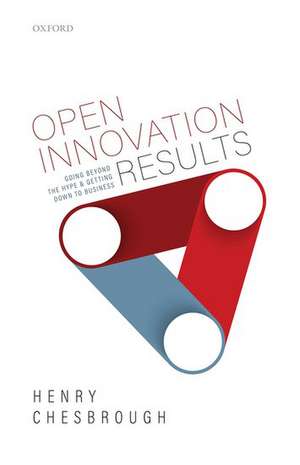
Open Innovation Results: Going Beyond the Hype and Getting Down to Business
Autor Henry Chesbroughen Limba Engleză Hardback – 4 dec 2019
Preț: 282.14 lei
Preț vechi: 323.62 lei
-13%
Puncte Express: 423
Carte disponibilă
Livrare economică 13-24 noiembrie
Livrare prin curier în România Termenul estimat este afișat lângă disponibilitate.
Transport gratuit de la 400.00 lei Plată online sau ramburs, în funcție de opțiunile comenzii.
Retur gratuit în 14 zile Comandă securizată și suport în română.
Specificații
ISBN-13: 9780198841906
ISBN-10: 0198841906
Pagini: 216
Dimensiuni: 160 x 242 x 18 mm
Greutate: 0.47 kg
Editura: OUP OXFORD
Colecția OUP Oxford
Locul publicării:Oxford, United Kingdom
ISBN-10: 0198841906
Pagini: 216
Dimensiuni: 160 x 242 x 18 mm
Greutate: 0.47 kg
Editura: OUP OXFORD
Colecția OUP Oxford
Locul publicării:Oxford, United Kingdom
V-ar putea interesa
-
 The New Geography of InnovationMehran GulPreț: 123.61 lei
 -
 How Innovation WorksMatt RidleyPreț: 80.22 lei
 -
 Where Good Ideas Come FromSteven JohnsonPreț: 79.46 lei
 -
 Winning at InnovationPhilip KotlerPreț: 281.85 lei
 -
 The Infinite AlphabetCésar A. HidalgoPreț: 191.23 lei
 -
 Make Elephants Fly: The Process of Radical InnovationSteven Hoffman-25%Preț: 92.73 lei123.23 lei
 -
 Preț: 231.49 lei
 -
 Ten Types of InnovationLarry KeeleyPreț: 216.66 lei
 -
 180 Business Hacks: Little Changes, Big DifferenceRoel de Graaf-26%Preț: 79.13 lei107.54 lei
 -
 The Future of ManagementBill BreenPreț: 213.20 lei
 -
 Preț: 129.97 lei
 -
 The Innovator's Solution: Creating and Sustaining Successful GrowthClayton M. ChristensenPreț: 195.49 lei
 -
 Disrupt EverythingJames PattersonPreț: 122.07 lei
 -
 The Open OrganizationJim WhitehurstPreț: 179.54 lei
 -
 The Innovator's DilemmaClayton M. ChristensenPreț: 153.88 lei
 -
 Preț: 123.79 lei
 -
 The Entrepreneur WithinMark RobertsPreț: 142.29 lei
 -
 The Year in Tech, 2026Amy WebbPreț: 123.62 lei
Recenzii
Henry Chesbrough has this unique ability to transform complex concepts into messages that everyone can relate. en Innovation Results links for the first time the effects of the financial crisis on innovation and therefore on long-term productivity. It is a must read for politicians, policy-makers and business leaders that want to make a difference by designing the right policies that drive not only the generation of new ideas but more importantly their broad dissemination and adoption by society.
At Enel, Open Innovation is combined with Sustainability,to make what we callInnovability, which we haveembedded in our business model and our operations. They create shared value for the Company and all of its stakeholders. Open Innovation Results addresses the changing environment in which most companies operate by moving past the hype of Open Innovation, putting theory into practice and achieving tangible results.
Open Innovation Results offers extensive insights into how organizations today can best innovate by showing the highly effective and practical ways of innovation across boundaries. To put it simply, Chesbrough shows us how carry out innovationwiselyin this day and age.
In Open Innovation for Results, Chesbrough presents a bold yet practical guide to harnessing the extraordinary power of boundary-spanning innovation. Taking a systemic view of innovation, he lays out a powerful and convincing case for infusing the spirit of openness into every aspect of the innovation process. This is essential reading for anyone who understands there are only two choices today: innovate or evaporate.
In this powerful and well researched book, Chesbrough builds out the open innovation paradigm by showing organizational leaders how to go beyond the generation of new technology, to leverage two additional processes those of dissemination and absorption to truly realize the power of open innovation.
Open Innovation Results is Chesbroughs most ambitious and expansive view yet of this important concept. It breaks new ground, linking open innovation not only to enterprise performance but to national economic growth as well. There are important insights into the difference between open and free innovation, along with insightful characterizations of Chinas use of open innovation practices and policies.
At Enel, Open Innovation is combined with Sustainability,to make what we callInnovability, which we haveembedded in our business model and our operations. They create shared value for the Company and all of its stakeholders. Open Innovation Results addresses the changing environment in which most companies operate by moving past the hype of Open Innovation, putting theory into practice and achieving tangible results.
Open Innovation Results offers extensive insights into how organizations today can best innovate by showing the highly effective and practical ways of innovation across boundaries. To put it simply, Chesbrough shows us how carry out innovationwiselyin this day and age.
In Open Innovation for Results, Chesbrough presents a bold yet practical guide to harnessing the extraordinary power of boundary-spanning innovation. Taking a systemic view of innovation, he lays out a powerful and convincing case for infusing the spirit of openness into every aspect of the innovation process. This is essential reading for anyone who understands there are only two choices today: innovate or evaporate.
In this powerful and well researched book, Chesbrough builds out the open innovation paradigm by showing organizational leaders how to go beyond the generation of new technology, to leverage two additional processes those of dissemination and absorption to truly realize the power of open innovation.
Open Innovation Results is Chesbroughs most ambitious and expansive view yet of this important concept. It breaks new ground, linking open innovation not only to enterprise performance but to national economic growth as well. There are important insights into the difference between open and free innovation, along with insightful characterizations of Chinas use of open innovation practices and policies.
Notă biografică
Henry Chesbrough is Adjunct Professor and Faculty Director of the Garwood Center for Corporate Innovation at UC Berkeley's Haas School of Business. He is also the LUISS Chair Professor of Open Innovation at LUISS University in Rome. He is the author of several management books on innovation: Open Services Innovation (Jossey-Bass, 2011), Open Business Models (Harvard Business School Press, 2006), and Open Innovation (Harvard Business School Press, 2003). He has won numerous awards for his work, including two honorary doctorates, the IRI Medal of Achievement, and the Innovation Luminary award from the European Commission. He has been named in the Thinkers 50 list of top management thinkers four successive times, and recognized as one of the top 50 business and technology leaders by Scientific American.