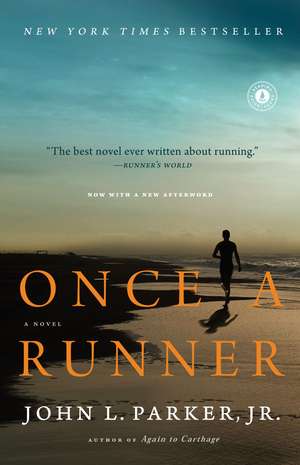
Once a Runner: A Novel: Bestsellers și noutăți cărți alergare
Autor John L. Parker, Jr.en Limba Engleză Paperback – 27 aug 2015
Inspired by the author's experience as a collegiate champion, the story focuses on Quenton Cassidy, a competitive runner at fictional Southeastern University whose lifelong dream is to run a four-minute mile. He is less than a second away when the turmoil of the Vietnam War era intrudes into the staid recesses of his school's athletic department. After he becomes involved in an athletes' protest, Cassidy is suspended from his track team. Under the tutelage of his friend and mentor, Bruce Denton, a graduate student and former Olympic gold medalist, Cassidy gives up his scholarship, his girlfriend, and possibly his future to withdraw to a monastic retreat in the countryside and begin training for the race of his life against the greatest miler in history.
A rare insider's account of the incredibly intense lives of elite distance runners, Once a Runneris an inspiring, funny, and spot-on tale of one man's quest to become a champion..


Preț: 59.72 lei
Preț vechi: 72.63 lei
-18%
Carte disponibilă
Livrare economică 13-25 noiembrie
Livrare express 23-29 octombrie pentru 34.79 lei
Specificații
ISBN-10: 1416597891
Pagini: 304
Dimensiuni: 140 x 214 x 13 mm
Greutate: 0.25 kg
Editura: Scribner
Colecția Scribner
Seria Bestsellers și noutăți cărți alergare
V-ar putea interesa
-
 The Loneliness of the Long Distance RunnerAlan SillitoePreț: 71.22 lei
 -
 Gracie Jenkins Runs a MarathonPenny MirrenPreț: 71.31 lei
 -
 It's Not About The BikeLance Armstrong-19%Preț: 75.67 lei93.26 lei
 -
 The Race To Be MyselfCaster Semenya-18%Preț: 59.72 lei72.66 lei
 -
 Preț: 75.35 lei
 -
 MeditationsMarcus AureliusPreț: 34.00 lei
 -
 -25%Preț: 72.06 lei95.52 lei
 -
 SacrificeOisin MurphyPreț: 158.18 lei
 -
 Again to Carthage: A NovelJohn L. Parker, Jr.-17%Preț: 54.61 lei65.50 lei
 -
 Racing the RainJohn L ParkerPreț: 99.76 lei
 -
 The Running GroundNick ThompsonPreț: 157.94 lei
 -
 Preț: 103.75 lei
 -
 -18%Preț: 105.84 lei129.02 lei
 -
 -27%Preț: 68.19 lei93.04 lei
 -
 Nowhere to RunJonathan Sayer-27%Preț: 61.21 lei84.23 lei
 -
 Running My Own RaceAbena EyesonPreț: 57.30 lei
 -
 And So I RunJamie DowardPreț: 111.31 lei
 -
 The Only Way I KnowAndy FarrellPreț: 190.72 lei
 -
 -19%Preț: 70.45 lei86.48 lei
Notă biografică
Extras
1.
Once…
THE NIGHT JOGGERS were out as usual.
The young man could see dim figures on the track even in this pale light, slowly pounding round and round the most infinite of footpaths. There would be, he knew, plump, determined-looking women slogging along while fleshy knees quivered. They would occasionally brush damp hair fiercely from their eyes and dream of certain cruel and smiling emcees: bikinis, ribbon-cuttings, and the like. And then, of course, tennis with white-toothed males, wild tangos in the moonlight.
And men too of various ages and levels of dilapidation, perhaps also grinding out secret fantasies (did they picture themselves a Peter Snell held back only by fat or fear as they turned their ninety-second quarters?).
The young man stood outside the fence for a few momentswhile moths attacked the streetlight dustily, leaving him in a dim spotlight of swirling shadows. He loved early fall in Florida’s Panhandle. Leaves would be turning elsewhere but here the hot breath of summer held forth. In the moist warmth there was a slight edge, though, a faint promise of cooler air hanging in the treetops and close to the Spanish moss. He picked up his small travel bag and went in the gate, walking clockwise on the track toward the white starting post at the head of the first turn. The joggers ignored the stranger in street clothes and he likewise paid them no attention. They would always be there.
The high-jump pit had been rearranged, a new section of bleachers added, a water jump installed for the steeplechase. But mostly it looked the same as it did four years ago, the same as a four-hundred-and-forty-yard oval probably will always look to one who knows a quarter of a mile by the inches.
The Games were over for this time around. He knew quite well that for him they were over for good. Four years is a very long time in some circles; in actual time—real-world time, as that of shopkeepers, insurance sellers, compounders of interest, and so on—it is perhaps not long at all. But in his own mind Time reposed in peculiar receptacles; to him the passing of one minute took on all manner of rare meaning. A minute was one fourth of a four-minute mile, a coffee spoon of his days and ways.
As with many of the others, he had no idea what he would be doing now that it was all over. It was such a demanding thing, so final, so cathartic, that most of them simply never thought beyond it. They were scattered around the world now, he supposed, doing pretty much what he was doing at this moment: thinking everything over, tallying gains and losses.
He was going to have to pick up the thread of a normal life again and although he did not exactly know why, he had to start by coming back here, back to the greenhouse warmth of the Panhandle, back to this very quarter-mile oval that still held his long-dried sweat. Back to September, the month of promises.
He put his bag down by the pole-vault pit, looked uptrack to make sure no one was coming, and then walked up to the starting line. God, he thought, one more time on the line.
In lane one he stood very still, looking down at his street shoes (joggers now going around him with curious glances) and tried to conjure up the feeling. After a moment a trace of it came to him and he knew that was all there would be. You can remember it, he told himself, but you cannot experience it again like this. You have to be satisfied with the shadows. Then he thought about how it was in the second and third laps and decided that the shadows were sometimes quite enough.
He was twenty-six years, five months, and two days old, and though as he stood there on the starting line he felt quite a bit older than that, the muscles that rippled up and down inside his trouser leg could have only been the result, biologically speaking, of more thousands of miles than he cared to think about all at one time.
He tried to focus blurred emotions, a metaphysical photographer zeroing in on hard edges to align in the center square. What was this he was feeling now, nostalgia? Regret? His mind double-clutched, asked the musical question: Am…I…buhloooo?
He could not tell. He realized again how adept he had become at not being able to tell such things. His emotions had calluses like feet.
The starter would tell them to stand tall, so he stood tall for a moment there in the night. There would be the set command and then the gun. He took a deep breath and began walking into the turn in the familiar counterclockwise direction, the way of all races, and thought: the first lap is lost in a flash of adrenaline and pounding hooves…
Recenzii
“By far the most accurate fictional portrayal of the world of the serious runner…a marvelous description of the way it really is.” —Kenny Moore, Sports Illustrated
“The best piece of running fiction around. Beg, borrow, or buy a copy, and you’ll never need another motivator.” —Dave Langlais, Runner’s World
Descriere
Originally self-published in 1978, Once a Runner captures the essence of competitive running-and of athletic competition in general-and has become one of the most beloved sports novels ever published. Inspired by the author's experience as a collegiate champion, the story focuses on Quenton Cassidy, a competitive runner at fictional Southeastern University whose lifelong dream is to run a four-minute mile. He is less than a second away when the turmoil of the Vietnam War era intrudes into the staid recesses of his school's athletic department.
After he becomes involved in an athletes' protest, Cassidy is suspended from his track team. Under the tutelage of his friend and mentor, Bruce Denton, a graduate student and former Olympic gold medalist, Cassidy gives up his scholarship, his girlfriend, and possibly his future to withdraw to a monastic retreat in the countryside and begin training for the race of his life against the greatest miler in history. A rare insider's account of the incredibly intense lives of elite distance runners, Once a Runneris an inspiring, funny, and spot-on tale of one man's quest to become a champion..