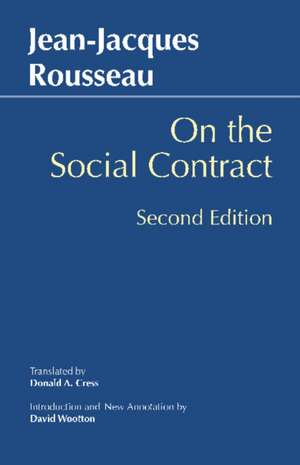
On the Social Contract
Autor Jean-Jacques Rousseau Introducere și note de David Wootton Traducere de Donald A. Cressen Limba Engleză Paperback – 15 mar 2019
Preț: 76.35 lei
Preț vechi: 86.47 lei
-12%
Puncte Express: 115
Carte disponibilă
Livrare economică 19 mai-02 iunie
Livrare express 02-08 mai pentru 28.71 lei
Specificații
ISBN-13: 9781624667855
ISBN-10: 1624667856
Pagini: 176
Ilustrații: none
Dimensiuni: 140 x 216 x 8 mm
Greutate: 0.19 kg
Ediția:Second Edition, second edition
Editura: Hackett Publishing Company,Inc
Colecția Hackett Publishing Company, Inc.
Locul publicării:United States
ISBN-10: 1624667856
Pagini: 176
Ilustrații: none
Dimensiuni: 140 x 216 x 8 mm
Greutate: 0.19 kg
Ediția:Second Edition, second edition
Editura: Hackett Publishing Company,Inc
Colecția Hackett Publishing Company, Inc.
Locul publicării:United States
V-ar putea interesa
-
 PROGRESS HBSamuel Miller McDonaldPreț: 148.60 lei
 -
 RepublicPlatoPreț: 29.30 lei
 -
 A Vindication of the Rights of WomanMary Wollstonecraft-24%Preț: 23.02 lei30.14 lei
 -
 The Essential Writings of Jean-Jacques RousseauJean-Jacques Rousseau-19%Preț: 73.91 lei90.73 lei
 -
 A Discourse on InequalityJean-Jacques Rousseau-21%Preț: 53.51 lei67.81 lei
 -
 Of The Social Contract and Other Political WritingsJean-Jacques Rousseau-19%Preț: 61.68 lei76.29 lei
 -
 Discourse on Political Economy and The Social ContractJean-Jacques RousseauPreț: 53.42 lei
 -
 The Body PoliticJean-Jacques Rousseau-38%Preț: 17.24 lei27.68 lei
 -
 The Rights of ManThomas Paine-17%Preț: 23.40 lei28.36 lei
 -
 Preț: 37.98 lei
 -
 AnthemAyn RandPreț: 50.48 lei
 -
 A Theory of JusticeJohn RawlsPreț: 282.43 lei
 -
 One Man's FreedomNicholas BuccolaPreț: 209.20 lei
 -
 Locke: Political WritingsJohn Locke-11%Preț: 133.22 lei150.15 lei
 -
 Arguing About Political PhilosophyMatt ZwolinskiPreț: 364.97 lei
 -
 Rousseau: The Discourses and Other Early Political WritingsJean-Jacques Rousseau-19%Preț: 501.18 lei618.74 lei
 -
 The Conquest of BreadPeter KropotkinPreț: 56.82 lei
 -
 Two Treatises of GovernmentJohn LockePreț: 47.31 lei
 -
 -20%Preț: 60.96 lei75.86 leiRecomandat
 -
 Lions and ScavengersBen ShapiroPreț: 104.66 leiRecomandat
 -
 Preț: 54.62 lei
 -
 Discourse on the Origin of InequalityJean-Jacques RousseauPreț: 44.72 lei
 -
 UtopiaThomas MorePreț: 31.89 lei
 -
 The Social ContractJean-Jacques RousseauPreț: 40.05 lei
Notă biografică
Jean-Jacques Rousseau (28 June 1712 - 2 July 1778) was a Genevan philosopher, writer and composer. His political philosophy influenced the progress of the Enlightenment throughout Europe, as well as aspects of the French Revolution and the development of modern political, economic and educational thought. His Discourse on Inequality and The Social Contract are cornerstones in modern political and social thought. Rousseau's sentimental novel Julie, or the New Heloise (1761) was important to the development of preromanticism and romanticism in fiction. His Emile, or On Education (1762) is an educational treatise on the place of the individual in society. Rousseau's autobiographical writings-the posthumously published Confessions (composed in 1769), which initiated the modern autobiography, and the unfinished Reveries of a Solitary Walker (composed 1776-1778)-exemplified the late-18th-century Age of Sensibility, and featured an increased focus on subjectivity and introspection that later characterized modern writing. Rousseau befriended fellow philosophy writer Denis Diderot in 1742, and would later write about Diderot's romantic troubles in his Confessions. During the period of the French Revolution, Rousseau was the most popular of the philosophers among members of the Jacobin Club. He was interred as a national hero in the Panthéon in Paris, in 1794, 16 years after his death.