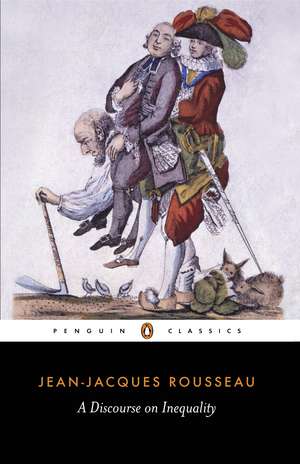
A Discourse on Inequality
Autor Jean-Jacques Rousseau Traducere de Maurice Cranstonen Limba Engleză Paperback – 25 oct 1984
For more than seventy years, Penguin has been the leading publisher of classic literature in the English-speaking world. With more than 1,700 titles, Penguin Classics represents a global bookshelf of the best works throughout history and across genres and disciplines. Readers trust the series to provide authoritative texts enhanced by introductions and notes by distinguished scholars and contemporary authors, as well as up-to-date translations by award-winning translators.
Preț: 57.24 lei
Preț vechi: 78.23 lei
-27%
Puncte Express: 86
Carte disponibilă
Livrare economică 30 octombrie-11 noiembrie
Livrare express 15-21 octombrie pentru 38.01 lei
Livrare prin curier în România Termenul estimat este afișat lângă disponibilitate.
Transport gratuit de la 400.00 lei Plată online sau ramburs, în funcție de opțiunile comenzii.
Retur gratuit în 14 zile Comandă securizată și suport în română.
Specificații
ISBN-13: 9780140444391
ISBN-10: 0140444394
Pagini: 192
Dimensiuni: 130 x 197 x 12 mm
Greutate: 0.15 kg
Ediția:Revised
Editura: Penguin Books
Locul publicării:London, United Kingdom
ISBN-10: 0140444394
Pagini: 192
Dimensiuni: 130 x 197 x 12 mm
Greutate: 0.15 kg
Ediția:Revised
Editura: Penguin Books
Locul publicării:London, United Kingdom
V-ar putea interesa
-
 The Essential Writings of Jean-Jacques RousseauJean-Jacques Rousseau-18%Preț: 77.19 lei93.63 lei
 -
 The 48 Laws of PowerRobert GreenePreț: 152.20 lei
 -
 The Social ContractJean-Jacques Rousseau-20%Preț: 44.59 lei55.87 lei
 -
 Good and Bad PowerGeoff MulganPreț: 116.75 lei
 -
 Of the Social Contract and Other Political WritingsJean-Jacques Rousseau-30%Preț: 64.47 lei92.67 lei
 -
 The ReformationDiarmaid MaccullochPreț: 170.85 lei
 -
 AnglerBarton GellmanPreț: 144.82 lei
 -
 The WatchersShane HarrisPreț: 141.55 lei
 -
 CitizenvilleGavin NewsomPreț: 148.16 lei
 -
 Ideology: A Very Short IntroductionMichael Freeden-20%Preț: 57.11 lei71.20 lei
 -
 Discourse on Political Economy and The Social ContractJean-Jacques RousseauPreț: 57.08 lei
 -
 Discourse on the Origin of InequalityJean-Jacques Rousseau-20%Preț: 51.32 lei64.08 lei
 -
 The Body PoliticJean-Jacques Rousseau-37%Preț: 18.02 lei28.65 lei
 -
 On the Social ContractJean-Jacques RousseauPreț: 32.80 lei
Cuprins
A Discourse on InequalityForeword
Introduction
Discourse on the Origins and Foundations of Inequality among Men
Rousseau's Notes
Abbreviations used in Editor's Introduction and Notes
Editor's Notes
Introduction
Discourse on the Origins and Foundations of Inequality among Men
Rousseau's Notes
Abbreviations used in Editor's Introduction and Notes
Editor's Notes
Notă biografică
JEAN-JACQUES ROUSSEAU was born in Geneva in 1712. Abandoned by his father at the age of ten he tried his hand as an engraver's apprentice before he left the city in 1728. From then on he was to wander Europe seeking an elusive happiness. At Turin he became a Catholic convert; and as a footman, seminarist, music teacher or tutor visited many parts of Switzerland and France. In 1732 he settled for eight years at Chambéry or Les Charmettes, the country house of Madame de Warens, remembered by Rousseau as an idyllic place in the Confessions. In 1741 he set out for Paris where he met Diderot who commissioned him to write the musical articles for the Encyclopédie. In the meantime he fathered five children by Thérèse Levasseur, a servant girl, and abandoned them to a foundling home. The 1750s witnessed a breach with Voltaire and Diderot and his writing struck a new note of defiant independence. In his Discours sur les sciences et les arts and the Discours sur l'origine de l'inégalité he showed how the growth of civilization corrupted natural goodness and increased inequality between men. In 1758 he attacked his former friends, the Encyclopaedists, in the Lettre à d'Alembert sur les spectacles which pilloried cultured society. In 1757 he moved to Montmorency and these five years were the most fruitful of his life. His remarkable novel La nouvelle Héloise (1761), met with immediate and enormous success. In this and in Émile, which followed a year later, Rousseau invoked the inviolability of personal ideals against the power of the state and the pressures of society. The crowning achievement of his political philosophy was The Social Contract, published in 1762. That same year he wrote an attack on revealed religion, the Profession de foi du vicaire savoyard. He was driven from Switzerland and fled to England where he only succeeded in making an enemy of Hume and returned to his continental peregrinations. In 1770 Rousseau completed his Confessions. His last years were spent largely in France where he died in 1778.
Descriere
Demonstrates how the growth of civilization corrupts man's natural happiness and freedom by creating artificial inequalities of wealth, power and social privilege.