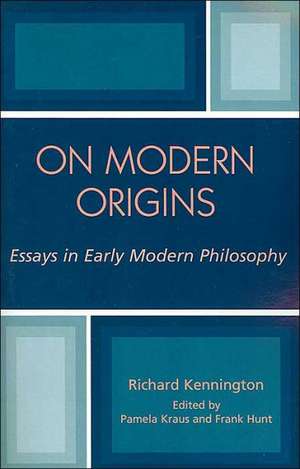
On Modern Origins: Essays in Early Modern Philosophy: Applications of Political Theory
Autor Richard Kennington Editat de Pamela Kraus, Frank Hunten Limba Engleză Paperback – 25 iun 2004
Din seria Applications of Political Theory
- 22%
 Preț: 316.04 lei
 - 22%
 Preț: 323.29 lei
 - 22%
 Preț: 293.20 lei
 - 22%
 Preț: 324.96 lei
 - 22%
 Preț: 324.48 lei
 - 22%
 Preț: 291.64 lei
 - 21%
 Preț: 350.53 lei
 - 23%
 Preț: 1085.71 lei
 - 34%
 Preț: 552.42 lei
 -
 Preț: 499.40 lei
 - 27%
 Preț: 262.02 lei
 - 23%
 Preț: 318.84 lei
 - 22%
 Preț: 309.23 lei
 - 22%
 Preț: 305.81 lei
 - 27%
 Preț: 260.61 lei
 - 22%
 Preț: 320.95 lei
 - 22%
 Preț: 305.71 lei
 - 23%
 Preț: 538.91 lei
 - 26%
 Preț: 264.28 lei
 - 22%
 Preț: 345.83 lei
 - 22%
 Preț: 326.98 lei
 - 26%
 Preț: 256.10 lei
 - 22%
 Preț: 310.27 lei
 - 23%
 Preț: 304.25 lei
 - 22%
 Preț: 305.42 lei
 - 22%
 Preț: 307.04 lei
 - 22%
 Preț: 366.22 lei
 - 22%
 Preț: 309.70 lei
Preț: 308.97 lei
Preț vechi: 395.94 lei
-22%
Puncte Express: 463
Preț estimativ în valută:
54.64€ • 64.12$ • 47.39£
54.64€ • 64.12$ • 47.39£
Carte tipărită la comandă
Livrare economică 10-24 martie
Specificații
ISBN-13: 9780739108154
ISBN-10: 0739108158
Pagini: 304
Dimensiuni: 146 x 226 x 20 mm
Greutate: 0.47 kg
Ediția:New.
Editura: Bloomsbury Publishing
Colecția Lexington Books
Seria Applications of Political Theory
Locul publicării:New York, United States
ISBN-10: 0739108158
Pagini: 304
Dimensiuni: 146 x 226 x 20 mm
Greutate: 0.47 kg
Ediția:New.
Editura: Bloomsbury Publishing
Colecția Lexington Books
Seria Applications of Political Theory
Locul publicării:New York, United States
Cuprins
Chapter 1 Bacon's Reform of Nature
Chapter 2 Bacon's Critique of Ancient Philosophy in New Organon 1
Chapter 3 Bacon's Ontology
Chapter 4 Bacon's Humanitarian Revision of Machiavelli
Chapter 5 Descartes's Olympica
Chapter 6 Descartes's Discourse on Method
Chapter 7 Descartes and Mastery of Nature
Chapter 8 The Finitude of Descartes's Evil Genius
Chapter 9 Cartesian Rationalism and Eternal Truths
Chapter 10 The "Teaching of Nature" in Descartes's Soul Doctrine
Chapter 11 René Descartes
Chapter 12 Analytic and Synthetic Methods in Spinoza's Ethics
Chapter 13 On the Intention of Leibniz
Chapter 14 Nature and Natural Right in Locke
Chapter 2 Bacon's Critique of Ancient Philosophy in New Organon 1
Chapter 3 Bacon's Ontology
Chapter 4 Bacon's Humanitarian Revision of Machiavelli
Chapter 5 Descartes's Olympica
Chapter 6 Descartes's Discourse on Method
Chapter 7 Descartes and Mastery of Nature
Chapter 8 The Finitude of Descartes's Evil Genius
Chapter 9 Cartesian Rationalism and Eternal Truths
Chapter 10 The "Teaching of Nature" in Descartes's Soul Doctrine
Chapter 11 René Descartes
Chapter 12 Analytic and Synthetic Methods in Spinoza's Ethics
Chapter 13 On the Intention of Leibniz
Chapter 14 Nature and Natural Right in Locke
Recenzii
Superbly practicing the art of reading, Richard Kennington uncovers the founding arguments of the early modern philosophers. His explications of the thought of Bacon and Descartes on the relations between method, experiential starting-points, and the final purposes of inquiry, are sans pareil for depth and subtlety. Kennington's work builds on insights of Heidegger, Leo Strauss, and Jacob Klein concerning the origins and intent of the modern project of mastering nature, but his reflection on this theme is more thorough and in the end more satisfying than any previous account.
While some scholars have examined the origins of modern natural science and others have examined the origins of modern political philosophy, Kennington masterfully combines the two in his profound studyof the philosophic accounts underlying "the mastery of nature." On Modern Origins is indispensable for understanding the origins of the modern world.
Mixing extraordinary learning with the most acute philosophical penetration, Kennington shows how the philosophers at the origins of modernity were concerned with something still more fundamental than either the purely theoretical question of knowledge or the practical question of the mastery of nature. Kennington articulates this deeper stratum of modern philosophy, in which it seeks to reconcile its understanding of the true with its understanding of the good, in its conscious opposition but also in its sometimes unintentional kinship with ancient philosophy. On Modern Origins is at once scrupulously careful in its interpretation and profoundly philosophical in its own right. It is a remarkable book in which one enounters a mind of rare quality.
Useful in several respects. First, it contains illuminating interpretations of certain key passages in the writings of the philosophers under consideration.The book is exemplary, moreover, in showing us how to read these philosophers.Finally, this collection of essays is useful for the questions it provokes.
Indespensible.
On Modern Origins is several books at once: an original, subtle, erudite, unclassifiable interpretation of the beginnings of modern philosophy; at a reflective level, a meditation on what it means to investigate the origins of philosophical positions; and an argument for reconsidering canonical assumptions about the order and priority of texts in the modern philosophical tradition. This is a very important contribution not only to our understanding of the figures discussed, but to our sense of what it could mean that philosophy might "begin again" in modernity.
While some scholars have examined the origins of modern natural science and others have examined the origins of modern political philosophy, Kennington masterfully combines the two in his profound studyof the philosophic accounts underlying "the mastery of nature." On Modern Origins is indispensable for understanding the origins of the modern world.
Mixing extraordinary learning with the most acute philosophical penetration, Kennington shows how the philosophers at the origins of modernity were concerned with something still more fundamental than either the purely theoretical question of knowledge or the practical question of the mastery of nature. Kennington articulates this deeper stratum of modern philosophy, in which it seeks to reconcile its understanding of the true with its understanding of the good, in its conscious opposition but also in its sometimes unintentional kinship with ancient philosophy. On Modern Origins is at once scrupulously careful in its interpretation and profoundly philosophical in its own right. It is a remarkable book in which one enounters a mind of rare quality.
Useful in several respects. First, it contains illuminating interpretations of certain key passages in the writings of the philosophers under consideration.The book is exemplary, moreover, in showing us how to read these philosophers.Finally, this collection of essays is useful for the questions it provokes.
Indespensible.
On Modern Origins is several books at once: an original, subtle, erudite, unclassifiable interpretation of the beginnings of modern philosophy; at a reflective level, a meditation on what it means to investigate the origins of philosophical positions; and an argument for reconsidering canonical assumptions about the order and priority of texts in the modern philosophical tradition. This is a very important contribution not only to our understanding of the figures discussed, but to our sense of what it could mean that philosophy might "begin again" in modernity.