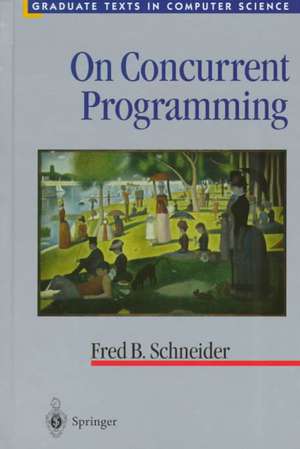
On Concurrent Programming: Texts in Computer Science
Autor Fred B. Schneideren Limba Engleză Hardback – 6 mai 1997
Din seria Texts in Computer Science
- 20%
 Preț: 330.09 lei
 - 20%
 Preț: 494.73 lei
 - 17%
 Preț: 396.70 lei
 - 20%
 Preț: 496.15 lei
 - 20%
 Preț: 445.89 lei
 - 20%
 Preț: 417.78 lei
 - 13%
 Preț: 435.53 lei
 - 15%
 Preț: 720.22 lei
 - 20%
 Preț: 484.25 lei
 - 20%
 Preț: 332.62 lei
 - 20%
 Preț: 693.33 lei
 - 20%
 Preț: 400.45 lei
 - 20%
 Preț: 344.40 lei
 - 20%
 Preț: 592.76 lei
 -
 Preț: 491.23 lei
 - 20%
 Preț: 379.48 lei
 - 15%
 Preț: 756.39 lei
 - 20%
 Preț: 373.23 lei
 - 20%
 Preț: 382.69 lei
 - 20%
 Preț: 310.74 lei
 - 20%
 Preț: 735.08 lei
 - 20%
 Preț: 671.21 lei
 - 20%
 Preț: 640.40 lei
 - 23%
 Preț: 795.37 lei
 - 20%
 Preț: 546.95 lei
 - 25%
 Preț: 322.31 lei
 - 20%
 Preț: 571.17 lei
 - 20%
 Preț: 589.70 lei
 - 20%
 Preț: 338.01 lei
 - 20%
 Preț: 492.01 lei
 - 20%
 Preț: 583.46 lei
 - 30%
 Preț: 391.47 lei
 -
 Preț: 415.60 lei
 - 20%
 Preț: 514.49 lei
 - 20%
 Preț: 346.44 lei
 - 20%
 Preț: 750.96 lei
 - 20%
 Preț: 359.75 lei
 - 20%
 Preț: 320.19 lei
Preț: 359.44 lei
Preț vechi: 449.31 lei
-20%
Puncte Express: 539
Carte tipărită la comandă
Livrare economică 28 noiembrie-12 decembrie
Livrare prin curier în România Termenul estimat este afișat lângă disponibilitate.
Transport gratuit de la 400.00 lei Plată online sau ramburs, în funcție de opțiunile comenzii.
Retur gratuit în 14 zile Comandă securizată și suport în română.
Specificații
ISBN-13: 9780387949420
ISBN-10: 0387949429
Pagini: 496
Ilustrații: XIX, 473 p.
Dimensiuni: 160 x 241 x 33 mm
Greutate: 0.85 kg
Ediția:1997
Editura: Springer
Colecția Texts in Computer Science
Seria Texts in Computer Science
Locul publicării:New York, NY, United States
ISBN-10: 0387949429
Pagini: 496
Ilustrații: XIX, 473 p.
Dimensiuni: 160 x 241 x 33 mm
Greutate: 0.85 kg
Ediția:1997
Editura: Springer
Colecția Texts in Computer Science
Seria Texts in Computer Science
Locul publicării:New York, NY, United States
V-ar putea interesa
-
 The Art of Multiprocessor ProgrammingMaurice Herlihy-40%Preț: 375.12 lei620.73 lei
 -
 Introduction to Formal LogicRussell Marcus-23%Preț: 602.84 lei782.91 lei
 -
 Distributed SystemsGeorge Coulouris-20%Preț: 624.57 lei780.72 lei
 -
 -20%Preț: 574.25 lei717.80 lei
 -
 Java Concurrency in PracticeBrian Goetz-20%Preț: 303.96 lei379.95 lei
 -
 Programming Language PragmaticsMichael Scott-40%Preț: 488.02 lei808.04 lei
 -
 Computer Architecture: A Quantitative ApproachJohn L. Hennessy-39%Preț: 534.37 lei882.55 lei
 -
 -20%Preț: 774.84 lei968.54 lei
 -
 -20%Preț: 758.53 lei948.16 lei
 -
 Operating Systems: Internals and Design Principles, Global EditionWilliam Stallings-20%Preț: 678.19 lei847.74 lei
 -
 Preț: 123.51 lei
 -
 Shared-Memory SynchronizationMichael L. Scott-20%Preț: 291.51 lei364.38 lei
 -
 System Programming in Linux: A Hands-On IntroductionStewart Weiss-35%Preț: 481.65 lei739.15 lei
 -
 Concurrent and Real-time ProgrammingManuel I. Capel-20%Preț: 353.05 lei441.31 lei
 -
 Networked SystemsSalem Lahlou-20%Preț: 996.76 lei1245.95 lei
 -
 -20%Preț: 391.26 lei489.08 lei
 -
 -20%Preț: 325.79 lei407.24 lei
 -
 Nonsequential and Distributed Programming with GoChristian Maurer-20%Preț: 378.97 lei473.70 lei
 -
 Concurrent Programming InterviewsBonan Liu-20%Preț: 255.44 lei319.30 lei
Public țintă
ResearchCuprins
1 Introduction.- 1.1 Concurrent Programs.- 1.2 Communication and Synchronization.- 1.3 Understanding Concurrent Programs.- 1.4 A Preview.- Historical Notes for Chapter 1.- Exercises for Chapter 1.- 2 Formal Logic.- 2.1 Formal Logical Systems.- 2.2 Propositional Logic.- 2.3 A Predicate Logic.- 2.4 Safety and Liveness Revisited.- Historical Notes for Chapter 2.- Exercises for Chapter 2.- 3 Temporal Logic.- 3.1 Informal Preview.- 3.2 Syntax and Meaning of Formulas.- 3.3 Axioms and Inference Rules.- 3.4 Temporal Logic Applications.- 3.5 About Modal Logics.- Historical Notes for Chapter 3.- Exercises for Chapter 3.- 4 Notation and Logic for Sequential Programming.- 4.1 Notation for Sequential Programs.- 4.2 Reasoning About Program States.- 4.3 Proof Outline Logic.- 4.4 Assignment to Composite Variables.- 4.5 A Predicate Transformer.- Historical Notes for Chapter 4.- Exercises for Chapter 4.- 5 Concurrency and Interference.- 5.1 Specifying Concurrency.- 5.2 Control Predicate Axioms.- 5.3 Interference Freedom.- 5.4 Hiding Control Predicates in Derived Terms.- 5.5 Synchronously Altered and Shared Assertions.- 5.6 Specifying Synchronization.- 5.7 Synchronization and Interference.- Historical Notes for Chapter 5.- Exercises for Chapter 5.- 6 Safety Properties: Invariance.- 6.1 Invariance Properties.- 6.2 Verifying Invariance Properties.- 6.3 Exclusion of Configurations.- 6.4 Direct Use of Proof Outlines.- 6.5 Developing Programs for Invariance Properties.- Historical Notes for Chapter 6.- Exercises for Chapter 6.- 7 Safety Properties with Past Terms.- 7.1 Historical Safety Properties.- 7.2 Past Extensions to Predicate Logic.- 7.3 Verifying Historical Safety Properties.- 7.4 Developing Programs for Historical Safety Properties.- 7.5 Auxiliary Variables.- 7.6 Some Cautions.- Historical Notes for Chapter 7.- Exercises for Chapter 7.- 8 Verifying Arbitrary Temporal Logic Properties.- 8.1 S-Temporal Logic Revisited.- 8.2 Unless Properties and Derivatives.- 8.3 Fairness Assumptions.- 8.4 Reasoning from Fairness Assumptions.- 8.5 Helpful Actions and Eventualities.- 8.6 Liveness for Mutual Exclusion.- Historical Notes for Chapter 8.- Exercises for Chapter 8.- 9 Programming with Fine-Grained Atomic Actions.- 9.1 Pretending Atomicity.- 9.2 Translation-Independent Reasoning.- 9.3 Implementing Condition Synchronization.- 9.4 Programming with the Subset.- 9.5 Synchronization and Interference Revisited.- 9.6 Interlock Instructions.- 9.7 Example: Barrier Synchronization.- Historical Notes for Chapter 9.- Exercises for Chapter 9.- 10 Semaphores, Locks, and Conditional Critical Regions.- 10.1 Semaphores.- 10.2 Change of Variable to use Semaphores.- 10.3 Binary Semaphores and Locks.- 10.4 Split Binary Semaphore Method.- 10.5 Conditional Critical Regions.- Historical Notes for Chapter 10.- Exercises for Chapter 10.- 11 Message Passing and Distributed Programming.- 11.1 Asynchronous Message-Passing.- 11.2 Synchronous Message-Passing.- 11.3 Derivation of Distributed Programs.- 11.4 Shared-Variable Representations.- Historical Notes for Chapter 11.- Exercises for Chapter 11.- 12 Putting It Together.- 12.1 On Languages.- 12.2 Principles for Verifying Safety and Liveness Properties.- 12.3 Proofs Only Increase Confidence.- 12.4 A Tool and Applications.- Historical Notes for Chapter 12.- References.