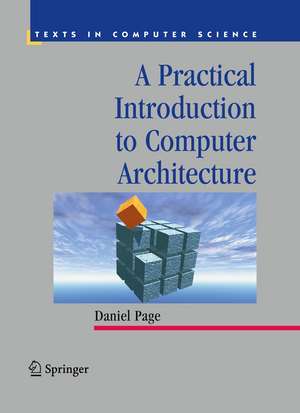
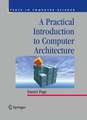
A Practical Introduction to Computer Architecture: Texts in Computer Science
Autor Daniel Pageen Limba Engleză Paperback – 4 feb 2011
Ne-a atras atenția în mod deosebit modul în care A Practical Introduction to Computer Architecture propune un exercițiu de modelare activă: utilizarea simulatorului SPIM pentru MIPS32 și a limbajului Verilog pentru a transforma conceptele teoretice în modele funcționale. Spre deosebire de abordările tradiționale care se bazează pe diagrame de circuit statice, Daniel Page impune o metodologie riguroasă de tip bottom-up. Notăm cu interes progresia logică a volumului, care refuză să introducă programarea în limbaj de asamblare până când cititorul nu înțelege fundamentul fizic — de la tranzistori și porți logice, până la unități aritmetice complexe. Ca și David Harris în Digital Design and Computer Architecture, autorul distilează experiență reală în principii acționabile, punând un accent major pe limbajele de descriere hardware (HDL). Totuși, lucrarea lui Page se distinge printr-o deschidere mai largă către ecosistemul software, analizând în detaliu rolul linkerelor, al compilatoarelor și al sistemelor de operare în medierea relației dintre cod și siliciu. Această perspectivă integrată este o evoluție firească față de lucrarea sa anterioară, What Is Computer Science?, unde autorul explora conceptele fundamentale ale disciplinei; aici, el trece de la „ce este” la „cum se construiește” o mașină de calcul modernă. Structura celor peste 600 de pagini, publicate de Springer în seria Texts in Computer Science, reflectă o organizare metodică. Partea introductivă stabilește preliminariile matematice, urmată de designul procesorului și măsurarea performanței, culminând cu strategii de programare eficientă. Putem afirma că volumul reușește să demistifice arhitectura sistemelor, oferind un fundament tehnic solid pentru studenții și profesioniștii care doresc să înțeleagă execuția instrucțiunilor la cel mai jos nivel.
Din seria Texts in Computer Science
- 20%
 Preț: 417.78 lei
 - 15%
 Preț: 720.22 lei
 - 20%
 Preț: 537.28 lei
 - 20%
 Preț: 445.89 lei
 - 20%
 Preț: 484.25 lei
 - 20%
 Preț: 342.08 lei
 - 20%
 Preț: 693.33 lei
 - 20%
 Preț: 400.45 lei
 - 20%
 Preț: 382.69 lei
 - 20%
 Preț: 735.08 lei
 - 20%
 Preț: 671.21 lei
 - 20%
 Preț: 640.40 lei
 - 20%
 Preț: 344.40 lei
 - 20%
 Preț: 592.76 lei
 -
 Preț: 491.23 lei
 - 20%
 Preț: 379.48 lei
 - 15%
 Preț: 756.39 lei
 - 20%
 Preț: 366.86 lei
 - 20%
 Preț: 310.74 lei
 - 23%
 Preț: 795.37 lei
 - 20%
 Preț: 546.95 lei
 - 25%
 Preț: 322.31 lei
 - 20%
 Preț: 750.96 lei
 - 20%
 Preț: 410.94 lei
 - 20%
 Preț: 571.17 lei
 - 20%
 Preț: 589.70 lei
 - 20%
 Preț: 338.01 lei
 - 20%
 Preț: 359.44 lei
 - 20%
 Preț: 492.01 lei
 - 20%
 Preț: 583.46 lei
 - 30%
 Preț: 391.47 lei
 -
 Preț: 373.94 lei
 - 20%
 Preț: 514.49 lei
 - 20%
 Preț: 346.44 lei
 - 20%
 Preț: 320.19 lei
 - 20%
 Preț: 348.23 lei
Preț: 359.75 lei
Preț vechi: 449.68 lei
-20%
Carte tipărită la comandă
Livrare economică 07-21 decembrie
Specificații
ISBN-10: 1849968314
Pagini: 664
Ilustrații: XXII, 642 p. 162 illus.
Dimensiuni: 178 x 235 x 36 mm
Greutate: 1.09 kg
Ediția:Softcover reprint of hardcover 1st ed. 2009
Editura: Springer
Colecția Texts in Computer Science
Seria Texts in Computer Science
Locul publicării:London, United Kingdom
V-ar putea interesa
-
 -20%Preț: 441.05 lei551.31 lei
 -
 -20%Preț: 340.30 lei425.37 lei
 -
 -20%Preț: 430.30 lei537.87 lei
 -
 Practical CryptographyBruce Schneier-20%Preț: 236.27 lei295.34 lei
 -
 Operating System Concepts Essentials, Second EditionA Silberschatz-20%Preț: 892.88 lei1116.11 lei
 -
 -20%Preț: 386.38 lei482.97 lei
 -
 Remote Sensing of Water-Related HazardsAmir Aghakouchak-11%Preț: 1083.64 lei1217.57 lei
 -
 -20%Preț: 485.05 lei606.30 lei
 -
 Software Engineering, Global EditionIan Sommerville-20%Preț: 633.41 lei791.76 lei
 -
 Modern Operating Systems, Global EditionAndrew Tanenbaum-20%Preț: 669.46 lei836.83 lei
 -
 Network WarriorGary A. Donahue-20%Preț: 351.13 lei438.91 lei
 -
 Pro ASP.NET Core 6Adam Freeman-20%Preț: 446.93 lei558.66 lei
 -
 Designing Distributed SystemsBrendan Burns-20%Preț: 221.76 lei277.20 lei
 -
 Cloud Native GoMatthew A. Titmus-20%Preț: 304.38 lei380.49 lei
 -
 -34%Preț: 328.63 lei496.70 lei
 -
 Distributed Services with GoTravis Jeffrey-20%Preț: 279.52 lei349.39 lei
 -
 Linux Device Drivers DevelopmentJohn Madieu-20%Preț: 383.84 lei479.80 lei
 -
 Mastering Embedded Linux Programming - Second EditionChris Simmonds-20%Preț: 418.10 lei522.63 lei
 -
 Practical Mobile Forensics - Fourth EditionRohit Tamma-20%Preț: 254.77 lei318.46 lei
 -
 InovatoriiWalter IsaacsonPreț: 89.00 lei
Public țintă
Lower undergraduateDe ce să citești această carte
Recomandăm această lucrare studenților și inginerilor care doresc o înțelegere aplicată a sistemelor de calcul. Câștigul principal este trecerea de la teoria abstractă la designul concret prin Verilog. Este o resursă esențială dacă vrei să înțelegi nu doar cum rulează un program, ci cum este orchestrată fiecare poartă logică pentru a permite acea execuție, beneficiind de un parcurs pedagogic complet, de la hardware la compilatoare.
Descriere scurtă
Cuprins
Recenzii
"The first impression is that the book tries to cover all aspects of computer design. … To summarize, the book lives up to its title. It is a practical and interesting introduction to computer architecture. … It is a good reference book that could be used as a guide in a computer architecture curriculum." (Javier Castillo, ACM Computing Reviews, August, 2009)
“Page … has tried to include ‘topics every computer science student should have at least a basic grasp of.’ … The book is clearly written and technically accurate. The exercises are good, with extensive solutions provided. The volume admirably serves its goal of offering a comprehensive introduction to computer science. Summing Up: Highly recommended. Lower- and upper-division undergraduates, two-year technical program students, research/faculty, practitioners, and general readers.” (C. Vickery, Choice, Vol. 47 (4), December, 2009)
Textul de pe ultima copertă
This easy-to-follow A Practical Introduction to Computer Architecture blends traditional teaching approaches with the use of mathematics, together with the use of a hardware description language (Verilog) and a concrete processor (MIPS32) as vehicles for "hands-on" modelling and experimenting with digital logic and processor design. This unique approach encourages readers to derive their own conclusions via experimentation, enabling them to discover for themselves the fundamental and exciting topics of computer architecture.
The book is divided into three parts, covering each of the three levels of abstraction: the digital logic layer, the instruction set and micro-architecture layer, and the hardware/software interface. The first part deals with the basic tools and techniques which underpin the rest of the book, whereas the second part deals with the broad topic of processor design and implementation. The final part bridges the gap between hardware and software by examining the programming tools and operating-system concepts that support the development and execution of programs.
Topics and features:
• Includes a wide-ranging introductory chapter, familiarising the reader with both the subject and the book’s contents
• Outlines basic methods for evaluating processors, with a focus on performance
• Investigates advanced topics in processor design, such as superscalar and vector processors
• Presents a detailed description of a development tool-chain
• Provides a stand-alone tutorial on using SPIM, a MIPS32 simulator
• Focuses onaspects of compilers which are closely tied to the processor, covering register allocation, instruction selection and scheduling
• Explores real implementations of concepts such as scheduling and interrupt handling
• Examines the concept of efficient programming
• Concludes every chapter with a set of example problems, and contains an appendix that discusses solutions
• Supplies additional supportive material, such as example source code and electronic lecture slides, at http://www.cs.bris.ac.uk/home/page/teaching/pica.html
This practical, reader-friendly textbook has been written with undergraduates in mind, and is suitable for self-study. The book can also be used by postgraduate students as a supportive reference for use in combination with more specialised textbooks.
Dr. Dan Page is a lecturer at the University of Bristol, affiliated with both the Languages and Architecture Group and the Cryptography and Information Security Group. He was one of the founders of Identum (now part of Trend Micro), which is involved in delivering cryptographic expertise and products to industrial customers.