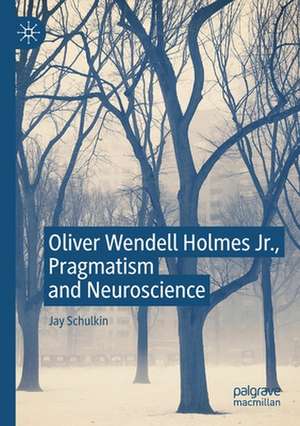
Oliver Wendell Holmes Jr., Pragmatism and Neuroscience
Autor Jay Schulkinen Limba Engleză Paperback – 29 aug 2020
Some facts of neuroscience fit easily into discussions of human experience and the law. However, it is important not to oversell neuroscience: a meeting of law and neuroscience is unlikely to prove persuasive in the courtroom any time soon. Nevertheless, as knowledge of neuroscience becomes more reliableand more easily accepted by both the larger legislative community and in the wider public, through which neuroscience filters into epistemic and judicial reliability, the two will ultimately find themselves in front of a judge. A pragmatist view of neuroscience will aid and underlie these events.
| Toate formatele și edițiile | Preț | Express |
|---|---|---|
| Paperback (1) | 495.35 lei 3-5 săpt. | +24.16 lei 7-13 zile |
| Springer International Publishing – 29 aug 2020 | 495.35 lei 3-5 săpt. | +24.16 lei 7-13 zile |
| Hardback (1) | 513.20 lei 6-8 săpt. | |
| Springer International Publishing – 29 aug 2019 | 513.20 lei 6-8 săpt. |
Preț: 495.35 lei
Preț vechi: 582.76 lei
-15% Nou
Puncte Express: 743
Preț estimativ în valută:
87.66€ • 102.22$ • 76.96£
87.66€ • 102.22$ • 76.96£
Carte disponibilă
Livrare economică 25 decembrie 25 - 08 ianuarie 26
Livrare express 11-17 decembrie pentru 34.15 lei
Preluare comenzi: 021 569.72.76
Specificații
ISBN-13: 9783030231026
ISBN-10: 303023102X
Pagini: 355
Ilustrații: XI, 355 p. 2 illus.
Dimensiuni: 148 x 210 x 25 mm
Greutate: 0.48 kg
Ediția:1st ed. 2019
Editura: Springer International Publishing
Colecția Palgrave Macmillan
Locul publicării:Cham, Switzerland
ISBN-10: 303023102X
Pagini: 355
Ilustrații: XI, 355 p. 2 illus.
Dimensiuni: 148 x 210 x 25 mm
Greutate: 0.48 kg
Ediția:1st ed. 2019
Editura: Springer International Publishing
Colecția Palgrave Macmillan
Locul publicării:Cham, Switzerland
Cuprins
1. Introduction.- 2. Holmes' Critical Experience in War.- 3. Experience, Inference and Surviving.- 4. Holmes, Pragmatism and Nature.- 5. Duty, Surviving, Social Contract.- 6. Emersonian Sensibilities.- 7. Bounded Choice, Human Freedom and Problem Solving.- 8. Naturalizing Decision-Making.- 9. Ethics, Body Politic, and Neuroscience.- 10. Neuroscientific Considerations and the Law.- 11. Conclusion.
Notă biografică
Dr Jay Schulkin is a Research Professor in the Department of Neuroscience as well as a member at the Center for the Brain Basis of Cognition, both at Georgetown University, USA. He is the author of a number of books, including Roots of Social Sensibility and Neural Function (2000), Naturalism and Pragmatism (2012), and Reflections on the Musical Mind (2013). He received his PhD in Behavioral Neuroscience from the University of Pennsylvania, USA.
Textul de pe ultima copertă
This book explores the cultures of philosophy and the law as they interact with neuroscience and biology, through the perspective of American jurist Oliver Wendell Holmes’ Jr., and the pragmatist tradition of John Dewey. Schulkin proposes that human problem solving and the law are tied to a naturalistic, realistic and an anthropological understanding of the human condition. The situated character of legal reasoning, given its complexity, like reasoning in neuroscience, can be notoriously fallible. Legal and scientific reasoning is to be understood within a broader context in order to emphasize both the continuity and the porous relationship between the two.
Some facts of neuroscience fit easily into discussions of human experience and the law. However, it is important not to oversell neuroscience: a meeting of law and neuroscience is unlikely to prove persuasive in the courtroom any time soon. Nevertheless, as knowledge of neuroscience becomes more reliableand more easily accepted by both the larger legislative community and in the wider public, through which neuroscience filters into epistemic and judicial reliability, the two will ultimately find themselves in front of a judge. A pragmatist view of neuroscience will aid and underlie these events.
Some facts of neuroscience fit easily into discussions of human experience and the law. However, it is important not to oversell neuroscience: a meeting of law and neuroscience is unlikely to prove persuasive in the courtroom any time soon. Nevertheless, as knowledge of neuroscience becomes more reliableand more easily accepted by both the larger legislative community and in the wider public, through which neuroscience filters into epistemic and judicial reliability, the two will ultimately find themselves in front of a judge. A pragmatist view of neuroscience will aid and underlie these events.
Caracteristici
Links Oliver Wendell Holmes Jr. to the larger culture of pragmatism, inquiry and the body politic Explores the new culture of neuroscience and the continuity of the law and science which Holmes represented Considers the work of pragmatist philosopher John Dewey as an alternative to Holmes