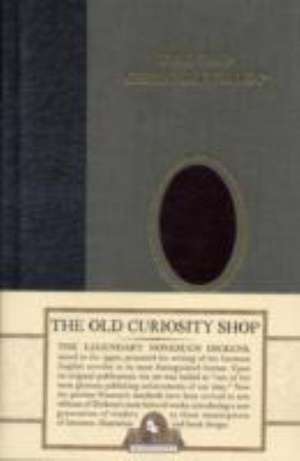
Old Curiosity Shop: Nonesuch Dickens
Autor Charles Dickensen Limba Engleză Hardback – 31 ian 2012
Preț: 260.62 lei
Puncte Express: 391
Carte indisponibilă temporar
Doresc să fiu notificat când acest titlu va fi disponibil:
Se trimite...
Specificații
ISBN-13: 9780715638859
ISBN-10: 0715638858
Pagini: 386
Dimensiuni: 200 x 265 x 49 mm
Greutate: 1.23 kg
Editura: Duckworth Overlook
Seria Nonesuch Dickens
Locul publicării:United Kingdom
ISBN-10: 0715638858
Pagini: 386
Dimensiuni: 200 x 265 x 49 mm
Greutate: 1.23 kg
Editura: Duckworth Overlook
Seria Nonesuch Dickens
Locul publicării:United Kingdom
V-ar putea interesa
-
 A Christmas CarolCharles DickensPreț: 28.32 lei
-
 Hard TimesCharles DickensPreț: 28.01 lei
-
 The Last UnicornPeter S. BeaglePreț: 124.48 leiRecomandat
-
 David CopperfieldCharles DickensPreț: 54.73 lei
-
 The Last UnicornPeter S. Beagle-25%Preț: 59.93 lei79.99 lei
-
 Classic Starts®: Oliver TwistCharles DickensPreț: 61.97 lei
-
 A Christmas CarolCharles DickensPreț: 29.27 lei
-
 Great ExpectationsCharles DickensPreț: 32.41 lei
-
 Oliver TwistCharles DickensPreț: 37.41 lei
-
 David CopperfieldCharles DickensPreț: 40.48 lei
-
 A Tale of Two CitiesCharles DickensPreț: 37.55 lei
-
 The Pickwick PapersCharles DickensPreț: 40.39 lei
-
 ShirleyCharlotte BrontëPreț: 38.92 lei
-
 Bleak HouseCharles DickensPreț: 41.29 lei
-
 Little DorritCharles DickensPreț: 41.65 lei
-
 Our Mutual FriendCharles DickensPreț: 28.01 lei
-
 Martin ChuzzlewitCharles DickensPreț: 41.00 lei
-
 Hard TimesCharles DickensPreț: 28.01 lei
-
 Dombey and SonCharles DickensPreț: 28.01 lei
-
 Complete Ghost StoriesCharles DickensPreț: 37.46 lei
-
 Barnaby RudgeCharles DickensPreț: 39.98 lei
Textul de pe ultima copertă
The Old Curiosity Shop is a story of the road, a genre at which Dickens excelled. Little Nell and her grandfather, pursued relentlessly through England by the evil and loathsome dwarf Quilp, meet a fascinating variety of vividly portrayed characters, including Mrs. Jarley, and Codlin and Short, the Punch and Judy men.
Descriere
Descriere de la o altă ediție sau format:
`... holding her solitary way among a crowd of wild, grotesque companions; the only pure, fresh, youthful object in the throng.' `Little Nell' cares for her grandfather in the gloomy surroundings of his curiosity shop. Reduced to poverty the pair flee London, pursued by the grotesque and vindictive Quilp. In a bizarre and shifting kaleidoscope of events and characters the story reaches its tragic climax, an ending that famously devastated the novel's earliest readers. Dickens blends naturalistic and allegorical styles to encompass both the actual blight of Victorian industrialization and textual echoes of Bunyan, the Romantic poets, Shakespeare, pantomine and Jacobean tragedy. Contrasting youth and old age, beauty and deformity, innocence and cynicism, The Old Curiosity Shop is a compelling mixture of humour and brooding meance. This edition uses the Clarendon text, the definitive edition of the novels of Charles Dickens, and includes the original illustrations. ABOUT THE SERIES: For over 100 years Oxford World's Classics has made available the widest range of literature from around the globe. Each affordable volume reflects Oxford's commitment to scholarship, providing the most accurate text plus a wealth of other valuable features, including expert introductions by leading authorities, helpful notes to clarify the text, up-to-date bibliographies for further study, and much more.
`... holding her solitary way among a crowd of wild, grotesque companions; the only pure, fresh, youthful object in the throng.' `Little Nell' cares for her grandfather in the gloomy surroundings of his curiosity shop. Reduced to poverty the pair flee London, pursued by the grotesque and vindictive Quilp. In a bizarre and shifting kaleidoscope of events and characters the story reaches its tragic climax, an ending that famously devastated the novel's earliest readers. Dickens blends naturalistic and allegorical styles to encompass both the actual blight of Victorian industrialization and textual echoes of Bunyan, the Romantic poets, Shakespeare, pantomine and Jacobean tragedy. Contrasting youth and old age, beauty and deformity, innocence and cynicism, The Old Curiosity Shop is a compelling mixture of humour and brooding meance. This edition uses the Clarendon text, the definitive edition of the novels of Charles Dickens, and includes the original illustrations. ABOUT THE SERIES: For over 100 years Oxford World's Classics has made available the widest range of literature from around the globe. Each affordable volume reflects Oxford's commitment to scholarship, providing the most accurate text plus a wealth of other valuable features, including expert introductions by leading authorities, helpful notes to clarify the text, up-to-date bibliographies for further study, and much more.
Recenzii
At a recent department meeting, it became evident that Dickens is an author who can divide a room. 'Let's teach some Dickens at key stage three,' some argued. 'I can't imagine anything worse,' others said. 'Too difficult', 'too wordy', 'enough to put anyone off'. 'But the stories are great,' I argued. It's easy to see both sides of the argument. As someone who has dipped in and out of Dickens over the years, I have always been delighted by the actual reading of the novel, but sometimes it has taken a considerable effort of will to start the thing. Many are long, all are complex, and there is some truth in the assertion that they are too difficult-not for all, certainly, but for some children at key stage three, Dickens could sound the death knell for reading pleasure. There is a case, then, for a differentiated Dickens, and here, as with other literary classics, Real Reads provides a helpful solution. The series currently includes nine of the major novels: Bleak House, A Christmas Carol, David Copperfield, Hard Times, Oliver Twist and Great Expectations, The Old Curiosity Shop, A Tale of Two Cities and Little Dorrit. All follow the same format-a couple of pages introducing the characters with some delightful illustrations by Karen Donnelly, forty-seven pages of narrative and a 'Taking Things Further' section at the back. Like other Real Reads, too, the novels are not designed to replace the originals, but to complement them. The publisher's hope is that for some readers, the Real Reads are a springboard into the original texts; for others it is to broaden their range of cultural experience and introduce them to a world of wonderful plots and characters. What makes these retellings particularly appealing from a classroom point of view is that significant attention is paid to the language use characteristic of the authors. The novels are retold with some integrity to the original-that is that some of the cadence of Dickens is retained; that some of the vocabulary remains authentic, and that some of those seminal passages remain relatively unaltered. Take the opening of A Tale of Two Cities as an example, 'It was the best of times, it was the worst of times; it was the age of wisdom, it was the age of foolishness; it was the season of wealth, it was the season of poverty. In short, it was a time very much like the present.' In short, it is very much like the original. The retellings go some way to preserving Dickens's characters and while there are of course casualties, the characters that remain are rounded and engaging. For Oliver we feel pity as he pleads with Sikes 'P-p-p-please don't make me steal,' in the face of Sikes terrifying whisper 'Quiet, vermin'. We long for Nancy to be saved by Mrs Maylie and feel the poignancy of her departure: 'You must take Oliver to safety. I must return to my life.' We sense the justice in Fagin's wait for death 'his face so distorted and pale, his eyes so bloodshot, that he already looked more dead than alive as he awaited his punishment.' Of course, we also feel the delight and relief as 'Oliver and Mr Brownlow walked hand in hand to their carriage.' Some of Dickens's humour is preserved: Mrs Joe is to be found bringing Pip up by hand and at the birth of David Copperfield, Peggotty's 'bosom swelled with such joy and pride that two buttons popped from her bodice and flew across the room.' The heartbreak remains too: 'As he wasted away over the next few days, Little Dorrit didn't leave her father's side. His spirit was like a maimed bird, able to think only of the place that had broken its wings. Finally, his spirit broke free of all earthly concerns. Little Dorrit wept bitterly. The 'Filling in the Spaces' section at the back of each book provides a helpful resource for teachers. Elements of the plot that have been omitted in order to contain the retelling in such a thin volume are listed here and can provide a useful point of departure to read some of the original text. There is some contextual material pertinent to the text, so for Little Dorrit we learn that Dickens's father was sent to Marshalsea Prison when Dickens was twelve and for Hard Times we can read about the rise of steam power and the way in which machinery in factories gave rise to mass migration to cities. There is also a two-page section called 'Food for thought' that provides points for discussion, themes, style and symbols and would neatly help shape classroom discussion and activity. In The Old Curiosity Shop, for example, 'Oscar Wilde said that Nell's death makes the reader laugh, whereas critics in Dickens' time were usually overcome by grief. Which is closer to your own reaction? Why?' would lend itself very well to paired, group or whole-class debate. Thinking about how the symbols of fog, hands, light and shadow and city and countryside match the action in Bleak House immediately suggests ways in which pupils might track language against action as they read. At the lower end of the price range for class readers, the excellent and durable quality of the books presents a good investment at GBP4.99 RRP for individual texts. -- Jane Campion English in Use
Notă biografică
Charles Dickens (1812-1870)
Charles Dickens was born on February 7, 1812, in Portsea, England. His parents were middle-class and suffered financially. When Dickens was twelve years old, his family faced financial crisis, which forced him to quit school and work in a shoe polish manufacturing factory. Dickens's mother and siblings eventually joined him. Dickens continued to work at the factory for several months. In the factory the horrific conditions haunted him throughout his life. Dickens never forgot the day when a senior boy in the warehouse took it upon himself to instruct Dickens how to do his work more efficiently.
As a young adult, Dickens worked as a law clerk and later as a journalist. He perceived the darker social conditions of the Industrial Revolution. A collection of semi-fictional sketches entitled Sketches by Boz earned him recognition as a writer. Dickens began to make money from his writing when he published his first novel, The Pickwick Papers in 1836. The Pickwick Papers was hugely popular and Dickens became a literary celebrity at the age of twenty-five. Dickens's themes included wealth and poverty, love and rejection, and the eventual triumph of good over evil. In 1836, Dickens married Catherine Hogarth, but after twenty years of marriage and their ten children, he fell in love with Ellen Ternan, an actress many years his junior. Soon after, Dickens and his wife separated. Dickens remained a prolific writer to the end of his life, and his novels - Great Expectations, A Tale of Two Cities, A Christmas Carol, David Copperfield, and Bleak House - continued to earn critical and popular acclaim. He died of a stroke in 1870, at the age of 58.