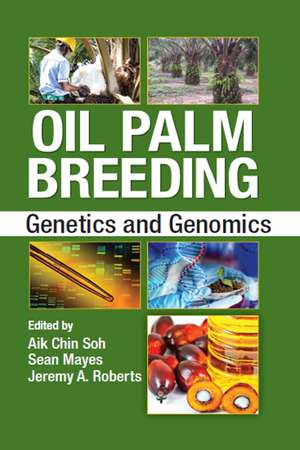
Oil Palm Breeding: Genetics and Genomics
Editat de Aik Chin Soh, Sean Mayes, Jeremy A. Robertsen Limba Engleză Paperback – 30 iun 2021
In Oil Palm: Breeding, Genetics and Genomics, world leading organizations and individuals who have been at the forefront of developments in this crop, provide their insights and experiences of oil palm research, while examining the different challenges that face the future of the oil palm. The editors have all been involved in research and breeding of oil palm for many years and use their knowledge of the crop and their disciplinary expertise to provide context and to introduce the different research topics covered.
Preț: 468.12 lei
Carte tipărită la comandă
Livrare economică 08-22 iunie
Specificații
ISBN-10: 1032096519
Pagini: 464
Ilustrații: 20 Illustrations, color; 65 Illustrations, black and white
Dimensiuni: 156 x 234 x 24 mm
Greutate: 0.66 kg
Ediția:1
Editura: CRC Press
Colecția CRC Press
V-ar putea interesa
-
 Advances in AgronomyDonald L. SparksPreț: 416.56 lei
 -
 Plant Biotechnology: The genetic manipulation of plantsAdrian Slater-22%Preț: 373.75 lei478.98 lei
 -
 OverleafRichard Ogilvy-24%Preț: 139.77 lei184.74 lei
 -
 Adventures in FermentationJohnny DrainPreț: 138.78 lei
 -
 -18%Preț: 75.00 lei91.44 lei
 -
 Temperate Tree Fruits and NutsGeorge Manganaris-34%Preț: 601.62 lei908.59 lei
 -
 Principles of Plant Genetics and BreedingGeorge Acquaah-19%Preț: 410.58 lei506.88 lei
 -
 Plant BiologyAlison M. Smith-9%Preț: 647.80 lei711.87 lei
 -
 -26%Preț: 98.82 lei132.93 lei
 -
 Plants from Test Tubes: An Introduction to MicropropogationHolly Scoggins-27%Preț: 175.22 lei241.17 lei
 -
 AlmondsRafel Socias I Company-23%Preț: 1020.16 lei1324.87 lei
 -
 -23%Preț: 1340.41 lei1740.79 lei
 -
 Tropical Fruits, Volume 2Odilo Duarte-19%Preț: 407.46 lei503.04 lei
 -
 Breeding and Biotechnology of Leaf, Fruit, and Seed Fiber CropsKhaled F. M. Salem-18%Preț: 1372.99 lei1674.38 lei
 -
 Crop ImprovementSiti Nor Akmar Abdullah-18%Preț: 1186.02 lei1446.37 lei
 -
 Wild Crop Relatives: Genomic and Breeding Resources: Temperate FruitsChittaranjan Kole-24%Preț: 869.52 lei1144.10 lei
 -
 Fundamentals of Field Crop BreedingDevendra Kumar Yadava-17%Preț: 584.88 lei704.67 lei
 -
 Fruit and Nut CropsP. E. Rajasekharan-18%Preț: 1616.96 lei1971.90 lei
Public țintă
Academic and Professional ReferenceCuprins
Acknowledgments......................................................................................................ix
Editors........................................................................................................................xi
Contributors............................................................................................................ xiii
Chapter 1 Introduction to the Oil Palm Crop........................................................1
Aik Chin Soh, Sean Mayes, and Jeremy Roberts
Chapter 2 The Plant and Crop................................................................................7
Aik Chin Soh, Sean Mayes, and Jeremy Roberts
Chapter 3 Genetic Resources............................................................................... 19
Aik Chin Soh, Sean Mayes, Jeremy Roberts, Nookiah
Rajanaidu, Amiruddin Mohd Din, Marjuni Marhalil, Abdullah
Norziha, Ong-Abdullah Meilina, Ahmad Malike Fadila,
Abu Bakar Nor Azwani, Libin Adelinna Anak, Yaakub Zulkifli,
Ahmad Kushairi Din, Edson Barcelos, and Philippe Amblard
Chapter 4 Plant Genetics...................................................................................... 57
Aik Chin Soh, Sean Mayes, and Jeremy Roberts
Chapter 5 Objective Traits...................................................................................85
Aik Chin Soh, Sean Mayes, Jeremy Roberts, Kees Breure,
Benoît Cochard, Bruno Nouy, Richard M. Cooper, Hubert de
Franqueville, Claude Louise, and Shenyang Chin
Chapter 6 Breeding Plans and Selection Methods....................
Recenzii
--Gurdev S Khush, University of California, published in The Planter, Vol. 94, No. 1105, April 2018
Descriere
The oil palm is a remarkable crop, producing around 40% of the world's vegetable oil from around 6% of the land devoted to oil crops. Conventional breeding has clearly been the major focus of genetic improvement in this crop. A mix of improved agronomy and management, coupled with breeding selection have quadrupled the oil yield of the crop since breeding began in earnest in the 1920s. However, as for all perennial crops with long breeding cycles, oil palm faces immense challenges in the coming years with increased pressure from population growth, climate change and the need to develop environmentally sustainable oil palm plantations.
In Oil Palm: Breeding, Genetics and Genomics, world leading organizations and individuals who have been at the forefront of developments in this crop, provide their insights and experiences of oil palm research, while examining the different challenges that face the future of the oil palm. The editors have all been involved in research and breeding of oil palm for many years and use their knowledge of the crop and their disciplinary expertise to provide context and to introduce the different research topics covered.