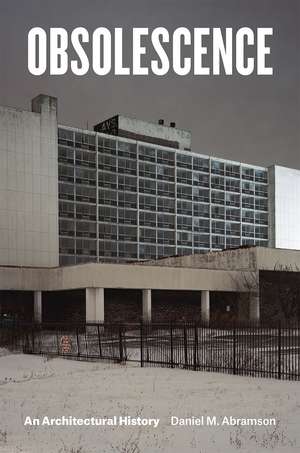
Obsolescence: An Architectural History
Autor Daniel M. Abramsonen Limba Engleză Paperback – 25 ian 2017
In our architectural pursuits, we often seem to be in search of something newer, grander, or more efficient—and this phenomenon is not novel. In the spring of 1910 hundreds of workers labored day and night to demolish the Gillender Building in New York, once the loftiest office tower in the world, in order to make way for a taller skyscraper. The New York Times puzzled over those who would sacrifice the thirteen-year-old structure, “as ruthlessly as though it were some ancient shack.” In New York alone, the Gillender joined the original Grand Central Terminal, the Plaza Hotel, the Western Union Building, and the Tower Building on the list of just one generation’s razed metropolitan monuments.
In the innovative and wide-ranging Obsolescence, Daniel M. Abramson investigates this notion of architectural expendability and the logic by which buildings lose their value and utility. The idea that the new necessarily outperforms and makes superfluous the old, Abramson argues, helps people come to terms with modernity and capitalism’s fast-paced change. Obsolescence, then, gives an unsettling experience purpose and meaning.
Belief in obsolescence, as Abramson shows, also profoundly affects architectural design. In the 1960s, many architects worldwide accepted the inevitability of obsolescence, experimenting with flexible, modular designs, from open-plan schools, offices, labs, and museums to vast megastructural frames and indeterminate building complexes. Some architects went so far as to embrace obsolescence’s liberating promise to cast aside convention and habit, envisioning expendable short-life buildings that embodied human choice and freedom. Others, we learn, were horrified by the implications of this ephemerality and waste, and their resistance eventually set the stage for our turn to sustainability—the conservation rather than disposal of resources. Abramson’s fascinating tour of our idea of obsolescence culminates in an assessment of recent manifestations of sustainability, from adaptive reuse and historic preservation to postmodernism and green design, which all struggle to comprehend and manage the changes that challenge us on all sides.
In the innovative and wide-ranging Obsolescence, Daniel M. Abramson investigates this notion of architectural expendability and the logic by which buildings lose their value and utility. The idea that the new necessarily outperforms and makes superfluous the old, Abramson argues, helps people come to terms with modernity and capitalism’s fast-paced change. Obsolescence, then, gives an unsettling experience purpose and meaning.
Belief in obsolescence, as Abramson shows, also profoundly affects architectural design. In the 1960s, many architects worldwide accepted the inevitability of obsolescence, experimenting with flexible, modular designs, from open-plan schools, offices, labs, and museums to vast megastructural frames and indeterminate building complexes. Some architects went so far as to embrace obsolescence’s liberating promise to cast aside convention and habit, envisioning expendable short-life buildings that embodied human choice and freedom. Others, we learn, were horrified by the implications of this ephemerality and waste, and their resistance eventually set the stage for our turn to sustainability—the conservation rather than disposal of resources. Abramson’s fascinating tour of our idea of obsolescence culminates in an assessment of recent manifestations of sustainability, from adaptive reuse and historic preservation to postmodernism and green design, which all struggle to comprehend and manage the changes that challenge us on all sides.
Preț: 238.99 lei
Puncte Express: 358
Carte disponibilă
Livrare economică 29 octombrie-12 noiembrie
Livrare express 15-21 octombrie pentru 22.06 lei
Livrare prin curier în România Termenul estimat este afișat lângă disponibilitate.
Transport gratuit de la 400.00 lei Plată online sau ramburs, în funcție de opțiunile comenzii.
Retur gratuit în 14 zile Comandă securizată și suport în română.
Specificații
ISBN-13: 9780226478050
ISBN-10: 022647805X
Pagini: 202
Ilustrații: 66 halftones, 1 table
Dimensiuni: 152 x 229 x 15 mm
Greutate: 0.28 kg
Ediția:1
Editura: University of Chicago Press
Colecția University of Chicago Press
ISBN-10: 022647805X
Pagini: 202
Ilustrații: 66 halftones, 1 table
Dimensiuni: 152 x 229 x 15 mm
Greutate: 0.28 kg
Ediția:1
Editura: University of Chicago Press
Colecția University of Chicago Press
V-ar putea interesa
-
 Sex with the QueenEleanor HermanPreț: 122.67 lei
 -
 Brothers in WarMichael WalshPreț: 124.23 lei
 -
 The Fall of ParisAlistair HornePreț: 125.33 lei
 -
 Ukraine: Birth of a Modern NationSerhy Yekelchyk-16%Preț: 216.07 lei258.11 lei
 -
 -11%Preț: 370.13 lei415.92 lei
 -
 Athene Palace: Hitler's "New Order" Comes to RumaniaR. G. WaldeckPreț: 173.44 lei
 -
 Ozone JournalPeter BalakianPreț: 125.11 lei
 -
 Preț: 216.94 lei
 -
 Plough, Sword, and Book: The Structure of Human HistoryErnest GellnerPreț: 306.90 lei
 -
 The Invention of HeterosexualityJonathan Ned KatzPreț: 207.03 lei
 -
 Preț: 282.45 lei
 -
 GuerraJason Webster-27%Preț: 67.07 lei91.44 lei
 -
 Dancing into Battle: A Social History of the Battle of WaterlooNicholas Foulkes-26%Preț: 57.89 lei78.55 lei
 -
 Royal Marines CommandosJohn Parker-28%Preț: 75.75 lei105.63 lei
 -
 Killing HitlerRoger MoorhousePreț: 112.59 lei
 -
 To the Victor the SpoilsSean LongdenPreț: 252.49 lei
 -
 -25%Preț: 81.63 lei108.34 lei
 -
 Vinnie Got Blown AwayJeremy CameronPreț: 57.02 lei
 -
 Art/HistoriesMuseum der Moderne Salzburg-35%Preț: 206.67 lei316.99 lei
Notă biografică
Daniel M. Abramson is professor of architectural history and director of architectural studies at Boston University. Previously, he taught at Tufts University and Connecticut College. He is the author of Building the Bank of England: Money, Architecture, Society, 1694-1942 and Skyscraper Rivals: The AIG Building and the Architecture of Wall Street.
Cuprins
Acknowledgments
Introduction
1 Inventing Obsolescence
2 Urban Obsolescence
3 The Promise of Obsolescence
4 Fixing Obsolescence
5 Reversing Obsolescence
6 Sustainability and Beyond
Notes
Illustration Credits
Index
Introduction
1 Inventing Obsolescence
2 Urban Obsolescence
3 The Promise of Obsolescence
4 Fixing Obsolescence
5 Reversing Obsolescence
6 Sustainability and Beyond
Notes
Illustration Credits
Index
Recenzii
“Abramson uses design as evidence to read society’s responses to the notion of obsolescence, rather than as mere illustration. And the resulting narrative is one of the most coherent and powerful explanations I’ve ever read of the seemingly disparate architectural movements of the past century: interwar conservatism, Brutalism, historic preservation and Post-Modernism. . . . The conclusion of Obsolescence is brilliant. Now superseded by sustainability, obsolescence is now itself obsolete. . . . The ideas of obsolescence and sustainability, in the end, are just ways to justify change. They are belief systems that preoccupy an era, and then they disappear.”
“A persuasive account of the origins of obsolescence in architectural thought.”
“Abramson explains that building obsolescence is an invented notion, created by Chicago real estate experts in the 1890s as a way to justify a near-ruthless push for profitable new construction. And once these ideas took root, they’d go global in the twentieth century, a wild reshaping of cities that put older buildings and neighborhoods in constant peril of demolition. . . . The wrecking ball still swings a bit freely in Chicago, with building obsolescence given as the reason. But Abramson’s book offers an important rebuttal.”
“Thoroughly researched, well indexed, and supported by copious notes and black and white illustrations, this brief 156 page volume offers compelling and thought-provoking arguments that make it well worth reading. Written for the architectural history community, Abramson’s clear and straightforward language will also make Obsolescence a relevant and accessible read for those interested in the development of real estate, urban planning, and historic preservation.”
“While all buildings are subject to the decay and ruin brought by time, Abramson is concerned in this book with a different culprit: obsolescence. In his analysis, this term refers to structures demolished for having outmoded mechanical systems, or insufficient rentable space, or a suddenly unappealing stylistic expression, among many other factors. Such buildings might have survived were it not for shifting economic standards, desires, or tastes. Abramson’s overriding concern is how architecture functions within capitalism.”
“Obsolescence is an important book because it directs our attention to a key temporal concept of twentieth century architecture, urbanism, and design. As Abramson ably shows, during the first half of the twentieth century obsolescence developed as a term through which the relationships, or nonrelationships, of permanence and dynamism were mediated. . . . Gathering a broad range of sources, Abramson shows how obsolescence, first applied to buildings by real estate specialists, became embedded in US tax law, thus codifying, normalizing, and monetizing the assumption that over time a building inevitably becomes increasingly less useful, until it must be replaced.”
“Obsolescence is far from an exact science, as Abramson’s succinct, thoughtful book Obsolescence: An Architectural History shows. Abramson, carefully transatlantic in his thinking, charts the ebb and flow of ideas which, as he writes ‘ran the gamut from accepting that obsolescence would happen to believing that obsolescence should happen’, liberating us all from ‘history and habit.’”
“If obsolescence has been a major topic in consumerism and real estate for over a century, Abramson shows its centrality to the history of modern architecture. His saga moves with grace and precision over an extraordinary terrain, from the surprisingly short life-spans of most early skyscrapers in New York and Chicago to the pseudo-scientific rhetoric about new commercial development in the 1920s, then the transatlantic phenomenon of urban renewal after WWII (in capitalist and socialist countries), on to the global phenomena of megastructures, visionary design, environmentalism, and historic preservation in the 1960s. He concludes by asking how this history can give us new insights about the issues of unpredictability, sustainability, and differences in human perceptions that have become central to contemporary architecture. This brilliantly conceived, inspiring and eloquent book will surely enjoy a long life.”
“It’s impossible to resist declaring Obsolescence timely; nevertheless, it’s impossible to deny. Abramson’s riveting architectural history of obsolescence moves seamlessly from NABOM to Nabokov. Claiming a longstanding tension between obsolescence and sustainability, he situates both terms within a richly detailed tableau that includes tax code information, close readings of buildings, cultural and economic theory, and texts that range from the late-nineteenth century to the most current architectural writing. Abramson masterfully composes a delightfully taut history across this breadth. Obsolescence will appeal to anyone who takes the time to pause and think about the built environment.”
“An excellent book. Innovative, penetrating, and compelling. Abramson probes an underlying idea we think we know quite well to weave a much more complicated tale about its ascendance, critique, and adaptations.”
"Abramson's dogged pursuit of. . .obsolescence convincingly embeds sustainability into the history of modern architecture, not as a diversion from it, nor as its damning, but as part of a live conundrum."
"One of Obsolescence’s great contributions is to give sustainability a history."
"A richly dense and enlightening book that expands how we conceptualize the built environment."