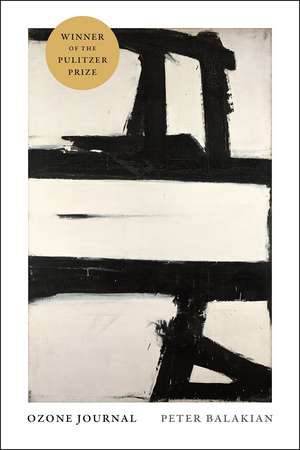
Ozone Journal
Autor Peter Balakianen Limba Engleză Paperback – 26 mar 2015
from "Ozone Journal"
Bach’s cantata in B-flat minor in the cassette,
we lounged under the greenhouse-sky, the UVBs hacking
at the acids and oxides and then I could hear the difference
between an oboe and a bassoon
at the river’s edge under cover—
trees breathed in our respiration;
there was something on the other side of the river,
something both of us were itching toward—
radical bonds were broken, history became science.
We were never the same.
The title poem of Peter Balakian's Ozone Journal is a sequence of fifty-four short sections, each a poem in itself, recounting the speaker's memory of excavating the bones of Armenian genocide victims in the Syrian desert with a crew of television journalists in 2009. These memories spark others—the dissolution of his marriage, his life as a young single parent in Manhattan in the nineties, visits and conversations with a cousin dying of AIDS—creating a montage that has the feel of history as lived experience. Bookending this sequence are shorter lyrics that span times and locations, from Nairobi to the Native American villages of New Mexico. In the dynamic, sensual language of these poems, we are reminded that the history of atrocity, trauma, and forgetting is both global and ancient; but we are reminded, too, of the beauty and richness of culture and the resilience of love.
Bach’s cantata in B-flat minor in the cassette,
we lounged under the greenhouse-sky, the UVBs hacking
at the acids and oxides and then I could hear the difference
between an oboe and a bassoon
at the river’s edge under cover—
trees breathed in our respiration;
there was something on the other side of the river,
something both of us were itching toward—
radical bonds were broken, history became science.
We were never the same.
The title poem of Peter Balakian's Ozone Journal is a sequence of fifty-four short sections, each a poem in itself, recounting the speaker's memory of excavating the bones of Armenian genocide victims in the Syrian desert with a crew of television journalists in 2009. These memories spark others—the dissolution of his marriage, his life as a young single parent in Manhattan in the nineties, visits and conversations with a cousin dying of AIDS—creating a montage that has the feel of history as lived experience. Bookending this sequence are shorter lyrics that span times and locations, from Nairobi to the Native American villages of New Mexico. In the dynamic, sensual language of these poems, we are reminded that the history of atrocity, trauma, and forgetting is both global and ancient; but we are reminded, too, of the beauty and richness of culture and the resilience of love.
Preț: 125.11 lei
Puncte Express: 188
Carte disponibilă
Livrare economică 14-28 noiembrie
Livrare prin curier în România Termenul estimat este afișat lângă disponibilitate.
Transport gratuit de la 400.00 lei Plată online sau ramburs, în funcție de opțiunile comenzii.
Retur gratuit în 14 zile Comandă securizată și suport în română.
Specificații
ISBN-13: 9780226207032
ISBN-10: 022620703X
Pagini: 72
Dimensiuni: 152 x 229 x 18 mm
Greutate: 0.14 kg
Ediția:1
Editura: University of Chicago Press
Colecția University of Chicago Press
ISBN-10: 022620703X
Pagini: 72
Dimensiuni: 152 x 229 x 18 mm
Greutate: 0.14 kg
Ediția:1
Editura: University of Chicago Press
Colecția University of Chicago Press
V-ar putea interesa
-
 June-TreePeter BalakianPreț: 89.69 lei
 -
 The Burning TigrisPeter BalakianPreț: 124.44 lei
 -
 Preț: 199.80 lei
 -
 Preț: 324.34 lei
 -
 Diary of Our Fatal IllnessCharles BardesPreț: 158.87 lei
 -
 Collected Poems of Howard NemerovHoward NemerovPreț: 316.94 lei
 -
 Rimbaud: Complete Works, Selected Letters, a Bilingual EditionJean Nicholas Arthur RimbaudPreț: 151.42 lei
 -
 Mixed CompanyAlan ShapiroPreț: 221.87 lei
 -
 Preț: 340.81 lei
 -
 Theodore Roethke's Far FieldsPeter BalakianPreț: 170.96 lei
 -
 Bloody News from My FriendSiamantoPreț: 175.68 lei
 -
 Preț: 174.73 lei
 -
 Paris, Capitale de la France: Recueil de VersTrong Hiep NguyenPreț: 94.27 lei
 -
 Rêveries d'un voyageur, poésie. Orient, Russie et MoldavieAdèle Hommaire de HellPreț: 139.19 lei
 -
 Sonnets À Laure. PétrarquePétrarquePreț: 109.40 lei
 -
 Guillaume de PalerneSans AuteurPreț: 176.41 lei
 -
 Preț: 87.17 lei
 -
 Preț: 150.94 lei
 -
 Les PalmiersCharles CastellanPreț: 123.95 lei
 -
 Le Poète Colardeau, à la fontaine de Segrais, à Pithiviers-le-Vieil (Loiret). Épître à M. DuhamelCharles-Pierre ColardeauPreț: 89.59 lei
 -
 Les Cynégétiques Français, Ou l'École Du Chasseur, Poëme En Quatre ChantsDecombes de MorellesPreț: 94.88 lei
 -
 Lydéric: PoèmeJ -B DeletombePreț: 89.59 lei
Notă biografică
Peter Balakian is the Donald M. and Constance H. Rebar Professor in Humanities and professor of English at Colgate University. He is the author of seven books of poems, most recently of Ziggurat and June-tree: New and Selected Poems, 1974–2000. He is also the author of The Burning Tigris: The Armenian Genocide and America’s Response, a New York Times best seller, and Black Dog of Fate, a memoir. A new collection of essays, Vise and Shadow, is also available this spring from the University of Chicago Press.
Cuprins
Acknowledgments
ONE
Name and Place
Pueblo 1, New Mexico
Pueblo 2, New Mexico
Pueblo, Christmas Dance
Joe Louis’s Fist
Hart Crane in LA, 1927
Providence/Teheran, ’79
Warhol/Mao, ’72
Baseball Days, ’61
TWO
Ozone Journal
THREE
Here and Now
Slum Drummers, Nairobi
Leaving Aleppo
Near the Border
Finches
Silk Road
Home
Notes
ONE
Name and Place
Pueblo 1, New Mexico
Pueblo 2, New Mexico
Pueblo, Christmas Dance
Joe Louis’s Fist
Hart Crane in LA, 1927
Providence/Teheran, ’79
Warhol/Mao, ’72
Baseball Days, ’61
TWO
Ozone Journal
THREE
Here and Now
Slum Drummers, Nairobi
Leaving Aleppo
Near the Border
Finches
Silk Road
Home
Notes
Recenzii
"In his new book, Ozone Journal, Balakian masterfully does the things nobody else does—derange history into poetry, make poetry painting, make painting culture, make culture living—and with a historical depth that finds the right experience in language."
“Balakian is blessed with an eerie ability to connect seemingly unrelated events separated by vast amounts of time and space. . . . Balakian’s work is one of contrasts: the contrast between day and night, earth and sky, love and hate, the temporary and eternal, between inner war and outer peace.”
“Balakian is a master of—the drifting, split-second mirage, the cinematic dissolve and cross-cut as well as the sculptural, statuesque moment chiseled out of consonant blends and an imagistic, jazzman’s ear for vowels. . . . Beautiful, haunting, plaintive, urgent. In our dying world’s age, these poems legislate a vital comportment to the demands of our shared present, timely and untimely both.”
"The grandchild of survivors of the Armenian genocide, Balakian is a poet with an acute awareness of how easily we forget. Ozone Journal, his latest collection, is a bold and daring book which expands his attention to erasure to the world around him. It examines the loom waste of a violent century which has flung so many populations to new homes and asks, why?"
“While Balakian’s essays [Vise and Shadow] reveal the ways history and its discontents inscribe themselves in the smallest features of familiar texts, his poems [Ozone Journal] offer a mournful silence in the face of these social upheavals, and their aftermath, that is only possible within the realm of art. Readers will find both texts equally necessary and equally moving.”
"[Ozone Journal] is a mix of intense sensory, even sensual, experience and cerebral force, the verse both meditative and urgent. Balakian’s long lines pick up and draw out thoughts, clauses, notes, in the rhythms of exploratory prose, then snap back at unexpected line-breaks, maintaining a gut-level as well as an intellectual tension."
“Few American poets of the boomer generation have explored the interstices of public and personal history as deeply and urgently as has Balakian, and his significance as a poet of social consciousness is complemented by his work in other genres.”
"Crossing time, space, and cultures, Balakian has created a multidimensional reality and space that belongs to all and none, where the past offers a respite from the present, but only for a fleeting moment."
"What Balakian manages so well in tense, intimate passages. . . is slowly, imperceptibly condensing the panorama of history into a series of personal moments, no matter how fleeting. . . . What the reader perceives in the process, gradually but unmistakably, is the cumulatively catastrophic impact of history on that memory."
"[Balakian] has . . . an observational superpower to write about the perils of our day that, in one way or another, are either being dismissed, denied or played down."
"Distinguished poet Balakian also authored the best-selling The Burning Tigris: The Armenian Genocide and America’s Response, so it’s no surprise that the 54-section title poem at this book’s heart recalls excavating the bones of Armenian genocide victims in 2009 Syria. But the poem seamlessly shifts to memories of a perfectly rendered New York, of jazz and John Cage, single parenthood and a relative’s death from AIDS, and throughout we see how experiences converge. . . how we are all containers of the past."
Descriere
Premiul Pulizer 2016
from "Ozone Journal"
Bach’s cantata in B-flat minor in the cassette,
we lounged under the greenhouse-sky, the UVBs hacking
at the acids and oxides and then I could hear the difference
between an oboe and a bassoon
at the river’s edge under cover—
trees breathed in our respiration;
there was something on the other side of the river,
something both of us were itching toward—
radical bonds were broken, history became science.
We were never the same.
The title poem of Peter Balakian's Ozone Journal is a sequence of fifty-four short sections, each a poem in itself, recounting the speaker's memory of excavating the bones of Armenian genocide victims in the Syrian desert with a crew of television journalists in 2009. These memories spark others—the dissolution of his marriage, his life as a young single parent in Manhattan in the nineties, visits and conversations with a cousin dying of AIDS—creating a montage that has the feel of history as lived experience. Bookending this sequence are shorter lyrics that span times and locations, from Nairobi to the Native American villages of New Mexico. In the dynamic, sensual language of these poems, we are reminded that the history of atrocity, trauma, and forgetting is both global and ancient; but we are reminded, too, of the beauty and richness of culture and the resilience of love.
Bach’s cantata in B-flat minor in the cassette,
we lounged under the greenhouse-sky, the UVBs hacking
at the acids and oxides and then I could hear the difference
between an oboe and a bassoon
at the river’s edge under cover—
trees breathed in our respiration;
there was something on the other side of the river,
something both of us were itching toward—
radical bonds were broken, history became science.
We were never the same.
The title poem of Peter Balakian's Ozone Journal is a sequence of fifty-four short sections, each a poem in itself, recounting the speaker's memory of excavating the bones of Armenian genocide victims in the Syrian desert with a crew of television journalists in 2009. These memories spark others—the dissolution of his marriage, his life as a young single parent in Manhattan in the nineties, visits and conversations with a cousin dying of AIDS—creating a montage that has the feel of history as lived experience. Bookending this sequence are shorter lyrics that span times and locations, from Nairobi to the Native American villages of New Mexico. In the dynamic, sensual language of these poems, we are reminded that the history of atrocity, trauma, and forgetting is both global and ancient; but we are reminded, too, of the beauty and richness of culture and the resilience of love.