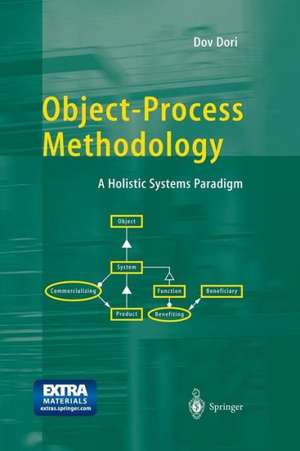
Object-Process Methodology
Autor Dov Dorien Limba Engleză Paperback – 3 oct 2013
The book presents the theory and practice of OPM with examples from various industry segments and engineering disciplines, as well as daily life.
Preț: 392.39 lei
Preț vechi: 490.49 lei
-20%
Puncte Express: 589
Carte disponibilă
Livrare economică 05-19 noiembrie
Livrare express 22-28 octombrie pentru 45.03 lei
Livrare prin curier în România Termenul estimat este afișat lângă disponibilitate.
Transport gratuit de la 400.00 lei Plată online sau ramburs, în funcție de opțiunile comenzii.
Retur gratuit în 14 zile Comandă securizată și suport în română.
Specificații
ISBN-13: 9783642629891
ISBN-10: 364262989X
Pagini: 488
Ilustrații: XXV, 455 p.
Dimensiuni: 155 x 235 x 27 mm
Greutate: 0.68 kg
Ediția:Softcover reprint of the original 1st edition 2002
Editura: Springer
Locul publicării:Berlin, Heidelberg, Germany
ISBN-10: 364262989X
Pagini: 488
Ilustrații: XXV, 455 p.
Dimensiuni: 155 x 235 x 27 mm
Greutate: 0.68 kg
Ediția:Softcover reprint of the original 1st edition 2002
Editura: Springer
Locul publicării:Berlin, Heidelberg, Germany
V-ar putea interesa
-
 Applying UML and PatternsCraig Larman-15%Preț: 605.79 lei712.70 lei
 -
 -20%Preț: 678.86 lei848.58 lei
 -
 SysML DistilledLenny DelligattiPreț: 323.34 lei
 -
 Systems EngineeringDerek K Hitchins-23%Preț: 778.18 lei1010.62 lei
 -
 Notes on the Synthesis of FormChristopher AlexanderPreț: 235.55 lei
 -
 System of Systems Modeling and AnalysisDaniel A. DeLaurentis-20%Preț: 1082.04 lei1352.55 lei
 -
 Design-Tech: Building Science for ArchitectsJason Alread-8%Preț: 465.32 lei505.78 leiRecomandat
 -
 -19%Preț: 526.02 lei649.41 lei
 -
 -20%Preț: 627.14 lei783.93 lei
 -
 -20%Preț: 606.03 lei757.53 lei
 -
 System Architecture, Global EditionBruce Cameron-11%Preț: 661.44 lei743.19 lei
 -
 Modern Systems Analysis and Design, Global EditionJoseph Valacich-8%Preț: 606.91 lei659.70 lei
 -
 The Standard for Organizational Project Management (OPM)Project Management Institute-25%Preț: 439.33 lei583.68 lei
 -
 Practical Model-Based Systems EngineeringJose L Fernandez-18%Preț: 661.59 lei806.81 lei
 -
 -24%Preț: 1651.31 lei2172.78 lei
 -
 Engineering Information Systems with Large Language ModelsFrancesca de Luzi-24%Preț: 1002.12 lei1318.58 lei
 -
 Components Operationally: Reversibility and System EngineeringClaudio Antares Mezzina-20%Preț: 389.32 lei486.66 lei
 -
 Business Process ManagementAndreas GadatschPreț: 324.24 lei
 -
 Delft Design Guide (revised edition): Perspectives - Models - Approaches - MethodsAnnemiek van Boeijen-20%Preț: 209.29 lei260.28 lei
 -
 Building Model-based Enterprise ArchitectureMudar Bahri-20%Preț: 241.80 lei302.25 lei
Public țintă
Professional/practitionerCuprins
I Foundations of Object-Process Methodology.- 1 A Taste of OPM.- 2 Object-Process Diagrams.- 3 Object-Process Language.- 4 Objects and Processes.- II Concepts of OPM Systems Modeling.- 5Dynamics.- 6Structure.- 7Aggregation and Exhibition.- 8 Generalization and Instantiation.- 9 Managing Systems’ Complexity.- III Building Systems with OPM.- 10 Systems and Modeling.- 11 System Lifecycle and Evolution.- 12 States and Values.- 13 Advanced OPM Concepts.- 14 Systems Theory.- 15 Object-Oriented Modeling.- Appendix A: The ATM System.- References.
Textul de pe ultima copertă
Object-Process Methodology (OPM) is a comprehensive novel approach to systems engineering. Integrating function, structure and behavior in a single, unifying model, OPM significantly extends the system modeling capabilities of current object-oriented methods. OPM system specification consists of a set of interrelated Object-Process Diagrams and an equivalent Formal English - a subset of natural English. The resulting graphic and textual system specification serves not only for communicating among system architects, domain experts, and prospective customers, but also for automated application generation.
OPM is a generic, domain-independent approach founded on the very basic elements of any system: objects and processes. As such, it is applicable to virtually any domain of business, engineering and science. Being intuitive and easy to understand and use, OPM enables system architects to document their natural train of thought. Equipped with a powerful holistic systems paradigm and relieved from the technicalities of unnatural languages, developers engage in creativity and discovery as they design complex system architectures.
The book presents the theory and practice of OPM with examples from various industry segments and engineering disciplines, as well as daily life.
OPM is a generic, domain-independent approach founded on the very basic elements of any system: objects and processes. As such, it is applicable to virtually any domain of business, engineering and science. Being intuitive and easy to understand and use, OPM enables system architects to document their natural train of thought. Equipped with a powerful holistic systems paradigm and relieved from the technicalities of unnatural languages, developers engage in creativity and discovery as they design complex system architectures.
The book presents the theory and practice of OPM with examples from various industry segments and engineering disciplines, as well as daily life.
Caracteristici
A clear presentation of Object-Process Methodology (OPM), a paradigm shift in systems engineering Contains many examples drawn from the author's rich industrial experience as a high-tech consultant Exercises with solutions at the end of each chapter Includes supplementary material: sn.pub/extras