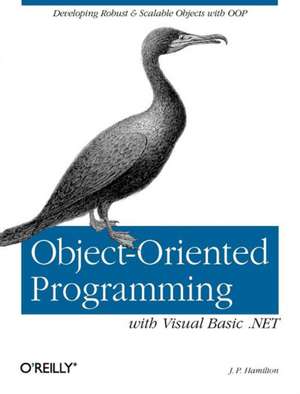
Object-Oriented Programming with Visual Basic .Net
Autor J P Hamiltonen Limba Engleză Paperback – 19 noi 2002
Preț: 176.92 lei
Preț vechi: 221.16 lei
-20%
Puncte Express: 265
Carte disponibilă
Livrare economică 10-24 noiembrie
Livrare prin curier în România Termenul estimat este afișat lângă disponibilitate.
Transport gratuit de la 400.00 lei Plată online sau ramburs, în funcție de opțiunile comenzii.
Retur gratuit în 14 zile Comandă securizată și suport în română.
Specificații
ISBN-13: 9780596001469
ISBN-10: 0596001460
Pagini: 308
Dimensiuni: 177 x 237 x 22 mm
Greutate: 0.49 kg
Editura: O'Reilly
Locul publicării:United States
ISBN-10: 0596001460
Pagini: 308
Dimensiuni: 177 x 237 x 22 mm
Greutate: 0.49 kg
Editura: O'Reilly
Locul publicării:United States
V-ar putea interesa
-
 Backup & RecoveryW. Curtis Preston-20%Preț: 295.02 lei368.76 lei
 -
 Checking C Programs with LintIan F Darwin-20%Preț: 74.26 lei92.83 lei
 -
 Just Spring IntegrationMadhusudhan Konda-20%Preț: 114.25 lei142.81 lei
 -
 Building Modular Cloud Apps with OsgiPaul Bakker-20%Preț: 148.14 lei185.18 lei
 -
 Automata-Theoretic Aspects of Formal Power SeriesArto Salomaa-20%Preț: 329.08 lei411.35 lei
 -
 Programming MethodologyDavid Gries-20%Preț: 343.57 lei429.46 lei
 -
 Topics in Advanced Scientific ComputationRichard E. Crandall-20%Preț: 330.37 lei412.96 lei
 -
 Underwater RobotsJunku Yuh-20%Preț: 2053.39 lei2566.74 lei
 -
 Computer Games IDavid N. L. Levy-20%Preț: 633.39 lei791.73 lei
 -
 Deep LearningJosh Patterson-20%Preț: 311.67 lei389.58 lei
 -
 Monitoring with GraphiteJason Dixon-20%Preț: 274.47 lei343.09 lei
 -
 -20%Preț: 183.55 lei229.44 lei
 -
 Practical Modern JavaScriptNicolas Bevacqua-20%Preț: 285.98 lei357.48 lei
 -
 Crafting the Infosec PlaybookJeff Bollinger-20%Preț: 261.88 lei327.35 lei
 -
 -20%Preț: 317.85 lei397.31 lei
 -
 -20%Preț: 321.81 lei402.26 lei
 -
 Forschungs- und Entwicklungsmanagement 2000plusHans D. Bürgel-20%Preț: 235.16 lei293.96 lei
 -
 Rechnergesteuerte VermittlungssystemePeter R. Gerke-20%Preț: 243.43 lei304.30 lei
 -
 Taschenbuch der InformatikKarl Steinbuch-20%Preț: 308.56 lei385.70 lei
 -
 Einführung in Computational Social ChoiceJörg Rothe-20%Preț: 221.13 lei276.41 lei
 -
 -20%Preț: 651.25 lei814.06 lei
 -
 ISSE 2011 Securing Electronic Business ProcessesNorbert Pohlmann-20%Preț: 342.93 lei428.67 lei
 -
 The Semantics of RelationshipsR. Green-20%Preț: 327.34 lei409.18 lei
 -
 -20%Preț: 326.94 lei408.67 lei
 -
 -20%Preț: 316.28 lei395.35 lei
 -
 -20%Preț: 626.71 lei783.38 lei
 -
 Esprit ’89: Proceedings of the 6th Annual ESPRIT Conference, Brussels, November 27 – December 1, 1989CEC, DG for Telecommunications-20%Preț: 360.34 lei450.43 lei
Cuprins
Preface;
Audience;
About This Book;
Assumptions This Book Makes;
Conventions Used in This Book;
How to Contact Us;
Acknowledgments;
Chapter 1: Introduction;
1.1 Visual Basic .NET and Object-Oriented Programming;
1.2 The .NET Framework;
Chapter 2: Object Fundamentals;
2.1 Creating and Compiling the Component;
2.2 Namespaces;
2.3 Using a Component;
2.4 Application Domains;
2.5 Contexts;
2.6 Assemblies;
2.7 Intermediate Language;
2.8 The Global Assembly Cache;
2.9 System Namespace;
Chapter 3: Class Anatomy;
3.1 Member Variables;
3.2 Properties;
3.3 Methods;
3.4 Access Modifiers;
3.5 Passing Parameters;
3.6 Value Types;
3.7 Creation and Destruction;
3.8 Delegates and Events;
3.9 Design Considerations;
3.10 An Exercise;
Chapter 4: Object-Orientation;
4.1 Generalization and Specialization;
4.2 Inheritance;
4.3 Containment;
4.4 Polymorphism;
4.5 Overloading;
4.6 Overriding;
4.7 Substitution;
Chapter 5: Interfacing .NET;
5.1 Private Implementation;
5.2 Versioning;
5.3 Interfaces Versus Abstract Base Classes;
5.4 Interfaces in .NET;
5.5 Design Considerations;
Chapter 6: Exceptional Objects;
6.1 The Basics of Exception Handling;
6.2 Unhandled Exception Handler;
6.3 The StackTrace Object;
6.4 Resuming Code;
6.5 Retrying Code;
6.6 Performance Counters;
Chapter 7: Object Inspection;
7.1 Reflection;
7.2 Runtime Type Discovery;
7.3 Dynamic Type Loading;
7.4 Attributes;
7.5 Custom Attributes;
Chapter 8: Object In, Object Out;
8.1 Streams;
8.2 Readers and Writers;
8.3 Serialization;
8.4 Schema Definition Tool;
8.5 Custom Serialization;
8.6 NetworkStream;
Chapter 9: Object Remoting;
9.1 Channels;
9.2 A Remotable Object;
9.3 Windows Services;
9.4 The Client;
9.5 Designing for Remoting;
9.6 Marshal by Value (MBV);
9.7 Hosting Objects in IIS;
9.8 Windows Service Versus IIS;
9.9 Authentication;
Chapter 10: Web Services;
10.1 Writing a Web Service;
10.2 Web Services Versus Remoting;
10.3 Using Web Services from .NET Remoting;
10.4 Compatibility;
10.5 UDDI;
10.6 Accessing Data for the Web Service;
Bibliography;
Colophon;
Audience;
About This Book;
Assumptions This Book Makes;
Conventions Used in This Book;
How to Contact Us;
Acknowledgments;
Chapter 1: Introduction;
1.1 Visual Basic .NET and Object-Oriented Programming;
1.2 The .NET Framework;
Chapter 2: Object Fundamentals;
2.1 Creating and Compiling the Component;
2.2 Namespaces;
2.3 Using a Component;
2.4 Application Domains;
2.5 Contexts;
2.6 Assemblies;
2.7 Intermediate Language;
2.8 The Global Assembly Cache;
2.9 System Namespace;
Chapter 3: Class Anatomy;
3.1 Member Variables;
3.2 Properties;
3.3 Methods;
3.4 Access Modifiers;
3.5 Passing Parameters;
3.6 Value Types;
3.7 Creation and Destruction;
3.8 Delegates and Events;
3.9 Design Considerations;
3.10 An Exercise;
Chapter 4: Object-Orientation;
4.1 Generalization and Specialization;
4.2 Inheritance;
4.3 Containment;
4.4 Polymorphism;
4.5 Overloading;
4.6 Overriding;
4.7 Substitution;
Chapter 5: Interfacing .NET;
5.1 Private Implementation;
5.2 Versioning;
5.3 Interfaces Versus Abstract Base Classes;
5.4 Interfaces in .NET;
5.5 Design Considerations;
Chapter 6: Exceptional Objects;
6.1 The Basics of Exception Handling;
6.2 Unhandled Exception Handler;
6.3 The StackTrace Object;
6.4 Resuming Code;
6.5 Retrying Code;
6.6 Performance Counters;
Chapter 7: Object Inspection;
7.1 Reflection;
7.2 Runtime Type Discovery;
7.3 Dynamic Type Loading;
7.4 Attributes;
7.5 Custom Attributes;
Chapter 8: Object In, Object Out;
8.1 Streams;
8.2 Readers and Writers;
8.3 Serialization;
8.4 Schema Definition Tool;
8.5 Custom Serialization;
8.6 NetworkStream;
Chapter 9: Object Remoting;
9.1 Channels;
9.2 A Remotable Object;
9.3 Windows Services;
9.4 The Client;
9.5 Designing for Remoting;
9.6 Marshal by Value (MBV);
9.7 Hosting Objects in IIS;
9.8 Windows Service Versus IIS;
9.9 Authentication;
Chapter 10: Web Services;
10.1 Writing a Web Service;
10.2 Web Services Versus Remoting;
10.3 Using Web Services from .NET Remoting;
10.4 Compatibility;
10.5 UDDI;
10.6 Accessing Data for the Web Service;
Bibliography;
Colophon;