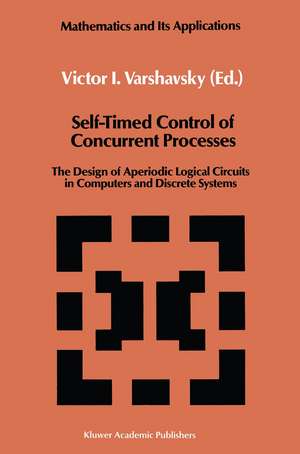
Self-Timed Control of Concurrent Processes: The Design of Aperiodic Logical Circuits in Computers and Discrete Systems: Mathematics and its Applications, cartea 52
Editat de Victor I. Varshavskyen Limba Engleză Paperback – 2 oct 2011
Din seria Mathematics and its Applications
- 15%
 Preț: 449.28 lei
 - 15%
 Preț: 459.33 lei
 - 15%
 Preț: 439.33 lei
 -
 Preț: 464.56 lei
 -
 Preț: 456.44 lei
 -
 Preț: 484.98 lei
 - 15%
 Preț: 466.89 lei
 -
 Preț: 486.67 lei
 - 15%
 Preț: 488.96 lei
 - 15%
 Preț: 538.21 lei
 -
 Preț: 483.27 lei
 - 15%
 Preț: 442.34 lei
 -
 Preț: 491.91 lei
 - 15%
 Preț: 432.33 lei
 -
 Preț: 483.48 lei
 - 15%
 Preț: 675.08 lei
 -
 Preț: 371.00 lei
 - 15%
 Preț: 616.45 lei
 -
 Preț: 372.15 lei
 - 20%
 Preț: 626.38 lei
 -
 Preț: 367.85 lei
 - 15%
 Preț: 625.88 lei
 - 15%
 Preț: 682.56 lei
 -
 Preț: 368.96 lei
 -
 Preț: 366.76 lei
 - 15%
 Preț: 620.38 lei
 - 20%
 Preț: 631.31 lei
 - 20%
 Preț: 649.06 lei
 -
 Preț: 377.68 lei
 - 15%
 Preț: 620.68 lei
 -
 Preț: 369.74 lei
 - 15%
 Preț: 627.93 lei
 - 15%
 Preț: 627.14 lei
 -
 Preț: 372.50 lei
 -
 Preț: 380.09 lei
 -
 Preț: 367.49 lei
 - 15%
 Preț: 675.14 lei
Preț: 626.71 lei
Preț vechi: 783.38 lei
-20%
Puncte Express: 940
Carte tipărită la comandă
Livrare economică 07-21 decembrie
Livrare prin curier în România Termenul estimat este afișat lângă disponibilitate.
Transport gratuit pentru acest produs Plată online sau ramburs, în funcție de opțiunile comenzii.
Retur gratuit în 14 zile Comandă securizată și suport în română.
Specificații
ISBN-13: 9789401067058
ISBN-10: 9401067058
Pagini: 428
Ilustrații: 432 p.
Dimensiuni: 155 x 235 x 22 mm
Greutate: 0.59 kg
Ediția:Softcover reprint of the original 1st ed. 1990
Editura: SPRINGER NETHERLANDS
Colecția Springer
Seria Mathematics and its Applications
Locul publicării:Dordrecht, Netherlands
ISBN-10: 9401067058
Pagini: 428
Ilustrații: 432 p.
Dimensiuni: 155 x 235 x 22 mm
Greutate: 0.59 kg
Ediția:Softcover reprint of the original 1st ed. 1990
Editura: SPRINGER NETHERLANDS
Colecția Springer
Seria Mathematics and its Applications
Locul publicării:Dordrecht, Netherlands
V-ar putea interesa
-
 Maximum Entropy and Bayesian MethodsAli Mohammad-Djafari-20%Preț: 1984.81 lei2481.02 lei
 -
 Cellular AutomataM. Delorme-20%Preț: 1028.87 lei1286.09 lei
 -
 Computer VisionSimon J. D. Prince-20%Preț: 582.72 lei728.39 lei
 -
 Enterprise Content and Search Management for Building Digital PlatformsShailesh Kumar Shivakumar-20%Preț: 528.34 lei660.43 lei
 -
 Visual and Spatial AnalysisJames Schwing-20%Preț: 1994.19 lei2492.74 lei
 -
 Spock: Up and RunningRob Fletcher-20%Preț: 351.55 lei439.44 lei
 -
 Tragic DesignJonathan Shariat-20%Preț: 192.19 lei240.24 lei
 -
 Thoughtful Machine Learning with PythonMatthew Kirk-20%Preț: 258.34 lei322.92 lei
 -
 This is Service Design DoingMarc Stickdorn-20%Preț: 264.28 lei330.35 lei
 -
 Karau, H: High Performance SparkHolden Karau-20%Preț: 242.50 lei303.13 lei
 -
 Practical TableauRyan Sleeper-20%Preț: 319.04 lei398.80 lei
 -
 Course in Mathematical CryptographyGilbert Baumslag-20%Preț: 343.49 lei429.36 lei
 -
 Computer ArchitectureT. R. Lewin-20%Preț: 349.10 lei436.36 lei
 -
 Databases for CardiologyG.T. Meester-5%Preț: 695.99 lei732.62 lei
 -
 Advances in High Performance ComputingLucio Grandinetti-20%Preț: 327.17 lei408.97 lei
 -
 -20%Preț: 318.17 lei397.71 lei
Public țintă
ResearchCuprins
1 Introduction.- 2 Asynchronous processes and their interpretation.- 2.1 Asynchronous processes.- 2.2 Petri nets.- 2.3 Signal graphs.- 2.4 The Muller model.- 2.5 Parallel asynchronous flow charts.- 2.6 Asynchronous state machines.- 2.7 Reference notations.- 3 Self-synchronizing codes.- 3.1 Preliminary definitions.- 3.2 Direct-transition codes.- 3.3 Two-phase codes.- 3.4 Double-rail code.- 3.5 Code with identifier.- 3.6 Optimally balanced code.- 3.7 On the code redundancy.- 3.8 Differential encoding.- 3.9 Reference notations.- 4 Aperiodic circuits.- 4.1 Two-phase implementation of finite state machine.- 4.2 Completion indicators and checkers.- 4.3 Synthesis of combinatorial circuits.- 4.4 Aperiodic flip-flops.- 4.5 Canonical aperiodic implementations of finite state machines.- 4.6 Implementation with multiple phase signals.- 4.7 Implementation with direct transitions.- 4.8 On the definition of an aperiodic state machine.- 4.9 Reference notations.- 5 Circuit modelling of control flow.- 5.1 The modelling of Petri nets.- 5.2 The modelling of parallel asynchronous flow charts.- 5.3 Functional completeness and synthesis of semi-modular circuits.- 5.4 Synthesis of semi-modular circuits in limited bases.- 5.5 Modelling pipeline processes.- 5.6 Reference notations.- 6 Composition of asynchronous processes and circuits.- 6.1 Composition of asynchronous processes.- 6.2 Composition of aperiodic circuits.- 6.3 Algebra of asynchronous circuits.- 6.4 Reference notations.- 7 The matching of asynchronous processes and interface organization.- 7.1 Matched asynchronous processes.- 7.2 Protocol.- 7.3 The matching asynchronous process.- 7.4 The T2 interface.- 7.5 Asynchronous interface organization.- 7.6 Reference notations.- 8 Analysis of asynchronous circuits and processes.- 8.1 The reachability analysis.- 8.2 The classification analysis.- 8.3 The set of operational states.- 8.4 The effect of non-zero wire delays.- 8.5 Circuit Petri nets.- 8.6 On the complexity of analysis algorithms.- 8.7 Reference notations.- 9 Anomalous behaviour of logical circuits and the arbitration problem.- 9.1 Arbiters.- 9.2 Oscillatory anomaly.- 9.3 Meta-stability anomaly.- 9.4 Designing correctly-operating arbiters.- 9.5 “Bounded” arbiters and safe inertial delays.- 9.6 Reference notations.- 10 Fault diagnosis and self-repair in aperiodic circuits.- 10.1 Totally self-checking combinational circuits.- 10.2 Totally self-checking sequential machines.- 10.3 Fault detection in autonomous circuits.- 10.4 Self-repair organization for aperiodic circuits.- 10.5 Reference notations.- 11 Typical examples of aperiodic design modules.- 11.1 The JK-flip-flop.- 11.2 Registers.- 11.3 Pipeline registers.- 11.4 Converting single-rail signals into double-rail ones.- 11.5 Counters.- 11.6 Reference notations.- Editor’s Epilogue.- References.