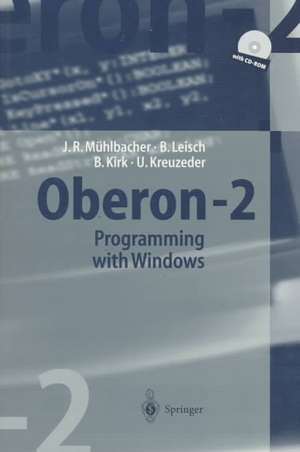
Oberon-2 Programming with Windows
Autor Jörg R. Mühlbacher, Ulrich Kreuzeder, Brian Kirk, Bernhard Leischen Limba Engleză Paperback – 20 iun 1997
Preț: 587.88 lei
Preț vechi: 734.85 lei
-20%
Puncte Express: 882
Carte tipărită la comandă
Livrare economică 27 noiembrie-11 decembrie
Livrare prin curier în România Termenul estimat este afișat lângă disponibilitate.
Transport gratuit pentru acest produs Plată online sau ramburs, în funcție de opțiunile comenzii.
Retur gratuit în 14 zile Comandă securizată și suport în română.
Specificații
ISBN-13: 9783540625223
ISBN-10: 3540625224
Pagini: 384
Ilustrații: IX, 372 p. With CD-ROM.
Dimensiuni: 155 x 235 x 21 mm
Greutate: 0.58 kg
Ediția:1997
Editura: Springer Berlin, Heidelberg
Locul publicării:Berlin, Heidelberg, Germany
ISBN-10: 3540625224
Pagini: 384
Ilustrații: IX, 372 p. With CD-ROM.
Dimensiuni: 155 x 235 x 21 mm
Greutate: 0.58 kg
Ediția:1997
Editura: Springer Berlin, Heidelberg
Locul publicării:Berlin, Heidelberg, Germany
V-ar putea interesa
-
 C Programming LanguageDennis Ritchie-20%Preț: 385.95 lei482.43 lei
 -
 -20%Preț: 588.01 lei735.01 lei
 -
 Programming Language PragmaticsMichael Scott-40%Preț: 488.02 lei808.04 lei
 -
 C ProgrammingK N King-20%Preț: 468.88 lei586.09 lei
 -
![An Introduction to Java Programming and Object-Oriented Application Development [With CD-ROM]: With the Unified Process](https://i1.books-express.ro/bt/9780619217464/an-introduction-to-java-programming-and-object-oriented-application-development-with-cd-rom.jpg) -25%Preț: 900.62 lei1201.94 lei
-25%Preț: 900.62 lei1201.94 lei -
 Windows 11 All-in-One For Dummies, 2nd EditionCiprian Adrian Rusen-20%Preț: 214.39 lei267.99 lei
 -
 Windows 11 for Seniors for Dummies, 2nd EditionCurt Simmons-20%Preț: 118.48 lei148.10 lei
 -
 -20%Preț: 144.32 lei180.41 lei
 -
 BEGINNING C++ THROUGH GAME-3EMichael Dawson-22%Preț: 379.53 lei484.04 lei
 -
 -35%Preț: 241.26 lei371.12 lei
 -
 -35%Preț: 302.79 lei467.40 lei
 -
 System Programming in Linux: A Hands-On IntroductionStewart Weiss-35%Preț: 481.65 lei739.15 lei
 -
 -37%Preț: 186.29 lei295.65 lei
 -
 C++ Programming in Easy StepsMike Mcgrath-20%Preț: 92.33 lei115.41 lei
 -
 Perl Programming in easy stepsMike Mcgrath-20%Preț: 117.32 lei146.64 lei
 -
 Python in Easy StepsMike Mcgrath-20%Preț: 74.68 lei93.35 lei
 -
 Python in Easy StepsMike Mcgrath-20%Preț: 82.04 lei102.55 lei
 -
 Murachs Python ProgrammingJoel Murach-29%Preț: 366.29 lei513.77 lei
 -
 The Python WorkbookBen Stephenson-20%Preț: 409.83 lei512.29 lei
 -
 Object-based Programming with GoChristian Maurer-20%Preț: 248.26 lei310.33 lei
Public țintă
Professional/practitionerCuprins
1. Introduction.- 2. First Steps.- 2.1 Installation of POW!.- 2.2 Operating the system.- 2.3 A first program.- 3. The Working Environment of POW!.- 3.1 Basic ideas.- 3.2 Editor.- 3.3 Project management.- 3.4 Templates.- 3.5 Button bar.- 3.6 Configuration.- 3.7 Working with windows.- 3.8 Tools.- 3.9 On-line help.- 3.10 Menu functions.- 3.11 Typical errors.- 3.12 Advanced topics.- 4. Introduction to Oberon-2.- 4.1 Introduction.- 4.2 Basics of a language.- 4.3 Basic language elements.- 4.4 Oberon-2 programs under POW!.- 4.5 Declarations.- 4.6 Statements.- 4.7 Expressions and assignments.- 4.8 Selection.- 4.9 Repeated execution (Iteration).- 4.10 Structured data types.- 4.11 Procedures.- 4.12 Modules.- 4.13 Pointer types.- 4.14 Recursion.- 4.15 Exercises.- 5. Object-Oriented Programming.- 5.1 Introduction.- 5.2 From abstract data types to classes.- 5.3 Concepts.- 5.4 Design.- 5.5 Application Examples.- 5.6 An object-oriented project.- 5.7 Retrospective and summary.- 5.8 Exercises.- 6. Oberon Portable Applications Library.- 6.1 What is a library?.- 6.2 Overview of the modules.- 6.3 Notes on the Windows implementation.- 6.4 The module ColorPlane.- 6.5 The module Display.- 6.6 The module File.- 6.7 The module Float.- 6.8 The module In.- 6.9 The module Out.- 6.10 The module Param.- 6.11 The module Print.- 6.12 The module Process.- 6.13 The module Strings.- 6.14 The module Utils.- 6.15 The module Volume.- 6.16 The module XYplane.- 7. Programming with the Windows API.- 7.1 Overview.- 7.2 Language extensions.- 7.3 Interfaces to “foreign” DLLs.- 7.4 Basic Windows program.- 7.5 The Mini-resource compiler.- Appendix A: Oberon-2 for Pascal programmers.- A.1 Constants.- A.2 Operators.- A.3 Data types.- A.4 Arrays.- A.5 Strings.- A.6 Open Arrays.- A.7 Pointer types.- A.8 Memorymanagement.- A.9 Compound data types.- A.10 Extensions of record types.- A.11 Procedure types.- A.12 Control structures.- A.13 Procedures.- A.14 Type-bound procedures.- A.15 Modules.- A.16 Export of identifiers.- A.17 Programs in Oberon-2.- A.18 Object-oriented programming.- Appendix B: The Programming Language Oberon-2.- B.1 Introduction.- B.2 Syntax.- B.3 Vocabulary and Representation.- B.4 Declarations and scope rules.- B.5 Constant declarations.- B.6 Type declarations.- B.7 Variable declarations.- B.8 Expressions.- B.9 Statements.- B.10 Procedure declarations.- B.11 Modules.- B.12 Definition of terms.- B.13 Syntax of Oberon-2.- B.14 The module SYSTEM.- B.15 Windows related language extensions.- Appendix C: Table of ASCII Codes.- Literature.
Textul de pe ultima copertă
This book is a detailed introduction to programming in Oberon-2, the object-oriented successor of Pascal. Oberon-2 provides elegant support for programming using a unique blend of structured and object-oriented techniques. The book follows a hands-on approach to teaching based on many examples, starting with basic Oberon-2 language features and gradually increasing in scope to cover the full range of object-oriented programming.
The book is completely self-contained and enables readers to develop native Windows programs. It comes with a multi-media CD-ROM (suitable for Windows 3.1x, Windows 95, and Windows NT 4.0) containing a full Windows-based integrated development environment, all the examples from the book, and a video tutorial to give users an easy start. The included software can be used and distributed freely.
The book is completely self-contained and enables readers to develop native Windows programs. It comes with a multi-media CD-ROM (suitable for Windows 3.1x, Windows 95, and Windows NT 4.0) containing a full Windows-based integrated development environment, all the examples from the book, and a video tutorial to give users an easy start. The included software can be used and distributed freely.