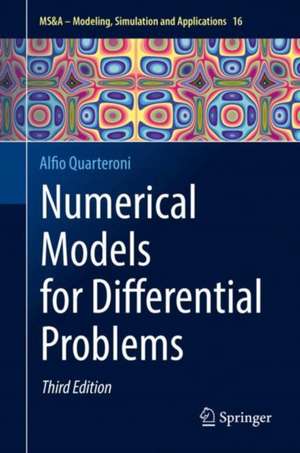
Numerical Models for Differential Problems
Autor Alfio Quarteronien Limba Engleză Hardback – 20 oct 2017
| Toate formatele și edițiile | Preț | Express |
|---|---|---|
| Paperback (1) | 503.01 lei 38-44 zile | |
| Springer – 23 aug 2016 | 503.01 lei 38-44 zile | |
| Hardback (1) | 643.52 lei 43-57 zile | |
| Springer – 20 oct 2017 | 643.52 lei 43-57 zile |
Preț: 643.52 lei
Preț vechi: 757.09 lei
-15%
Puncte Express: 965
Preț estimativ în valută:
113.93€ • 132.66$ • 98.97£
113.93€ • 132.66$ • 98.97£
Carte tipărită la comandă
Livrare economică 23 februarie-09 martie
Preluare comenzi: 021 569.72.76
Specificații
ISBN-13: 9783319493152
ISBN-10: 3319493159
Pagini: 712
Ilustrații: XVII, 692 p. 236 illus., 61 illus. in color.
Dimensiuni: 160 x 241 x 44 mm
Greutate: 1.22 kg
Ediția:Third Edition 2017
Editura: Springer
Locul publicării:Cham, Switzerland
ISBN-10: 3319493159
Pagini: 712
Ilustrații: XVII, 692 p. 236 illus., 61 illus. in color.
Dimensiuni: 160 x 241 x 44 mm
Greutate: 1.22 kg
Ediția:Third Edition 2017
Editura: Springer
Locul publicării:Cham, Switzerland
V-ar putea interesa
-
 -24%Preț: 341.76 lei448.33 lei
 -
 -34%Preț: 763.68 lei1157.59 lei
 -
 Theory and Practice of Finite ElementsAlexandre Ern-18%Preț: 713.59 lei870.23 lei
 -
 An Introduction to Difference EquationsSaber Elaydi-15%Preț: 496.39 lei583.99 lei
 -
 Understanding Nonlinear DynamicsDaniel KaplanPreț: 381.34 lei
 -
 A First Course in Discrete Dynamical SystemsRichard A. Holmgren-15%Preț: 449.98 lei529.39 lei
 -
 A First Course in Finite ElementsJacob Fish-19%Preț: 385.48 lei475.90 lei
 -
 Introduction to Discrete Dynamical Systems and ChaosMario Martelli-9%Preț: 1176.07 lei1292.38 lei
 -
 Reduced Order Methods for Modeling and Computational ReductionAlfio Quarteroni-15%Preț: 626.36 lei736.90 lei
 -
 Stochastic Integration and Differential EquationsPhilip Protter-18%Preț: 709.63 lei865.41 lei
 -
 Numerical Solution of Stochastic Differential EquationsPeter E. Kloeden-18%Preț: 774.25 lei944.21 lei
 -
 -18%Preț: 1347.91 lei1643.79 lei
 -
 Nonlinear Differential Equations and Dynamical SystemsFerdinand VerhulstPreț: 440.93 lei
 -
 Random Dynamical SystemsLudwig Arnold-18%Preț: 771.22 lei940.51 lei
Cuprins
1 A brief survey of partial differential equations.- 2 Elements of functional analysis.- 3 Elliptic equations.- 4 The Galerkin finite element method for elliptic problems.- 5 Parabolic equations.- 6 Generation of 1D and 2D grids.- 7 Algorithms for the solution of linear systems.- 8 Elements of finite element programming.- 9 The finite volume method.- 10 Spectral methods.- 11 Isogeometric analysis.- 12 Discontinuous element methods (D Gandmortar).- 13 Diffusion-transport-reaction equations.- 14 Finite differences for hyperbolic equations.- 15 Finite elements and spectral methods for hyperbolic equations.- 16 Nonlinear hyperbolic problems.- 17 Navier-Stokes equations.- 18 Optimal control of partial differential equations.- 19 Domain decomposition methods.- 20 Reduced basis approximation for parametrized partial differential equations.- References
Notă biografică
The Author is Professor and Director of the Chair of Modelling and Scientific Computing (CMCS) at the Institute of Analysis and Scientific Computing of EPFL, Lausanne (Switzerland), since 1998, Professor of Numerical Analysis at the Politecnico di Milano (Italy) since 1989, and Scientific Director of MOX, since 2002. Author of 22 books published with Springer, and of about 200 papers published in refereed international Journals, Conference Proceedings and Magazines, Alfio Quarteroni is actually one of the strongest and reliable mathematicians in the world in the field of Modelling and SC.
Textul de pe ultima copertă
In this text, we introduce the basic concepts for the numerical modelling of partial differential equations. We consider the classical elliptic, parabolic and hyperbolic linear equations, but also the diffusion, transport, and Navier-Stokes equations, as well as equations representing conservation laws, saddle-point problems and optimal control problems. Furthermore, we provide numerous physical examples which underline such equations. We then analyze numerical solution methods based on finite elements, finite differences, finite volumes, spectral methods and domain decomposition methods, and reduced basis methods. In particular, we discuss the algorithmic and computer implementation aspects and provide a number of easy-to-use programs.
The text does not require any previous advanced mathematical knowledge of partial differential equations: the absolutely essential concepts are reported in a preliminary chapter. It is therefore suitable for students of bachelor and master coursesin scientific disciplines, and recommendable to those researchers in the academic and extra-academic domain who want to approach this interesting branch of applied mathematics.
The text does not require any previous advanced mathematical knowledge of partial differential equations: the absolutely essential concepts are reported in a preliminary chapter. It is therefore suitable for students of bachelor and master coursesin scientific disciplines, and recommendable to those researchers in the academic and extra-academic domain who want to approach this interesting branch of applied mathematics.
Caracteristici
Author faces here the basic concepts for the numerical modeling of partial differential equations An outstanding reference work in this branch of applied mathematics In particular, the author discuss the algorithmic and computer implementation aspects and provide a number of easy-to-use programs