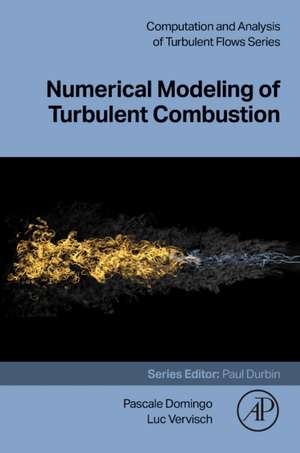
Numerical Modeling of Turbulent Combustion: Computation and Analysis of Turbulent Flows
Editat de Luc Vervisch, Pascale Domingoen Limba Engleză Paperback – 18 iul 2025
- Offers a comprehensive and balanced approach by addressing the problem both theoretically and practically
- Provides a consistent and in-depth exploration of flames and turbulent combustion
- Highlights the most current and crucial applications, with a particular emphasis on fostering a fundamental understanding and emerging technologies


Preț: 1192.28 lei
Preț vechi: 1640.61 lei
-27% Nou
Puncte Express: 1788
Preț estimativ în valută:
210.95€ • 245.76$ • 184.21£
210.95€ • 245.76$ • 184.21£
Carte tipărită la comandă
Livrare economică 12-26 ianuarie 26
Preluare comenzi: 021 569.72.76
Specificații
ISBN-13: 9780443291586
ISBN-10: 0443291586
Pagini: 572
Dimensiuni: 152 x 229 mm
Greutate: 0.91 kg
Editura: ELSEVIER SCIENCE
Seria Computation and Analysis of Turbulent Flows
ISBN-10: 0443291586
Pagini: 572
Dimensiuni: 152 x 229 mm
Greutate: 0.91 kg
Editura: ELSEVIER SCIENCE
Seria Computation and Analysis of Turbulent Flows
Cuprins
1. Aerothermochemistry and scalars dynamics in turbulent flame modeling
2. Fundamental and tools for turbulent combustion modeling
3. Solid fuel combustion modeling
4. Soot modeling and Flame synthesis of nanostructured materials
5. Radiation and heat transfer modeling in combustion
6. Flame front capturing and flame surface density
7. Modeling needs for MILD combustion
8. Flamelet modeling and presumed PDF
9. Conditional Moment Closure
10. PDF transport
11. LBM method for combustion
12. Machine learning for combustion modeling
2. Fundamental and tools for turbulent combustion modeling
3. Solid fuel combustion modeling
4. Soot modeling and Flame synthesis of nanostructured materials
5. Radiation and heat transfer modeling in combustion
6. Flame front capturing and flame surface density
7. Modeling needs for MILD combustion
8. Flamelet modeling and presumed PDF
9. Conditional Moment Closure
10. PDF transport
11. LBM method for combustion
12. Machine learning for combustion modeling