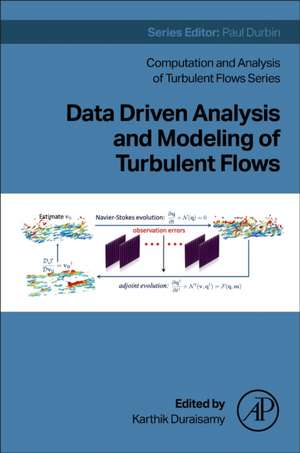
Data Driven Analysis and Modeling of Turbulent Flows: Computation and Analysis of Turbulent Flows
Editat de Karthik Duraisamyen Limba Engleză Paperback – 6 iun 2025
The book is organized into three parts:
- Exploration of techniques for discovering coherent structures within turbulent flows, introducing advanced decomposition methods
- Methods for estimation and control using data assimilation and machine learning approaches
- Finally, novel modeling techniques that combine physical insights with machine learning
- Exploration of techniques for discovering coherent structures within turbulent flows, introducing advanced decomposition methods
- Methods for estimation and control using data assimilation and machine learning approaches
- Finally, novel modeling techniques that combine physical insights with machine learning

Preț: 1093.71 lei
Preț vechi: 1471.37 lei
-26%
Puncte Express: 1641
Carte tipărită la comandă
Livrare economică 30 noiembrie-14 decembrie
Livrare prin curier în România Termenul estimat este afișat lângă disponibilitate.
Transport gratuit pentru acest produs Plată online sau ramburs, în funcție de opțiunile comenzii.
Retur gratuit în 14 zile Comandă securizată și suport în română.
Specificații
ISBN-13: 9780323950435
ISBN-10: 0323950434
Pagini: 414
Dimensiuni: 152 x 229 mm
Greutate: 0.68 kg
Editura: ELSEVIER SCIENCE
Seria Computation and Analysis of Turbulent Flows
ISBN-10: 0323950434
Pagini: 414
Dimensiuni: 152 x 229 mm
Greutate: 0.68 kg
Editura: ELSEVIER SCIENCE
Seria Computation and Analysis of Turbulent Flows
Cuprins
1. Introduction to data-driven modeling
2. Modal Decomposition
3. Resolvent analysis for turbulent flows
4. Data assimilation and flow estimation
5. Data-driven control
6. Constitutive Modeling
7. Parameter estimation and uncertainty quantification
8. Machine Learning Augmented modeling
9. Symbolic regression methods
2. Modal Decomposition
3. Resolvent analysis for turbulent flows
4. Data assimilation and flow estimation
5. Data-driven control
6. Constitutive Modeling
7. Parameter estimation and uncertainty quantification
8. Machine Learning Augmented modeling
9. Symbolic regression methods