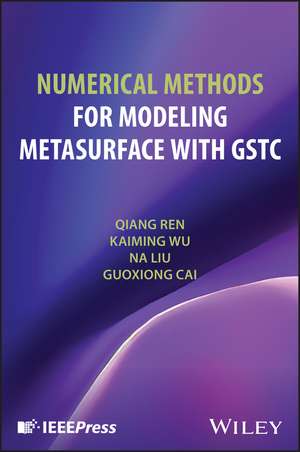
Numerical Methods for Modeling Metasurface with Gstc
Autor Qiang Ren, Kaiming Wu, Na Liu, Guoxiong Caien Limba Engleză Hardback – 22 sep 2026
Numerical Methods for Modeling Metasurface with GSTC provides a systemic and deep monograph of numerical modeling approaches for metasurfaces and thoroughly explores various numerical methods, encompassing not only those in the frequency domain, but also those in the time domain that incorporate generalized sheet transition conditions (GSTCs). It then introduces the mainstream full-wave computational electromagnetic method, including finite-difference frequency-domain method (FDFD), method of moments (MoM), finite element method (FEM), spectral element method (SEM), finite-difference time-domain method (FDTD), and discontinue Galerkin time-domain method (DGTD), and the incorporation of GSTC with these numerical methods. Well-designed examples show that the GSTC equivalence is a quick and accurate tool for metasurface analysis.
Written by a team of highly qualified authors, Numerical Methods for Modeling Metasurface with GSTC also includes information on:
- The basics of metasurfaces, the GSTC technique, and computational electromagnetics methods
- Metasurfaces modeling, covering media homogenization techniques, GSTC theory, and the susceptibility synthesis method
- Methods to simulate steady or transient responses of both planar and curved metasurfaces
Preț: 755.67 lei
Preț vechi: 981.38 lei
-23% Nou
Puncte Express: 1134
Carte disponibilă
Livrare economică 16-30 noiembrie
Livrare prin curier în România Termenul estimat este afișat lângă disponibilitate.
Transport gratuit pentru acest produs Plată online sau ramburs, în funcție de opțiunile comenzii.
Retur gratuit în 14 zile Comandă securizată și suport în română.
Specificații
ISBN-13: 9781394244294
ISBN-10: 1394244290
Pagini: 256
Dimensiuni: 160 x 233 x 19 mm
Greutate: 0.49 kg
Editura: Wiley
Locul publicării:Hoboken, United States
ISBN-10: 1394244290
Pagini: 256
Dimensiuni: 160 x 233 x 19 mm
Greutate: 0.49 kg
Editura: Wiley
Locul publicării:Hoboken, United States
V-ar putea interesa
-
 Elements of ElectromagneticsMatthew Sadiku-23%Preț: 1683.18 lei2188.05 lei
 -
 Waves in MetamaterialsLaszlo Solymar-20%Preț: 493.33 lei616.46 lei
 -
 -27%Preț: 1330.90 lei1813.16 lei
 -
 Preț: 212.84 lei
 -
 Continuum Models and Discrete SystemsFrançois Willot-18%Preț: 1156.23 lei1410.03 lei
 -
 Select Ideas in Partial Differential EquationsPeter J. Costa-15%Preț: 612.08 lei720.09 lei
 -
 Microwave Numerical Solutions¿Tefan Cantaragiu-15%Preț: 667.68 lei785.50 lei
 -
 Advanced Topics in Electric CircuitsZdzislaw Trzaska-18%Preț: 999.63 lei1219.06 lei
 -
 Statistics for ScientistsUmberto Michelucci-20%Preț: 279.62 lei349.53 lei
 -
 Simulation Techniques in Microwave Photonics SystemsRangana Banerjee Chaudhuri-18%Preț: 920.78 lei1122.90 lei
 -
 Antimicrobial Materials and InterfacesEn-Tang Kang-23%Preț: 1511.42 lei1962.88 lei
 -
 Mathematical Modeling and SimulationKai Velten-8%Preț: 628.05 lei682.66 lei
 -
 Field Simulation for Accelerator MagnetsStephan Russenschuck-23%Preț: 2277.91 lei2958.32 lei
 -
 Metaphor: ReFantazio Official Strategy GuideFuture Press-20%Preț: 354.55 lei443.18 lei
 -
 -18%Preț: 2596.07 lei3165.93 lei
 -
 -18%Preț: 1041.85 lei1270.55 lei
 -
 Neural Network Modelling of Microstrip AntennasVenkata A. P. Chavali-18%Preț: 920.35 lei1122.38 lei
 -
 -18%Preț: 985.58 lei1201.93 lei
 -
 -18%Preț: 1153.38 lei1406.56 lei
Cuprins
About the Authors xi
Preface xiii
Acknowledgments xv
1 Introduction 1
1.1 Overview of Metasurfaces 2
1.2 Computational Electromagnetic Methods 5
1.3 Layout of This Book 8
2 Metasurface Modeling 13
2.1 Effective Media Modeling Techniques 13
2.1.1 Asymptotic Analysis of Maxwell's Equations 13
2.1.2 Electromagnetic Material Properties 15
2.1.3 Traditional Boundary Conditions 21
2.2 GSTCs for Metasurfaces 25
2.2.1 A Bit of History 26
2.2.2 Derivation of GSTC 27
2.2.3 Comparison of GSTC and Other Boundary Conditions 34
2.2.4 Analytic Solutions with GSTC 35
2.3 Susceptibility Determination Method 40
2.3.1 Tangential Susceptibilities Determination 40
2.3.2 Normal Susceptibility Determination 44
2.3.3 Transformation from Other Electromagnetic Parameters 45
2.3.4 Examples of Determination 47
2.4 Conclusion 55
3 Frequency-Domain Method for Metasurface Using GSTCs 61
3.1 FDFD Method with GSTCs 62
3.1.1 Introduction of FDFD Method 62
3.1.2 Strategies for Integrating GSTCs in FDFD 66
3.1.3 Simulation Examples 70
3.2 FEM with GSTCs 77
3.2.1 Introduction of FEM 77
3.2.2 Strategies for Integrating GSTCs in FEM 82
3.2.3 Simulation Examples 85
3.3 SEM with GSTCs 95
3.3.1 Introduction of SEM 95
3.3.2 GSTCs Implementation in SEM 100
3.3.3 Simulation Examples 103
3.4 IE Method with GSTCs 108
3.4.1 Introduction of IE Method 108
3.4.2 Strategies for Integrating GSTCs in IE 114
3.4.3 Simulation Examples 122
3.5 Conclusion 134
4 Time-Domain Method for Metasurface Using GSTCs 141
4.1 FDTD Method with GSTCs 142
4.1.1 Introduction of the FDTD Method 142
4.1.2 Dispersive Susceptibility and Parameter Fitting 160
4.1.3 Strategies for Integrating GSTC in FDTD 162
4.1.4 Simulation Examples 179
4.2 DGTD Method with GSTCs 185
4.2.1 Introduction of the DGTD Method 185
4.2.2 Strategies for Integrating GSTCs in DGTD 196
4.2.3 Simulation Examples 213
4.3 Conclusion 218
5 Conclusions and Remarks 225
5.1 Conclusions on the GSTC and Surface Susceptibility Model 225
5.2 Conclusions on Numerical Algorithms 226
5.3 Future Challenges 229
5.3.1 Artificial Intelligence in Susceptibility Retrieval 229
5.3.2 Rationality of the Surface Susceptibilities Model 229
5.3.3 Calculation Rules of Surface Susceptibilities 230
5.3.4 GSTC in the High-Frequency Method 230
References 231
Index 233
Preface xiii
Acknowledgments xv
1 Introduction 1
1.1 Overview of Metasurfaces 2
1.2 Computational Electromagnetic Methods 5
1.3 Layout of This Book 8
2 Metasurface Modeling 13
2.1 Effective Media Modeling Techniques 13
2.1.1 Asymptotic Analysis of Maxwell's Equations 13
2.1.2 Electromagnetic Material Properties 15
2.1.3 Traditional Boundary Conditions 21
2.2 GSTCs for Metasurfaces 25
2.2.1 A Bit of History 26
2.2.2 Derivation of GSTC 27
2.2.3 Comparison of GSTC and Other Boundary Conditions 34
2.2.4 Analytic Solutions with GSTC 35
2.3 Susceptibility Determination Method 40
2.3.1 Tangential Susceptibilities Determination 40
2.3.2 Normal Susceptibility Determination 44
2.3.3 Transformation from Other Electromagnetic Parameters 45
2.3.4 Examples of Determination 47
2.4 Conclusion 55
3 Frequency-Domain Method for Metasurface Using GSTCs 61
3.1 FDFD Method with GSTCs 62
3.1.1 Introduction of FDFD Method 62
3.1.2 Strategies for Integrating GSTCs in FDFD 66
3.1.3 Simulation Examples 70
3.2 FEM with GSTCs 77
3.2.1 Introduction of FEM 77
3.2.2 Strategies for Integrating GSTCs in FEM 82
3.2.3 Simulation Examples 85
3.3 SEM with GSTCs 95
3.3.1 Introduction of SEM 95
3.3.2 GSTCs Implementation in SEM 100
3.3.3 Simulation Examples 103
3.4 IE Method with GSTCs 108
3.4.1 Introduction of IE Method 108
3.4.2 Strategies for Integrating GSTCs in IE 114
3.4.3 Simulation Examples 122
3.5 Conclusion 134
4 Time-Domain Method for Metasurface Using GSTCs 141
4.1 FDTD Method with GSTCs 142
4.1.1 Introduction of the FDTD Method 142
4.1.2 Dispersive Susceptibility and Parameter Fitting 160
4.1.3 Strategies for Integrating GSTC in FDTD 162
4.1.4 Simulation Examples 179
4.2 DGTD Method with GSTCs 185
4.2.1 Introduction of the DGTD Method 185
4.2.2 Strategies for Integrating GSTCs in DGTD 196
4.2.3 Simulation Examples 213
4.3 Conclusion 218
5 Conclusions and Remarks 225
5.1 Conclusions on the GSTC and Surface Susceptibility Model 225
5.2 Conclusions on Numerical Algorithms 226
5.3 Future Challenges 229
5.3.1 Artificial Intelligence in Susceptibility Retrieval 229
5.3.2 Rationality of the Surface Susceptibilities Model 229
5.3.3 Calculation Rules of Surface Susceptibilities 230
5.3.4 GSTC in the High-Frequency Method 230
References 231
Index 233
Notă biografică
Qiang Ren, PhD, is a Blue Sky Full Professor with the School of Electronic and Information Engineering at Beihang University, China. He is a co-author of the Wiley-IEEE Press title Advances in Time-Domain Computational Electromagnetic Methods (Dec 2022).
Kaiming Wu is a Lecturer with the College of Photonic and Electronic Engineering, Fujian Normal University, Fuzhou, China.
Na Liu, PhD, is an Associate Professor with the School of Electronic Science and Engineering (National Model Microelectronics College), Xiamen University, Xiamen, China.
Guoxiong Cai, PhD, is an Associate Professor with the School of Electronic Science and Engineering (National Model Microelectronics College), Xiamen University, Xiamen, China.
Kaiming Wu is a Lecturer with the College of Photonic and Electronic Engineering, Fujian Normal University, Fuzhou, China.
Na Liu, PhD, is an Associate Professor with the School of Electronic Science and Engineering (National Model Microelectronics College), Xiamen University, Xiamen, China.
Guoxiong Cai, PhD, is an Associate Professor with the School of Electronic Science and Engineering (National Model Microelectronics College), Xiamen University, Xiamen, China.