
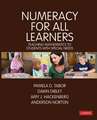
Numeracy for All Learners: Math Recovery
Autor Pamela D Tabor, Dawn Dibley, Amy J. Hackenbergen Limba Engleză Hardback – 21 oct 2020
It builds on the first six books in the Math Recovery series and presents knowledge, resources, and examples for teachers working with students with special needs from Pre-K through secondary school.
Key topics include: dyscalculia, what contemporary neuroscience tells us about mathematical learning, and differentiating assessment and instruction effectively to meet the needs of all students in an equitable framework.






Preț: 808.70 lei
Preț vechi: 929.55 lei
-13%
Carte disponibilă
Livrare economică 16-30 noiembrie
Livrare express 30 octombrie-05 noiembrie pentru 40.57 lei
Specificații
ISBN-10: 1526491966
Pagini: 226
Dimensiuni: 196 x 241 x 17 mm
Greutate: 0.6 kg
Ediția:1
Editura: SAGE Publishing Ltd
Colecția Math Recovery
Seria Math Recovery
Locul publicării:London, United Kingdom
Cuprins
Chapter 2: Professional Principles and Practices
Chapter 3: Good Instruction for All Students
Chapter 4: Numeracy and Functional Mathematics
Chapter 5: Assessing Students with Disabilities
Chapter 6: Using the Learning Framework in Number to Write Individualized Education Programs
Chapter 7: Brain Research: Implications for Teaching and Learning Mathematics
Chapter 8: Dyscalculia
Chapter 9: Differentiating Instruction
Chapter 10: Teaching Students with Disabilities
Chapter 11: The Constructivist as Teacher
Chapter 12: Supporting Students with Other Special Needs
Notă biografică
Dr. Pamela D. Tabor holds a Bachelor of Science degree in elementary education and Bible from Kentucky Christian University, a Master of Arts degree in elementary education from East Tennessee State University, and a Doctor of Philosophy in mathematics education from Southern Cross University. Her supervisor was Robert J. Wright, the developer of Mathematics Recovery. She has recently worked as Research and Evaluation Specialist for the US Math Recovery Council in which she has had the pleasure of working with instructional leaders from districts around the US and internationally to think deeply about the impact of Math Recovery in their school contexts. Previously, she spent nearly two decades as a school-based math specialist, interventionist and instructional coach. In that capacity she worked with administrators, teachers of mathematics, teachers of special education, students, and parents to improve the quality of mathematics instruction in a public elementary school in Maryland. She is also a coauthor of the Math Recovery series book Developing Number Knowledge, a contributor of Teaching Number in the Classroom with 4--8 year Olds, one of the original developers of USMRC's Add+VantageMR Professional Development Courses, and one of the developers of USMRC's Student Numeracy Assessment Progressions (SNAP).