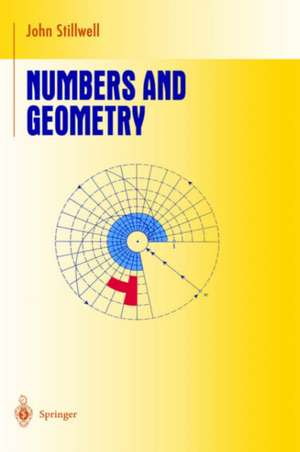
Numbers and Geometry
Autor John Stillwellen Limba Engleză Hardback – 30 oct 1997
Bazându-ne pe resursele bibliografice oferite de editura Springer, reținem că Numbers and Geometry nu este un manual convențional de calcul, ci o sinteză elegantă care unifică ramuri aparent divergente ale matematicii. John Stillwell propune o abordare care pornește de la rădăcinile istorice ale disciplinei, explorând tensiunea conceptuală dintre aritmetică și geometrie — cele două extreme ale gândirii matematice. Ne-a atras atenția modul în care autorul utilizează algebra ca punte de legătură, transformând un conflict istoric într-un instrument de explorare a numerelor reale și a planului euclidian. Structura volumului este riguros organizată în capitole care progresează de la bazele aritmeticii (numere prime, factorizare, inducție) către intuiția geometrică și construcții, culminând cu studiul punctelor raționale pe curbe pătratice. Această succesiune reflectă tranziția de la geometria clasică a lui Euclid către perspectivele moderne, integrând 2000 de ani de evoluție matematică în demonstrații accesibile. Cititorii familiarizați cu Geometry de Roger Fenn vor aprecia Numbers and Geometry pentru accentul pus pe conexiunea organică dintre numere și forme, în timp ce abordarea lui Fenn este mai centrată pe măsurători și rigoare geometrică pură. În contextul operei sale, acest volum se situează între cercetarea fundamentală din The Real Numbers și sinteza istorică din Mathematics and Its History. Dacă în alte lucrări Stillwell se concentrează pe rigoarea analizei sau pe evoluția demonstrației, aici miza este coerența sistemului matematic la nivel universitar incipient. Merită menționat că fiecare secțiune este susținută de exerciții bine calibrate, menite să fixeze conceptele imediat după prezentarea lor teoretică.
Preț: 350.67 lei
Preț vechi: 418.34 lei
-16%
Carte indisponibilă temporar
Specificații
ISBN-10: 0387982892
Pagini: 360
Ilustrații: XIV, 343 p.
Dimensiuni: 160 x 241 x 25 mm
Greutate: 0.65 kg
Ediția:1998
Editura: Springer
Locul publicării:New York, NY, United States
V-ar putea interesa
-
 The Four Pillars of GeometryJohn Stillwell-18%Preț: 268.76 lei328.94 lei
 -
 Naive Lie TheoryJohn StillwellPreț: 337.93 lei
 -
 Elements of Number TheoryJohn Stillwell-19%Preț: 315.34 lei388.46 lei
 -
 Geometry of SurfacesJohn StillwellPreț: 436.50 lei
 -
 Classical Topology and Combinatorial Group TheoryJohn StillwellPreț: 518.06 lei
 -
 O-Minimality and Diophantine GeometryG. O. Jones-11%Preț: 471.44 lei529.70 lei
 -
 An Introduction to Probabilistic Number TheoryEmmanuel KowalskiPreț: 364.11 lei
 -
 Modelling Land-Use ChangeEric Koomen-18%Preț: 1230.52 lei1500.64 lei
 -
 Mathematics and Its HistoryJohn Stillwell-15%Preț: 461.97 lei543.49 lei
 -
 Zeropsis ICharles NamakandoPreț: 105.75 lei
 -
 Numbers for Kids age 1-3 (Engage Early Readers)Dayna MartinPreț: 52.18 lei
 -
 MODULAR FORMS (2ND ED)Kilford Lloyd J P-15%Preț: 465.07 lei547.14 lei
 -
 -15%Preț: 701.12 lei824.85 lei
 -
 A Journey Through The Realm of NumbersMenny AkaPreț: 326.96 lei
 -
 Arakelov Geometry and Diophantine ApplicationsEmmanuel Peyre-15%Preț: 406.62 lei478.37 lei
 -
 Arithmetic and Geometry over Local FieldsBruno AnglèsPreț: 460.54 lei
 -
 Grundbegriffe der elementaren ZahlentheorieGerald WittmannPreț: 123.94 lei
 -
 Modulare ArithmetikThorsten HolmPreț: 123.50 lei
 -
 Planning Support Systems Best Practice and New MethodsStan Geertman-18%Preț: 1235.87 lei1507.16 lei
 -
 Srinivasa RamanujanK. Srinivasa Rao-18%Preț: 736.52 lei898.19 lei
 -
 -18%Preț: 982.39 lei1198.05 lei
 -
 -15%Preț: 455.50 lei535.89 lei
Public țintă
Lower undergraduateDe ce să citești această carte
Recomandăm această carte studenților aflați la început de drum și pasionaților care doresc să înțeleagă matematica dincolo de simple formule. Numbers and Geometry oferă o viziune de ansamblu asupra modului în care algebra unifică geometria și aritmetica. Cititorul câștigă o perspectivă istorică și conceptuală rară, transformând noțiuni abstracte în instrumente de înțelegere a structurii lumii matematice, totul într-un format accesibil de tip hardback.