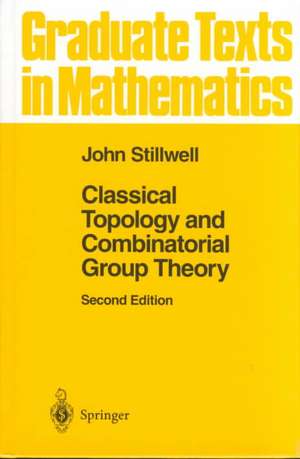
Classical Topology and Combinatorial Group Theory
Autor John Stillwellen Limba Engleză Hardback – 25 mar 1993
Pe același raft cu Topology of Surfaces de L.Christine Kinsey, lucrarea lui John Stillwell se distinge printr-o rezistență asumată față de tendința academică de a transforma topologia într-o simplă anexă a algebrei omologice. În timp ce multe cursuri universitare se pierd în diagrame comutative și spații abstracte, Classical Topology and Combinatorial Group Theory readuce în prim-plan intuiția geometrică și plăcerea vizualizării. Credem că această abordare este esențială pentru a înțelege de ce există nodurile sau cum funcționează banda lui Möbius, dincolo de formalismul arid.
John Stillwell rămâne fidel stilului său exploratoriu, pe care l-am întâlnit și în Mathematics and Its History sau The Story of Proof. Aici, autorul nu doar prezintă teoreme, ci reconstruiește contextul istoric în care topologia a apărut ca soluție la probleme din analiza complexă (Riemann) sau mecanică (Poincaré). Apreciem modul în care volumul este structurat: începe cu fundamentele complexelor simpliciale, trece prin clasificarea suprafețelor și studiul grupurilor libere, culminând cu teoria omologiei și algoritmul lui Dehn. Această progresie reflectă o viziune unitară asupra matematicii, unde topologia și teoria grupurilor se întrepătrund natural.
Textul este scris în limba engleză și se adresează în principal studenților de nivel masterat, însă claritatea expunerii îl face accesibil oricărui matematician care dorește să recupereze fundamentul geometric al disciplinei. Ritmul narativ este susținut de conexiuni profunde între ramuri aparent distincte, demonstrând că rigoarea nu trebuie să excludă frumusețea vizuală.
Preț: 489.23 lei
Carte indisponibilă temporar
Specificații
ISBN-10: 0387979700
Pagini: 352
Ilustrații: XII, 336 p.
Dimensiuni: 160 x 241 x 24 mm
Greutate: 0.69 kg
Ediția:Second Edition 1993
Editura: Springer
Locul publicării:New York, NY, United States
V-ar putea interesa
-
 Undergraduate Topology: A Working TextbookAisling McCluskey-14%Preț: 267.30 lei312.48 lei
 -
 Encyclopedia of Knot TheoryColin Adams-8%Preț: 458.22 lei498.07 lei
 -
 A Topological PicturebookGeorge K. Francis-15%Preț: 469.00 lei551.76 lei
 -
 Computational HomologyTomasz Kaczynski-18%Preț: 847.46 lei1033.49 lei
 -
 Fractals and Universal Spaces in Dimension TheoryStephen LipscombPreț: 377.68 lei
 -
 Elements of Homotopy TheoryGeorge W. Whitehead-18%Preț: 731.17 lei891.67 lei
 -
 General TopologyJ. DixmierPreț: 421.18 lei
 -
 Topological SpacesGerard BuskesPreț: 466.59 lei
 -
 Fractals for the Classroom: Strategic Activities Volume TwoHeinz-Otto PeitgenPreț: 393.48 lei
 -
 Introduction to Large Truncated Toeplitz MatricesAlbrecht Böttcher-15%Preț: 648.34 lei762.75 lei
 -
 Variational Problems in Differential GeometryRoger Bielawski-11%Preț: 411.62 lei462.49 lei
 -
 Introduction to TopologySolomon LefschetzPreț: 372.07 lei
 -
 Computational Topology for Data AnalysisTamal Krishna DeyPreț: 464.09 lei
 -
 Monoidal TopologyDirk Hofmann-14%Preț: 1125.97 lei1309.27 lei
 -
 The Four Pillars of GeometryJohn StillwellPreț: 305.73 lei
 -
 Measure, Topology, and Fractal GeometryGerald EdgarPreț: 372.46 lei
 -
 Naive Lie TheoryJohn StillwellPreț: 387.33 lei
 -
 Papers on Group Theory and TopologyMax Dehn-15%Preț: 511.18 lei601.39 lei
 -
 Lecture Notes on Elementary Topology and GeometryI. M. SingerPreț: 370.46 lei
 -
 Plane Algebraic CurvesEgbert Brieskorn-18%Preț: 752.36 lei917.51 lei
 -
 The Real NumbersJohn StillwellPreț: 316.63 lei
 -
 Planning Support Systems and Smart CitiesStan Geertman-18%Preț: 965.77 lei1177.77 lei
 -
 Planning Support Science for Smarter Urban FuturesStan Geertman-18%Preț: 1238.80 lei1510.73 lei
 -
 -18%Preț: 967.82 lei1180.27 lei
 -
 LECTURE NOTES ON GENERALIZED HEEGAARD SPLITTINGSScharlemann MartinPreț: 407.28 lei
 -
 Introductory Topology: Exercises and SolutionsMOHAMMED HICHEM MORTADPreț: 256.15 lei
 -
 -15%Preț: 549.45 lei646.41 lei
Public țintă
GraduateDe ce să citești această carte
Recomandăm această carte oricărui student sau pasionat de matematică dezamăgit de cursurile de topologie excesiv de abstracte. Veți câștiga o înțelegere profundă a suprafețelor și a grupurilor fundamentale, ghidați de un autor care pune preț pe contextul istoric și pe claritatea geometrică. Este o resursă rară care explică nu doar „cum”, ci și „de ce” au apărut marile idei ale topologiei clasice.