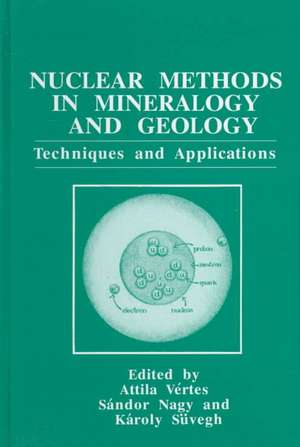
Nuclear Methods in Mineralogy and Geology: Techniques and Applications
Editat de Attila Vértes, Sándor Nagy, Károly Süveghen Limba Engleză Hardback – 29 apr 1998
| Toate formatele și edițiile | Preț | Express |
|---|---|---|
| Paperback (1) | 1185.51 lei 6-8 săpt. | |
| Springer Us – 14 oct 2012 | 1185.51 lei 6-8 săpt. | |
| Hardback (1) | 1192.34 lei 6-8 săpt. | |
| Springer Us – 29 apr 1998 | 1192.34 lei 6-8 săpt. |
Preț: 1192.34 lei
Preț vechi: 1454.07 lei
-18% Nou
Puncte Express: 1789
Preț estimativ în valută:
210.99€ • 247.41$ • 185.29£
210.99€ • 247.41$ • 185.29£
Carte tipărită la comandă
Livrare economică 30 ianuarie-13 februarie 26
Preluare comenzi: 021 569.72.76
Specificații
ISBN-13: 9780306458323
ISBN-10: 0306458322
Pagini: 555
Ilustrații: XIII, 555 p.
Dimensiuni: 170 x 244 x 32 mm
Greutate: 1.1 kg
Ediția:1998
Editura: Springer Us
Colecția Springer
Locul publicării:New York, NY, United States
ISBN-10: 0306458322
Pagini: 555
Ilustrații: XIII, 555 p.
Dimensiuni: 170 x 244 x 32 mm
Greutate: 1.1 kg
Ediția:1998
Editura: Springer Us
Colecția Springer
Locul publicării:New York, NY, United States
V-ar putea interesa
-
 Fundamentals of Fluvial GeomorphologyRo Charlton-15%Preț: 551.91 lei649.32 lei
 -
 Planetary Surface ProcessesH. Jay Melosh-11%Preț: 589.00 lei661.79 lei
 -
 Natural HazardsEdward Bryant-19%Preț: 499.69 lei616.90 lei
 -
 Wind as a Geomorphic Agent in Cold ClimatesMatti Seppälä-14%Preț: 1254.70 lei1458.95 lei
 -
 Rivers and FloodplainsJohn S Bridge-9%Preț: 737.31 lei810.22 lei
 -
 Landslides: Types, Mechanisms and ModelingJohn J. Clague-14%Preț: 1112.44 lei1293.54 lei
 -
 The Geology of the Island of Arran: From Original SurveyAndrew Crombie RamsayPreț: 261.29 lei
 -
 Introduction to Coastal Processes and GeomorphologyGerd Masselink-8%Preț: 552.42 lei600.47 lei
 -
 Tectonic Geomorphology 2eD Burbank-8%Preț: 596.87 lei648.77 lei
 -
 WeatheringMatthew J. Colon-30%Preț: 773.96 lei1112.78 lei
 -
 -24%Preț: 933.59 lei1228.40 lei
 -
 Global Land Ice Measurements from SpaceJeffrey S. Kargel-24%Preț: 1278.93 lei1682.80 lei
Public țintă
ResearchDescriere
This book appears a century after the discovery of radioactivity. It was in 1896, when Henri Becquerel reported his first results about the penetrating radiation, which could darken the packed photographic plates. The initial fascination of radioactivity, e.g., the discovery of new radioactive elements, the first real description of the structure of atoms and their nuclei, the applications of radiotracers, the high sensitivity of activation analysis, etc., was followed by the use of atomic bomb in 1945. The mushroom cloud became a symbol of destructive nuclear power. And even nuclear energy production (which provides about 20% of the world's electricity) is overshadowed by radioactive waste. However, the latest results suggest that the Accelerator-Driven Transmutation Technology (ADTT) will solve this problem, since this technique can decrease the lifetime of the fission products comparatively to the human lifespan. Practical control of fusion may also be possible in the first decades of the next millennium.
Cuprins
Basics of Nuclear Science; S. Nagy. Radioactive Dating Techniques; R. Bowen. Radiometric Methods for Dating Groundwater; E. Hertelendi. Isotopic Paleoclimatology; R. Bowen. Neutron Activation Analysis in Geosciences; G. Keömley. Application of Energy Dispersive X-Ray Fluorescence Analysis (ED-XRFA) in Mineral Analysis; J. Bacsó. Nuclear Magnetic Resonance in Geosciences; K. Tompa. Geological and Mineralogical Applications of Mössbauer Spectroscopy; E. Kuzmann, et al. Positron Annihilation Spectroscopy; A Promising New Tool in Mineral Analysis; K. Süvegh, A. Vértes. Characterization of Minerals Using Ion and Photon Beam Methods; S. Török, et al. Index.