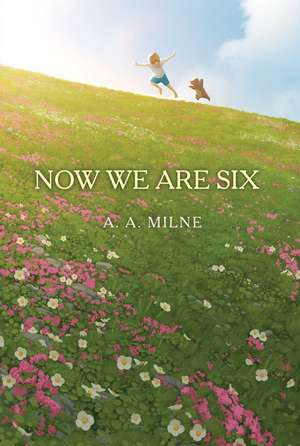
Now We Are Six: The Winnie-the-Pooh Collection
Autor A. A. Milne Ilustrat de Ernest H. Sheparden Limba Engleză Paperback – 12 sep 2024 – vârsta ani
Micii cititori vor experimenta în paginile acestui volum o stare de pură încântare, descoperind lumea prin ochii unui copil pentru care fiecare colț de grădină ascunde o poveste. Now We Are Six nu este doar o culegere de versuri, ci o poartă către universul inocenței, unde rimele jucăușe și umorul blând transformă lectura de seară într-un ritual de conectare. Considerăm că această ediție aduce o prospețime remarcabilă clasicului din 1927, deoarece ilustrațiile iconice ale lui Ernest H. Shepard sunt acum prezentate în culori vibrante, reușind să capteze atenția generațiilor actuale fără a pierde farmecul original.
Remarcăm modul în care A. A. Milne reușește să dea voce gândurilor și micilor dileme ale copilăriei. Copiii care au iubit When We Were Very Young vor găsi aici aceeași magie a versului ritmat, însă într-un context nou, adaptat unei vârste care începe să exploreze independența și curiozitatea de a fi „mare”. Dacă în Winnie-the-Pooh accentul cade pe aventurile narative ale ursulețului, în acest volum poezia devine instrumentul prin care A. A. Milne explorează interioritatea lui Christopher Robin.
Structura volumului, care alternează între momente de introspecție veselă și întâlniri cu Pooh sau Piglet, oferă un ritm liniștitor. Această lucrare completează perfect seria The Winnie-the-Pooh Collection, consolidând moștenirea literară a autorului care a transformat jucăriile fiului său în simboluri universale ale prieteniei. Este o experiență de lectură senzorială, susținută de finisajele premium ale copertei, care invită la o explorare tactilă și vizuală deopotrivă.


Preț: 39.95 lei
Carte disponibilă
Livrare economică 09-23 noiembrie
Livrare express 24-30 octombrie pentru 39.50 lei
Specificații
ISBN-10: 1665947764
Pagini: 128
Ilustrații: f-c soft-touch matte uv cvr w- spot gloss, emboss, foil; b-w interior illustrations
Dimensiuni: 130 x 194 x 10 mm
Greutate: 0.12 kg
Editura: Aladdin
Colecția Aladdin
Seria The Winnie-the-Pooh Collection
V-ar putea interesa
-
 Preț: 190.10 lei
 -
 Preț: 326.11 lei
 -
 Winnie-the-Pooh: The Best Bear in all the WorldBrian SibleyPreț: 79.39 lei
 -
 When We Were Very YoungA. A. MilnePreț: 49.55 lei
 -
 The World of Winnie the PoohA. A. MilnePreț: 193.54 lei
 -
 Pooh's LibraryA. A. MilnePreț: 411.23 lei
 -
 The Complete Tales and Poems of Winnie-The-PoohA. A. MilnePreț: 365.11 lei
 -
 My First Winnie-The-PoohA. A. MilnePreț: 59.86 lei
 -
 Winnie-The-Pooh Classic Edition Gift SetA. A. MilnePreț: 206.95 lei
 -
 Now We Are Sixty: 20th Anniversary EditionChristopher Matthew-27%Preț: 67.95 lei92.90 lei
 -
 Preț: 51.27 lei
 -
 Preț: 254.38 lei
 -
 Winnie-the-Pooh Pocket LibraryA. A. MilnePreț: 52.24 lei
 -
 Winnie-the-PoohA. A. MilnePreț: 41.88 lei
 -
 When We Were Very YoungA. A. MilnePreț: 39.95 lei
 -
 -18%Preț: 290.95 lei353.65 lei
 -
 The Wind in the WillowsKenneth GrahamePreț: 28.01 lei
 -
 All Together NowMichaela MorganPreț: 63.84 lei
 -
 Winnie the PoohA. A. MilnePreț: 42.02 lei
De ce să citești această carte
Recomandăm această carte părinților care doresc să introducă poezia în viața copiilor prin intermediul unor personaje familiare. Este ideală pentru vârsta de 5-7 ani, oferind un suport emoțional pentru tranziția spre școală. Cititorul câștigă o conexiune profundă cu literatura clasică engleză, totul într-un format vizual modernizat care face versurile de acum un secol să pară scrise astăzi.
Despre autor
A. A. Milne (1882–1956) a fost un scriitor și dramaturg britanic de renume, a cărui carieră a fost marcată iremediabil de succesul global al poveștilor despre Winnie-the-Pooh. Deși a fost un autor versatil, scriind piese de teatru și romane pentru adulți, sensibilitatea sa față de universul infantil s-a cristalizat în lucrările dedicate fiului său, Christopher Robin Milne. Experiența sa de viață, trecând prin ambele Războaie Mondiale, pare să fi alimentat dorința de a crea, prin scrierile sale, un spațiu al siguranței și al bunătății. În Now We Are Six, el demonstrează o măiestrie rară în a capta vocea autentică a copilăriei.
Descriere scurtă
Originally published after the novel Winnie-the-Pooh and the verse collection When We Were Very Young, A. A. Milne wrote this classic book of children’s poems about and for his son Christopher Robin when he turned six. With appearances from the beloved Winnie-the-Pooh throughout, these sweet and funny poems tell of playful adventures, the joys and pains of growing up, memorable animal friends, and more.
Notă biografică
Ernest Shepard (1879–1976) was an English painter and book illustrator. Encouraged by his parents to pursue art, he attended the Royal Academy Schools and began his career illustrating for Punch magazine. During the First World War, he aided the Intelligence Department by sketching combat areas, and he was later awarded the Military Cross for his service with the Royal Artillery. In addition to his work as an artist, Shepard wrote two autobiographies and two novels for children. He is best remembered for his anthropomorphic animal illustrations in The Wind and the Willows and the Winnie-the-Pooh series.
Extras
I have a house where I go
When there’s too many people,
I have a house where I go
Where no one can be;
I have a house where I go
Where nobody ever says “No”;
Where no one says anything—so
There is no one but me.
King John’s Christmas
King John was not a good man—
He had his little ways.
And sometimes no one spoke to him
For days and days and days.
And men who came across him,
When walking in the town,
Gave him a supercilious stare,
Or passed with noses in the air—
And bad King John stood dumbly there,
Blushing beneath his crown.
King John was not a good man,
And no good friends had he.
He stayed in every afternoon.…
But no one came to tea.
And, round about December,
The cards upon his shelf
Which wished him lots of Christmas cheer,
And fortune in the coming year,
Were never from his near and dear,
But only from himself.
King John was not a good man.
Yet had his hopes and fears.
They’d given him no present now
For years and years and years.
But every year at Christmas,
While minstrels stood about,
Collecting tribute from the young
For all the songs they might have sung,
He stole away upstairs and hung
A hopeful stocking out.
King John was not a good man.
He lived his life aloof;
Alone he thought a message out
While climbing up the roof.
He wrote it down and propped it
Against the chimney stack:
“TO ALL AND SUNDRY—NEAR AND FAR—
F. CHRISTMAS IN PARTICULAR.”
And signed it not “Johannes R.”
But very humbly, “JACK.”
“I want some crackers,
And I want some candy;
I think a box of chocolates
Would come in handy;
I don’t mind oranges,
I do like nuts!
And I SHOULD like a pocketknife
That really cuts.
And, oh! Father Christmas, if you love me at all,
Bring me a big, red, india rubber ball!”
King John was not a good man—
He wrote this message out,
And got him to his room again,
Descending by the spout.
And all that night he lay there,
A prey to hopes and fears.
“I think that’s him a-coming now.”
(Anxiety bedewed his brow.)
“He’ll bring one present, anyhow—
The first I’ve had for years.”
“Forget about the crackers,
And forget about the candy;
I’m sure a box of chocolates
Would never come in handy;
I don’t like oranges,
I don’t want nuts,
And I HAVE got a pocketknife
That almost cuts.
But, oh! Father Christmas, if you love me at all,
Bring me a big, red, india rubber ball!”
King John was not a good man—
Next morning when the sun
Rose up to tell a waiting world
That Christmas had begun,
And people seized their stockings,
And opened them with glee,
And crackers, toys, and games appeared,
And lips with sticky sweets were smeared,
King John said grimly: “As I feared,
Nothing again for me!”
“I did want crackers,
And I did want candy;
I know a box of chocolates
Would come in handy;
I do love oranges,
I did want nuts.
I haven’t got a pocketknife—
Not one that cuts.
And, oh! If Father Christmas had loved me at all,
He would have brought a big, red, india rubber ball!”
King John stood by the window,
And frowned to see below
The happy bands of boys and girls
All playing in the snow.
A while he stood there watching,
And envying them all…
When through the window, big and red
There hurtled by his royal head,
And bounced and fell upon the bed,
An india rubber ball!
AND, OH, FATHER CHRISTMAS,
MY BLESSINGS ON YOU FALL
FOR BRINGING HIM
A BIG, RED,
INDIA RUBBER
BALL!