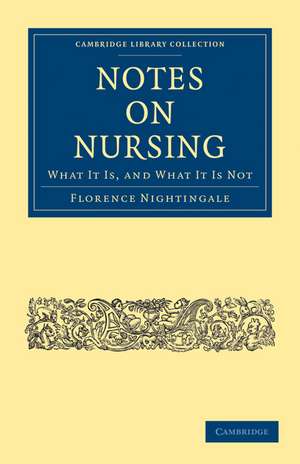
Notes on Nursing
Autor Florence Nightingaleen Limba Engleză Paperback – iul 2010
Preț: 302.52 lei
Puncte Express: 454
Carte tipărită la comandă
Livrare economică 26 noiembrie-10 decembrie
Livrare prin curier în România Termenul estimat este afișat lângă disponibilitate.
Transport gratuit de la 400.00 lei Plată online sau ramburs, în funcție de opțiunile comenzii.
Retur gratuit în 14 zile Comandă securizată și suport în română.
Specificații
ISBN-13: 9781108020619
ISBN-10: 1108020615
Pagini: 246
Dimensiuni: 140 x 216 x 15 mm
Greutate: 0.35 kg
Editura: Cambridge University Press
Locul publicării:Cambridge, United Kingdom
ISBN-10: 1108020615
Pagini: 246
Dimensiuni: 140 x 216 x 15 mm
Greutate: 0.35 kg
Editura: Cambridge University Press
Locul publicării:Cambridge, United Kingdom
V-ar putea interesa
-
 Foundations of Nursing Practice: Themes, Concepts and FrameworksRICHARD HOGSTON-23%Preț: 282.82 lei365.25 lei
 -
 Nursing Theorists and Their WorkMartha Raile Alligood-5%Preț: 615.08 lei647.45 lei
 -
 Nursing Models for Nursing StudentsTeresa Chinn-34%Preț: 185.50 lei278.98 lei
 -
 -25%Preț: 295.36 lei396.23 lei
 -
 Nursing Theorists and Their WorkMartha Raile Alligood-31%Preț: 537.44 lei780.40 lei
 -
 ReflectionsB. A. Nurse EducatorPreț: 55.84 lei
 -
 Notes on Nursing: A Guide for Today's CaregiversLinda Carrier-Walker-29%Preț: 62.60 lei87.60 lei
 -
 Florence Nightingale on Public Health CareLynn Mcdonald-23%Preț: 896.10 lei1163.77 lei
 -
 -23%Preț: 937.07 lei1216.98 lei
 -
 -5%Preț: 455.72 lei479.71 lei
 -
 Fundamentals of Health Promotion for NursesJane Wills-5%Preț: 288.80 lei304.00 lei
 -
 The Woman Who Revolutionised Nurses' TrainingJudith Vallely-5%Preț: 147.49 lei155.24 lei
 -
 -36%Preț: 53.24 lei82.97 lei
 -
 -27%Preț: 66.27 lei91.39 lei
 -
 Nursing Theories and Nursing PracticeMarlaine C. Smith-5%Preț: 585.21 lei616.02 lei
 -
 Notes on HospitalsFlorence NightingalePreț: 70.61 lei
 -
 Brunner & Suddarth's Textbook of Medical-Surgical NursingJANICE L. HINKLE-18%Preț: 664.19 lei813.09 lei
Cuprins
Introductory; 1. Ventilation and warming; 2. Health of houses; 3. Petty management; 4. Noise; 5. Variety; 6. Taking food; 7. What food; 8. Bed and bedding; 9. Light; 10. Cleanliness of rooms and walls; 11. Personal cleanliness; 12. Chattering hopes and advices; 13. Observation of the sick; Conclusion; Supplementary chapter.
Descriere
A basic introduction and must-read for aspiring nurses, written by one of the founders of modern nursing, Florence Nightingale.
Notă biografică
Florence Nightingale /¿nät¿n¿e¿l/, OM, RRC, DStJ (12 May 1820 - 13 August 1910) was a British social reformer and statistician, and the founder of modern nursing. Nightingale came to prominence while serving as a manager and trainer of nurses during the Crimean War, in which she organised care for wounded soldiers.[3] She gave nursing a favourable reputation and became an icon of Victorian culture, especially in the persona of "The Lady with the Lamp" making rounds of wounded soldiers at night.[4][5] Recent commentators have asserted Nightingale's Crimean War achievements were exaggerated by media at the time, but critics agree on the importance of her later work in professionalising nursing roles for women.[6] In 1860, Nightingale laid the foundation of professional nursing with the establishment of her nursing school at St Thomas' Hospital in London. It was the first secular nursing school in the world, and is now part of King's College London. In recognition of her pioneering work in nursing, the Nightingale Pledge taken by new nurses, and the Florence Nightingale Medal, the highest international distinction a nurse can achieve, were named in her honour, and the annual International Nurses Day is celebrated on her birthday. Her social reforms included improving healthcare for all sections of British society, advocating better hunger relief in India, helping to abolish prostitution laws that were harsh for women, and expanding the acceptable forms of female participation in the workforce. Nightingale was a prodigious and versatile writer. In her lifetime, much of her published work was concerned with spreading medical knowledge. Some of her tracts were written in simple English so that they could easily be understood by those with poor literary skills. She was also a pioneer in data visualization with the use of infographics, effectively using graphical presentations of statistical data.[6] Much of her writing, including her extensive work on religion and mysticism, has only been published posthumously.