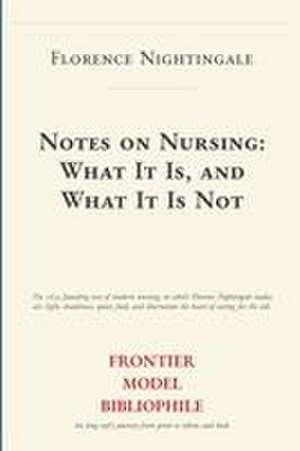
Notes on Nursing
Autor Florence Nightingaleen Limba Engleză Paperback – 18 mai 2027
Preț: 122.54 lei
Preț vechi: 128.99 lei
-5% Precomandă
Puncte Express: 184
Carte nepublicată încă
Livrare prin curier în România Precomanda se expediază când titlul devine disponibil.
Transport gratuit de la 400.00 lei Plată online sau ramburs, în funcție de opțiunile comenzii.
Retur gratuit în 14 zile Comandă securizată și suport în română.
Doresc să fiu notificat când acest titlu va fi disponibil:
Se trimite...
Specificații
ISBN-13: 9798259504110
Pagini: 104
Dimensiuni: 152 x 229 x 6 mm
Greutate: 0.15 kg
Ediția:Frontier Model Bibliophile Source edition
Editura: W. Frederick Zimmerman
Pagini: 104
Dimensiuni: 152 x 229 x 6 mm
Greutate: 0.15 kg
Ediția:Frontier Model Bibliophile Source edition
Editura: W. Frederick Zimmerman
V-ar putea interesa
-
 Foundations of Nursing Practice: Themes, Concepts and FrameworksRICHARD HOGSTON-23%Preț: 282.82 lei365.25 lei
 -
 Nursing Theorists and Their WorkMartha Raile Alligood-5%Preț: 615.08 lei647.45 lei
 -
 Nursing Models for Nursing StudentsTeresa Chinn-34%Preț: 185.50 lei278.98 lei
 -
 -25%Preț: 295.53 lei396.23 lei
 -
 Nursing Theorists and Their WorkMartha Raile Alligood-31%Preț: 537.75 lei780.40 lei
 -
 ReflectionsB. A. Nurse EducatorPreț: 55.84 lei
 -
 Notes on Nursing: A Guide for Today's CaregiversLinda Carrier-Walker-29%Preț: 62.60 lei87.60 lei
 -
 Florence Nightingale on Public Health CareLynn Mcdonald-23%Preț: 896.10 lei1163.77 lei
 -
 -23%Preț: 937.07 lei1216.98 lei
 -
 -5%Preț: 455.72 lei479.71 lei
 -
 Fundamentals of Health Promotion for NursesJane Wills-5%Preț: 288.80 lei304.00 lei
 -
 The Woman Who Revolutionised Nurses' TrainingJudith Vallely-5%Preț: 147.49 lei155.24 lei
 -
 -36%Preț: 53.24 lei82.97 lei
 -
 -27%Preț: 66.27 lei91.39 lei
 -
 Nursing Theories and Nursing PracticeMarlaine C. Smith-5%Preț: 585.21 lei616.02 lei
 -
 Notes on HospitalsFlorence NightingalePreț: 70.61 lei
 -
 Brunner & Suddarth's Textbook of Medical-Surgical NursingJANICE L. HINKLE-18%Preț: 664.19 lei813.09 lei
Notă biografică
Florence Nightingale is the source author of this public-domain nursing and public-health classic.
Descriere
Descriere de la o altă ediție sau format:
Be inspired by the timeless insights of the woman who created the foundations of modern nursing, with Florence Nightingale’s Notes On Nursing , the 160th Anniversary Edition.
Supported by essays from modern-day nurses, this still-relevant work offers concise, on-the-ground experience and breakthrough insights into the crucial elements of patient care. Each chapter brings to life Nightingale’s determination to advance the healthcare system of her time, empowering modern nursing professionals, educators, and students of all levels to establish their own crucial findings and innovations.
Power up your professional commitment by diving into Nightingale’s bravery and groundbreaking vision:
Foundational findings and instruction on the importance of adequate room ventilation, management of the patient’s environment, what it means to be in charge as a nurse, patient observation, nutrition, appropriate lighting, and cleanliness of beds and rooms
Supported by essays from modern-day nurses, this still-relevant work offers concise, on-the-ground experience and breakthrough insights into the crucial elements of patient care. Each chapter brings to life Nightingale’s determination to advance the healthcare system of her time, empowering modern nursing professionals, educators, and students of all levels to establish their own crucial findings and innovations.
Power up your professional commitment by diving into Nightingale’s bravery and groundbreaking vision:
Foundational findings and instruction on the importance of adequate room ventilation, management of the patient’s environment, what it means to be in charge as a nurse, patient observation, nutrition, appropriate lighting, and cleanliness of beds and rooms
- Seasoned guidance and reflections on Nightingale’s writings from experienced nurses, nurse educators, and professional development practitioners, including:
- The palliative care perspective
- Advanced nursing practice and midwifery
- The influence of the nurse on patient emotional state and overall well-being
- Professional identity and inspiration
- A tribute to Notes on Nursing
- Preparing to be a nurse educator
- Issues ranging from bedsores to global health care
- Offers Nightingale’s principles of health —her holistic viewpoint and understanding of how sickroom environment, patient mindset, and patient inner mental/emotional struggles affect health and recovery
- Emphasizes the importance of assisting in patient well-being on all levels of health and well-being
- Perfectly supports the current emphasis on research and evidence-based practice by using data to support arguments for offering compassionate, quality care—illuminates all levels of nursing practice, education, and research
Cuprins
Introductory; 1. Ventilation and warming; 2. Health of houses; 3. Petty management; 4. Noise; 5. Variety; 6. Taking food; 7. What food; 8. Bed and bedding; 9. Light; 10. Cleanliness of rooms and walls; 11. Personal cleanliness; 12. Chattering hopes and advices; 13. Observation of the sick; Conclusion; Supplementary chapter.