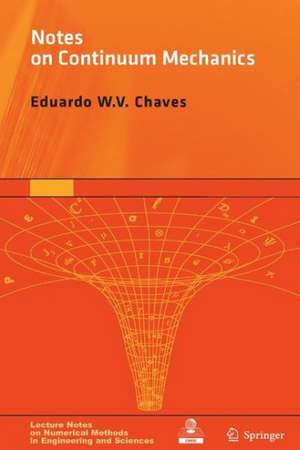
Notes on Continuum Mechanics: Lecture Notes on Numerical Methods in Engineering and Sciences, cartea 4
Autor Eduardo Wv Chavesen Limba Engleză Hardback – 8 mar 2013
Ecosistemul analitic propus în Notes on Continuum Mechanics se fundamentează pe utilizarea versatilă a notațiilor tensoriale, indiciale și Voigt, instrumente matematice esențiale pentru formularea și rezolvarea ecuațiilor cu valori inițiale la limită (IBVP). Apreciem în mod deosebit rigoarea cu care Eduardo WV Chaves transpune conceptele teoretice în modele numerice aplicabile în ingineria modernă, oferind o punte solidă între mecanica teoretică și simularea computațională. Dacă Theory and Practice of Solid Mechanics de Thomas Dawson v-a oferit cadrul teoretic și derivările fundamentale de la primele principii, această carte oferă instrumentele practice și suportul vizual necesar pentru implementarea acestor teorii în contextul metodelor numerice. Structura celor 700 de pagini este organizată progresiv, pornind de la fundamentul matematic al tensorilor și cinematica mediilor continue, către subiecte avansate precum hiperelasticitatea, plasticitatea la deformări mari și mecanica deteriorării (Damage Mechanics). Această progresie reflectă natura sa de suport de curs pentru nivel doctoral, unde complexitatea fenomenelor fizice este dublată de necesitatea unei reprezentări matematice impecabile. Considerăm că includerea celor peste 280 de figuri și a celor 100 de probleme rezolvate transformă un subiect abstract într-un ghid aplicativ. Spre deosebire de alte tratate care se limitează la notația absolută, Notes on Continuum Mechanics pregătește cercetătorul pentru literatura tehnică diversă, permițând tranziția facilă între diferite convenții de scriere matematică. Este o resursă tehnică ce nu evită dificultățile modelării fluidelor sau ale termoelasticității, integrându-le într-un volum unitar publicat de Springer.

Preț: 780.31 lei
Preț vechi: 951.59 lei
-18%
Carte tipărită la comandă
Livrare economică 09-23 decembrie
Specificații
ISBN-10: 9400759851
Pagini: 700
Ilustrații: XXI, 673 p.
Dimensiuni: 160 x 241 x 43 mm
Greutate: 1.15 kg
Ediția:2013
Editura: Springer
Colecția Lecture Notes on Numerical Methods in Engineering and Sciences
Seria Lecture Notes on Numerical Methods in Engineering and Sciences
Locul publicării:Dordrecht, Netherlands
V-ar putea interesa
-
 Fluid MechanicsPijush K. Kundu-31%Preț: 675.59 lei980.75 lei
 -
 Introduction to Mechanics of Solid MaterialsLallit Anand-18%Preț: 443.17 lei542.97 lei
 -
 Introduction to Coupled Theories in Solid MechanicsLallit Anand-21%Preț: 590.73 lei751.97 lei
 -
 BiomechanicsY. C. Fung-5%Preț: 1106.47 lei1164.70 lei
 -
 Concepts and Applications of Finite Element AnalysisRobert D. Cook-18%Preț: 1379.65 lei1682.50 lei
 -
 Mathematical PhysicsDonald H. MenzelPreț: 110.74 lei
 -
 Non-Linear Elastic DeformationsR W OgdenPreț: 159.15 lei
 -
 Statics of Deformable SolidsRaymond L. BisplinghoffPreț: 123.80 lei
 -
 Fluid Mechanics: Volume 4David TongPreț: 250.72 lei
 -
 Applied Mechanics of SolidsAllan F. Bower-14%Preț: 792.43 lei921.43 lei
 -
 Thermomechanics of ViscoplasticityMilan Micunovic-24%Preț: 891.60 lei1173.15 lei
 -
 Foundations of the Theory of Elasticity, Plasticity, and ViscoelasticityEduard Starovoitov-15%Preț: 573.22 lei674.37 lei
 -
 Classical Mechanics with Mathematica®Antonio RomanoPreț: 502.86 lei
 -
 General Physics IMehdi Rahmani-AndebiliPreț: 411.34 lei
 -
 Encyclopedia of Continuum MechanicsHolm Altenbach-18%Preț: 6539.62 lei7975.15 lei
 -
 MechanicsStefan RothPreț: 503.51 lei
 -
 Mechanics of Soft MaterialsKonstantin VolokhPreț: 395.27 lei
 -
 Mechanics of Solid Deformable BodyMichael Zhuravkov-19%Preț: 503.68 lei621.83 lei
 -
 Mechanics of SolidsP. C. Dumir-18%Preț: 799.83 lei975.40 lei
Public țintă
ResearchDe ce să citești această carte
Recomandăm acest volum cercetătorilor și studenților la doctorat care au nevoie de o bază matematică solidă pentru metode numerice. Cititorul câștigă o înțelegere profundă a tensiunilor și deformațiilor prin cele 100 de probleme rezolvate, trecând dincolo de teorie către aplicații în mecanica solidelor și a fluidelor. Este instrumentul ideal pentru a stăpâni notația Voigt și ecuațiile constitutive complexe cerute în simulările moderne de inginerie.
Descriere scurtă
The book is divided into twelve chapters with the following topics: Tensors, Continuum Kinematics, Stress, The Objectivity of Tensors, The Fundamental Equations of Continuum Mechanics, An Introduction to Constitutive Equations, Linear Elasticity, Hyperelasticity, Plasticity (small and large deformations), Thermoelasticity (small and large deformations), Damage Mechanics (small and large deformations), and An Introduction to Fluids. Moreover, the text is supplemented with over 280 figures, over 100 solved problems, and 130 references.
Cuprins
Recenzii
“The book is meant as a textbook for master and doctoral students and researchers. It is based on lecture notes of civil engineering courses of the author given at the University of Castillia-La Mancha (Spain). So the reader can expect a careful and detailed introduction to the subject without too much novelty. … The book is perhaps helpful for those readers who have already a strong background in continuum mechanics and want to find additional information on topics … .” (Albrecht Bertram, zbMATH, Vol. 1277, 2014)