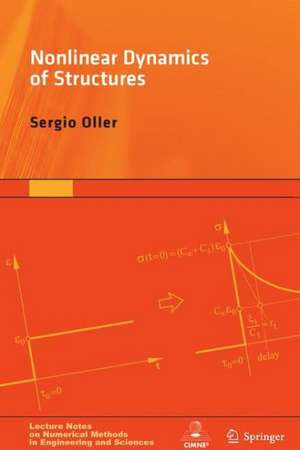
Nonlinear Dynamics of Structures: Lecture Notes on Numerical Methods in Engineering and Sciences
Autor Sergio Olleren Limba Engleză Hardback – 3 iul 2014
Prin parcurgerea lucrării Nonlinear Dynamics of Structures, cititorul va dobândi capacitatea de a implementa algoritmi de calcul pentru analiza fenomenelor neliniare ce apar în dinamica structurală, de la plasticitate și degradare până la evoluția frecvențelor. Observăm o abordare riguroasă care transformă conceptele teoretice de echilibru dinamic în soluții computaționale concrete, esențiale pentru proiectarea structurilor supuse unor solicitări complexe. Pe linia practică a volumului Non-Linear Finite Element Analysis in Structural Mechanics de Wilhelm Rust, dar cu un focus distinct pe fundamentele termodinamice și pe tratarea unitară a materialelor dependente de timp (vâscoelasticitate și vâscoplasticitate), Sergio Oller oferă o punte între mecanica teoretică și programarea algoritmică. Analizând structura cărții, remarcăm o progresie logică: se pornește de la cinematica corpurilor deformabile și legile termodinamicii, stabilind cadrul local Lagrangian pentru disiparea mecanică, pentru ca ulterior să se concentreze pe soluționarea sistemelor de ecuații prin metode implicite și explicite. Credem că secțiunile dedicate metodelor Newmark și Houbolt, completate de tehnici de accelerare a convergenței precum algoritmul Aitken, sunt deosebit de valoroase pentru cercetătorii care dezvoltă propriul software de analiză. Această lucrare continuă direcția începută de autor în Numerical Simulation of Mechanical Behavior of Composite Materials, unde acesta explora formulările neliniare pentru materiale compozite, extinzând acum aria de aplicabilitate către întregul spectru al dinamicii neliniare. Este un instrument tehnic care nu se limitează la descrierea fenomenelor, ci oferă mecanismele matematice necesare pentru simularea lor numerică precisă.

Preț: 416.23 lei
Carte disponibilă
Livrare economică 06-20 noiembrie
Specificații
ISBN-10: 3319051938
Pagini: 204
Ilustrații: XII, 192 p.
Dimensiuni: 215 x 303 x 17 mm
Greutate: 0.73 kg
Ediția:2015
Editura: Springer
Colecția Lecture Notes on Numerical Methods in Engineering and Sciences
Seria Lecture Notes on Numerical Methods in Engineering and Sciences
Locul publicării:Cham, Switzerland
V-ar putea interesa
-
 Williams, D: Structural MechanicsD. Williams-11%Preț: 652.66 lei733.32 lei
 -
 Computational Methods for Plasticity - Theory and ApplicationsDavid R. J. Owen-23%Preț: 961.42 lei1248.59 lei
 -
 Concepts and Applications of Finite Element AnalysisRobert D. Cook-18%Preț: 1345.31 lei1640.62 lei
 -
 Theory of Elastic StabilityStephen P. Timoshenko-22%Preț: 202.43 lei257.93 lei
 -
 Non-Linear Elastic DeformationsR W OgdenPreț: 159.15 lei
 -
 Applied Mechanics of SolidsAllan F. Bower-14%Preț: 792.43 lei921.43 lei
 -
 Thermomechanics of ViscoplasticityMilan Micunovic-24%Preț: 877.70 lei1154.87 lei
 -
 Foundations of the Theory of Elasticity, Plasticity, and ViscoelasticityEduard Starovoitov-15%Preț: 573.22 lei674.37 lei
 -
 Nonlinear Structures and Systems, Volume 1Gaetan Kerschen-18%Preț: 1394.35 lei1700.42 lei
 -
 Nonlinear Structural Dynamics and DampingJuan Carlos Jauregui-24%Preț: 662.03 lei871.08 lei
 -
 Advances in Nonlinear DynamicsWalter Lacarbonara-24%Preț: 1760.50 lei2316.45 lei
 -
 Structural EngineeringAdnan Ibrahimbegovic-19%Preț: 456.85 lei564.01 lei
 -
 Stability and Bifurcation of StructuresAngelo Luongo-15%Preț: 519.78 lei611.50 lei
 -
 Lectures on Nonlinear DynamicsJosé Roberto Castilho Piqueira-18%Preț: 1080.00 lei1317.07 lei
 -
 -18%Preț: 1073.93 lei1309.67 lei
 -
 Preț: 408.21 lei
 -
 Recent Developments in Structural Engineering, Volume 4Manmohan Dass Goel-18%Preț: 1357.69 lei1655.71 lei
 -
 Dynamic Behavior of Soft and Hard Materials, Volume 3R. Velmurugan-18%Preț: 1396.55 lei1703.11 lei
 -
 Recent Developments in Structural Engineering, Volume 1Manmohan Dass Goel-18%Preț: 1361.58 lei1660.47 lei
Public țintă
ResearchDe ce să citești această carte
Recomandăm această carte inginerilor și cercetătorilor care au nevoie de o bază solidă pentru modelarea numerică a structurilor. Veți câștiga o înțelegere profundă a algoritmilor de integrare temporală și a metodelor Newton-Raphson aplicate în contextul neliniarității materialelor. Este un ghid esențial pentru cei care doresc să treacă dincolo de analizele liniare standard și să dezvolte simulări avansate de integritate structurală.
Despre autor
Sergio Oller este un specialist recunoscut în domeniul mecanicii computaționale și al ingineriei structurale. Expertiza sa se concentrează pe dezvoltarea modelelor numerice pentru comportamentul materialelor complexe, cu un accent deosebit pe materialele compozite și fenomenele de degradare (damage mechanics). În lucrările sale, precum Numerical Simulation of Mechanical Behavior of Composite Materials, Oller integrează formulări mecanice originale pentru a rezolva probleme de neliniaritate, contribuind semnificativ la literatura tehnică dedicată metodelor numerice în inginerie.
Cuprins
Notă biografică
He has also been Visiting Professor at the Civil Engineering Laboratory of the National University of Tucumán, Argentina, and at the Department of Civil and Environmental Engineering of the University of California at Berkeley, USA.
Oller teaches “Strength of Materials and Structures”, a course in Civil Engineering, Geologic Engineering and Aeronautical Engineering; “Fracture Mechanics”, a course in Numerical Methods in Engineering, and “Composite Materials” and “Non-linear Dynamics” courses in the Doctoral Program in Structural Engineering.
His research fields include: New Structural Materials, Industrial Casting Processes, Parallel Computing, Constitutive Models, Composites Materials, Fatigue, Earthquake Engineering and Dynamic of Structures.
His research fields include: New Structural Materials, Industrial Casting Processes, Parallel Computing, Constitutive Models, Composites Materials, Fatigue, Earthquake Engineering and Dynamic of Structures.
Textul de pe ultima copertă
This work is intended for graduate engineering students who want to expand their knowledge on the dynamic behavior of structures, specifically in the nonlinear field, by presenting the basis of dynamic balance in non‐linear behavior structures due to the material and kinematics mechanical effects.
Particularly, this publication shows the solution of the equation of dynamic equilibrium for structure with nonlinear time‐independent materials (plasticity, damage and frequencies evolution), as well as those time dependent non‐linear behavior materials (viscoelasticity and viscoplasticity). The convergence conditions for the non‐linear dynamic structure solution are studied, and the theoretical concepts and its programming algorithms are presented.