
Notes from the Underground
Autor Fyodor Dostoevskyen Limba Engleză Paperback – 14 noi 2018
Notes from the Underground is recounted from the perspective of an unnamed narrator who describes himself as sick, spiteful, and unattractive. His thoughts and his moods veer unpredictably as he reflects on the folly of idealism and the reality of human squalor and degradation.
The psychological power of the book is deeply rooted in the conflicts and contradictions that afflict the narrator—many of which seem to have afflicted Dostoevsky himself. Once attracted to idealistic and utopian notions, he subsequently found himself repelled by them. A passionate advocate of freedom, he had little confidence that humans could use freedom for good. The narrator of Notes from the Underground is not a unified self, but a self-contradictory character, like his author. His bewildering complexity and relentless self-analysis make him one of the most memorable and thought-provoking protagonists of modern literature.
This new translation of Notes from the Underground renders Dostoevsky’s famous work in readable and idiomatic contemporary English. As well as the full text of the work itself and an informative introduction, this edition provides background materials that offer personal and intellectual context for the work. These materials (also newly translated) include writings from some of the thinkers against whom Dostoevsky positioned himself; excerpts from Dostoevsky’s personal letters and his earlier published works; and a substantial selection of relevant illustrations and photographs.
Preț: 113.78 lei
Puncte Express: 171
Carte tipărită la comandă
Livrare economică 21-27 mai
Specificații
ISBN-13: 9781731705495
ISBN-10: 1731705492
Pagini: 120
Dimensiuni: 152 x 229 x 7 mm
Greutate: 0.19 kg
Editura: Simon & Brown
ISBN-10: 1731705492
Pagini: 120
Dimensiuni: 152 x 229 x 7 mm
Greutate: 0.19 kg
Editura: Simon & Brown
V-ar putea interesa
-
 White Nights & Other StoriesFyodor DostoyevskyPreț: 69.36 leiNou
 -
 Great Short Works of Fyodor DostoevskyFyodor DostoyevskyPreț: 154.28 lei
 -
 Notes From UndergroundFyodor Dostoevsky-29%Preț: 48.24 lei67.68 lei
 -
 Notes from Underground and the DoubleFyodor DostoyevskyPreț: 77.57 lei
 -
 Fyodor Dostoevsky: A Very Short IntroductionDeborah Martinsen-21%Preț: 53.56 lei67.84 lei
 -
 Fathers and SonsIvan TurgenevPreț: 49.24 lei
 -
 Notes from the Underground, and The GamblerFyodor DostoevskyPreț: 50.07 lei
 -
 -5%Preț: 42.80 lei45.07 lei
 -
 Notes from UndergroundFyodor DostoevskyPreț: 41.13 lei
 -
 Preț: 37.76 lei
 -
 -20%Preț: 21.79 lei27.35 lei
 -
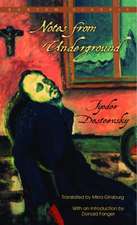 Notes From UndergroundFyodor Dostoevsky-26%Preț: 27.42 lei37.30 lei
 -
 The Brothers KaramazovFyodor DostoyevskyPreț: 50.73 lei
 -
 The IdiotFyodor DostoyevskyPreț: 46.53 lei
 -
 Pelsaert's NightmareGregory Warwick HansenPreț: 185.03 lei
 -
 Notes from Underground and the DoubleFyodor DostoyevskyPreț: 66.74 lei
 -
 The Curse of EveFlora Annie SteelPreț: 152.53 lei
 -
 The Life and Adventures of Martin ChuzzlewitCharles DickensPreț: 314.92 lei
 -
 Notes from UndergroundFyodor DostoyevskyPreț: 49.52 lei
 -
 Revolving DoorsHelen MacphersonPreț: 111.32 lei
 -
 SightingsMaggie FetzerPreț: 99.49 lei
 -
 The River's EndJ. G. JakesPreț: 94.32 lei
 -
 Preț: 192.03 lei
 -
 DevilsFyodor DostoevskyPreț: 39.24 lei
 -
 Crime and PunishmentFyodor DostoevskyPreț: 37.65 lei
 -
 Notes from Underground & Other StoriesFyodor DostoevskyPreț: 39.25 lei
 -
 Nikolai GogolVladimir Nabokov-20%Preț: 54.28 lei68.27 lei
 -
 The IdiotFyodor DostoevskyPreț: 38.21 lei
 -
 White Nights & Notes from the UndergroundFyodor Mikhailovich DostoevskyPreț: 132.62 lei
Recenzii
Notes from the Underground is recounted from the perspective of an unnamed narrator who describes himself as sick, spiteful, and unattractive. His thoughts and his moods veer unpredictably as he reflects on the folly of idealism and the reality of human squalor and degradation.
The psychological power of the book is deeply rooted in the conflicts and contradictions that afflict the narrator—many of which seem to have afflicted Dostoevsky himself. Once attracted to idealistic and utopian notions, he subsequently found himself repelled by them. A passionate advocate of freedom, he had little confidence that humans could use freedom for good. The narrator of Notes from the Underground is not a unified self, but a self-contradictory character, like his author. His bewildering complexity and relentless self-analysis make him one of the most memorable and thought-provoking protagonists of modern literature.
This new translation of Notes from the Underground renders Dostoevsky’s famous work in readable and idiomatic contemporary English. As well as the full text of the work itself and an informative introduction, this edition provides background materials that offer personal and intellectual context for the work. These materials (also newly translated) include writings from some of the thinkers against whom Dostoevsky positioned himself; excerpts from Dostoevsky’s personal letters and his earlier published works; and a substantial selection of relevant illustrations and photographs.
“Kirsten Lodge’s edition of Notes from the Underground is superlative in all respects. It offers an excellent translation, highly readable yet always faithful to the original, as well as essential supplementary materials that make it by far the easiest edition to teach from.” — Michael Wachtel, Princeton University
“Kirsten Lodge offers a marvelous translation of one of Dostoevsky’s most famous and most difficult works. … [T]he translator manages to convey the very pulsation of the paradoxical and painful thoughts of the narrator. … You can feel the changes in his mood, immerse yourself into the depth of his suffering, and instantly grasp those tiny little details which characterize his tragically shrewd style.” — Ilya Vinitsky, University of Pennsylvania
“Kirsten Lodge’s new annotated translation gives a convincing contemporary voice to the Underground Man’s timeless lament.” — Luba Golburt, University of California, Berkeley
“Kirsten Lodge’s important new edition of Dostoevsky’s Notes from Underground offers readers a dazzling collection of contexts, sources, and images for Dostoevsky and his novel, all of which will be indispensable for students and general readers alike. She also has included two classic essays by Mikhailovsky and Rozanov which encapsulate the range in Russia of nineteenth-century responses to Dostoevsky’s literary genius. Her introduction deftly orients the reader to the complex intellectual terrain and the high-stakes political debates in which the Notes have played and continue to play such an important role. ” — Robin Feuer Miller, Brandeis University
“For teachers and students, Lodge surrounds the novel with a wealth of fascinating materials for understanding what was at stake for Dostoevsky and his political opponents. Lodge’s introduction is especially noteworthy, as it provides what may well be the most clearheaded summary of the novel and its polemics as exists in print. Yet beyond this historical context, Dostoevsky also wrote the Notes from the Underground as a literary experiment, one in which he stretched the conventions of the novel to their breaking point so as to engage the present in as direct a manner as possible. … Lodge’s translation admirably succeeds in conveying all the energy and urgency of the original for a new generation of readers. From his first word to the last, she lets the Underground Man speak for himself.” — Jefferson Gatrall, Montclair State University
“Kirsten Lodge honors both the book and its readers with an agile, contemporary translation accompanied by excellent contextual materials… With this generous and thoughtful contextualization, this edition will be especially useful to students and scholars of Russian literature and history… It is this translation’s greatest accomplishment to render The Underground Man’s voice as vivid and sarcastic as it sounds in the original; he insists or—demands—that he be heard, and Lodge’s text maintains the urgency and the stream-of-consciousness flow of his speech.” — Nina Shevchuk-Murray, Slavic and East European Journal
“For years I have taught these classic Russian texts [Tolstoy’s The Death of Ivan Ilyich, Dostoyevsky’s Notes from the Underground, and Zamyatin’s We] to students with little or no knowledge of Russian language or culture. In addition to providing clear, readable translations of the texts themselves, Lodge’s editions provide critical apparatus—introductions, notes, secondary texts, and images—that have made these stories much more accessible to my students. Contextual material that I have long had to put in handouts and powerpoints is now conveniently included in the text itself. These are certainly the most teachable editions of these texts currently available.” — Chad Engbers, Calvin University
The psychological power of the book is deeply rooted in the conflicts and contradictions that afflict the narrator—many of which seem to have afflicted Dostoevsky himself. Once attracted to idealistic and utopian notions, he subsequently found himself repelled by them. A passionate advocate of freedom, he had little confidence that humans could use freedom for good. The narrator of Notes from the Underground is not a unified self, but a self-contradictory character, like his author. His bewildering complexity and relentless self-analysis make him one of the most memorable and thought-provoking protagonists of modern literature.
This new translation of Notes from the Underground renders Dostoevsky’s famous work in readable and idiomatic contemporary English. As well as the full text of the work itself and an informative introduction, this edition provides background materials that offer personal and intellectual context for the work. These materials (also newly translated) include writings from some of the thinkers against whom Dostoevsky positioned himself; excerpts from Dostoevsky’s personal letters and his earlier published works; and a substantial selection of relevant illustrations and photographs.
“Kirsten Lodge’s edition of Notes from the Underground is superlative in all respects. It offers an excellent translation, highly readable yet always faithful to the original, as well as essential supplementary materials that make it by far the easiest edition to teach from.” — Michael Wachtel, Princeton University
“Kirsten Lodge offers a marvelous translation of one of Dostoevsky’s most famous and most difficult works. … [T]he translator manages to convey the very pulsation of the paradoxical and painful thoughts of the narrator. … You can feel the changes in his mood, immerse yourself into the depth of his suffering, and instantly grasp those tiny little details which characterize his tragically shrewd style.” — Ilya Vinitsky, University of Pennsylvania
“Kirsten Lodge’s new annotated translation gives a convincing contemporary voice to the Underground Man’s timeless lament.” — Luba Golburt, University of California, Berkeley
“Kirsten Lodge’s important new edition of Dostoevsky’s Notes from Underground offers readers a dazzling collection of contexts, sources, and images for Dostoevsky and his novel, all of which will be indispensable for students and general readers alike. She also has included two classic essays by Mikhailovsky and Rozanov which encapsulate the range in Russia of nineteenth-century responses to Dostoevsky’s literary genius. Her introduction deftly orients the reader to the complex intellectual terrain and the high-stakes political debates in which the Notes have played and continue to play such an important role. ” — Robin Feuer Miller, Brandeis University
“For teachers and students, Lodge surrounds the novel with a wealth of fascinating materials for understanding what was at stake for Dostoevsky and his political opponents. Lodge’s introduction is especially noteworthy, as it provides what may well be the most clearheaded summary of the novel and its polemics as exists in print. Yet beyond this historical context, Dostoevsky also wrote the Notes from the Underground as a literary experiment, one in which he stretched the conventions of the novel to their breaking point so as to engage the present in as direct a manner as possible. … Lodge’s translation admirably succeeds in conveying all the energy and urgency of the original for a new generation of readers. From his first word to the last, she lets the Underground Man speak for himself.” — Jefferson Gatrall, Montclair State University
“Kirsten Lodge honors both the book and its readers with an agile, contemporary translation accompanied by excellent contextual materials… With this generous and thoughtful contextualization, this edition will be especially useful to students and scholars of Russian literature and history… It is this translation’s greatest accomplishment to render The Underground Man’s voice as vivid and sarcastic as it sounds in the original; he insists or—demands—that he be heard, and Lodge’s text maintains the urgency and the stream-of-consciousness flow of his speech.” — Nina Shevchuk-Murray, Slavic and East European Journal
“For years I have taught these classic Russian texts [Tolstoy’s The Death of Ivan Ilyich, Dostoyevsky’s Notes from the Underground, and Zamyatin’s We] to students with little or no knowledge of Russian language or culture. In addition to providing clear, readable translations of the texts themselves, Lodge’s editions provide critical apparatus—introductions, notes, secondary texts, and images—that have made these stories much more accessible to my students. Contextual material that I have long had to put in handouts and powerpoints is now conveniently included in the text itself. These are certainly the most teachable editions of these texts currently available.” — Chad Engbers, Calvin University
Cuprins
Introduction
Notes from the Underground
In Context
Notes from the Underground
In Context
- Literary Contexts
- from Charles Fourier, “The Scale of Personalities and Temperaments,” The New Industrial and Social World (1829)
- Poems by Nikolai Nekrasov
- [“When with an ardent word”] (1846)
[“When I’m riding along a dark street alone”] (1847)
[“Yesterday around six”] (1848)
from On the Weather (1858–59) - from Nikolai Chernyshevsky, What Is to Be Done? (1863)
- from Chapter 2
from Chapter 4: Vera Pavlovna’s Fourth Dream
- from Chapter 2
- Other Writings by Dostoevsky
- from Notes from the House of the Dead (1860)
from “Baal,” Winter Notes on Summer Impressions (1863)
Selections from Dostoevsky’s Letters to His Brother Mikhail (1859–64) - Critical Reception
- from Nikolai K. Mikhailovsky, “A Cruel Talent” (1883)
from Vasily Rozanov, Dostoevsky and the Legend of the Grand Inquisitor (1891) - Nineteenth-Century Images
Notă biografică
Fyodor Dostoevsky (1821-1881) was a Russian short story writer, essayist, journalist, and one of the greatest novelists in all of world literature. His works are broadly thought to have anticipated Russian symbolism, existentialism, expressionism, and psychoanalysis. He also influenced later writers and philosophers including Anton Chekov, Hermann Hesse, Ernest Hemingway, Friedrich Nietzsche, Sigmund Freud, and Jean-Paul Sartre. His books have been translated into more than one hundred and seventy languages.