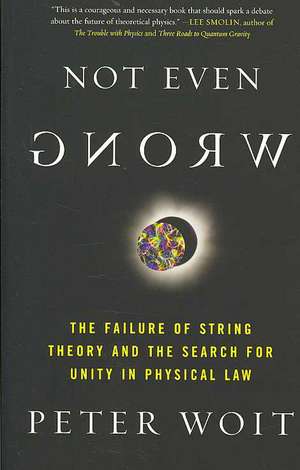
Not Even Wrong: Basic Books
Autor Peter Woiten Limba Engleză Paperback – sep 2007
When does physics depart the realm of testable hypothesis and come to resemble theology? Peter Woit argues that string theory isn't just going in the wrong direction, it's not even science. Not Even Wrong shows that what many physicists call superstring “theory” is not a theory at all. It makes no predictions, not even wrong ones, and this very lack of falsifiability is what has allowed the subject to survive and flourish. Peter Woit explains why the mathematical conditions for progress in physics are entirely absent from superstring theory today, offering the other side of the story.
| Toate formatele și edițiile | Preț | Express |
|---|---|---|
| Paperback (2) | 107.79 lei 3-5 săpt. | +7.62 lei 7-13 zile |
| Vintage Publishing – 7 iun 2007 | 107.79 lei 3-5 săpt. | +7.62 lei 7-13 zile |
| Hachette Book Group – sep 2007 | 173.90 lei 6-8 săpt. |


Preț: 173.90 lei
Nou
Puncte Express: 261
Preț estimativ în valută:
30.77€ • 36.08$ • 27.02£
30.77€ • 36.08$ • 27.02£
Carte tipărită la comandă
Livrare economică 05-19 februarie 26
Preluare comenzi: 021 569.72.76
Specificații
ISBN-13: 9780465092765
ISBN-10: 0465092764
Pagini: 312
Dimensiuni: 139 x 203 x 22 mm
Greutate: 0.27 kg
Ediția:Reprint
Editura: Hachette Book Group
Colecția Basic Books
Seria Basic Books
ISBN-10: 0465092764
Pagini: 312
Dimensiuni: 139 x 203 x 22 mm
Greutate: 0.27 kg
Ediția:Reprint
Editura: Hachette Book Group
Colecția Basic Books
Seria Basic Books
V-ar putea interesa
-
 The Constants Of NatureJohn D. Barrow-38%Preț: 72.51 lei116.54 lei
 -
 Gould, S: Hedgehog, The Fox And The Magister's PoxStephen Jay GouldPreț: 115.65 lei
 -
 Six DegreesDuncan J. WattsPreț: 109.32 lei
 -
 Johnson, G: Ten Most Beautiful ExperimentsGeorge JohnsonPreț: 88.36 lei
 -
 The Richness of Life: A Stephen Jay Gould ReaderStephen Jay Gould-34%Preț: 96.51 lei145.29 lei
 -
 I Have LandedStephen Jay GouldPreț: 117.27 lei
 -
 Sex, Lies, and Brain Scans: How fMRI reveals what really goes on in our mindsBarbara J. Sahakian-13%Preț: 112.11 lei129.29 lei
 -
 -15%Preț: 390.85 lei459.83 lei
 -
 Men, Machines, and Modern Times: Ediție aniversară 50 aniElting E. MorisonPreț: 157.95 lei
 -
 Princeton Field Guide to Prehistoric MammalsDonald R. ProtheroPreț: 228.24 lei
 -
 A is for Arsenic: The Poisons of Agatha ChristieKathryn Harkup-28%Preț: 59.10 lei82.08 lei
 -
 Professor Stewart's Incredible NumbersProfessor Ian Stewart-19%Preț: 67.35 lei83.43 lei
 -
 OriginaliiAdam GrantPreț: 65.00 lei
Notă biografică
Peter Woit is a lecturer in the mathematics department of Columbia University, where in recent years he has taught graduate courses in quantum field theory, representation theory, and differential geometry. His math and physics blog, Not Even Wrong (www.math.columbia.edu/~woit/wordpress), has been featured in Discover, Seed, and New Scientist. He lives in New York.
Descriere
Descriere de la o altă ediție sau format:
Tells a complex story about human beings and their attempts to come to grips with perhaps the most intellectually demanding puzzle there is: how does the world work at the most fundamental level and what is the role of mathematics in its description? It considers what the role of beauty may be in mathematics and physics.
Tells a complex story about human beings and their attempts to come to grips with perhaps the most intellectually demanding puzzle there is: how does the world work at the most fundamental level and what is the role of mathematics in its description? It considers what the role of beauty may be in mathematics and physics.