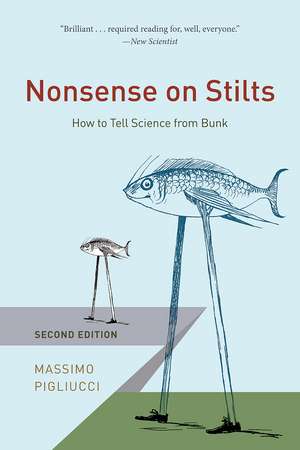
Nonsense on Stilts
Autor Massimo Pigliuccien Limba Engleză Paperback – 5 oct 2018
Considerăm că a doua ediție a lucrării Nonsense on Stilts reprezintă un instrument metodologic esențial pentru formarea unei gândiri critice riguroase, fiind direct relevantă pentru studenții și profesioniștii din domeniul filozofiei, jurnalismului științific și politicilor publice. Într-un context marcat de „fapte alternative”, Massimo Pigliucci propune o analiză tranșantă a modului în care știința este interpretată și, deseori, distorsionată în spațiul public. Autorul extinde cadrul propus în Philosophy of Pseudoscience cu date noi privind mecanismele de finanțare a dezinformării și impactul rețelelor sociale asupra percepției adevărului științific.
Remarcăm structura logică a volumului, care ghidează cititorul de la distincția fundamentală dintre „hard science” și „soft science” până la complexitatea „războaielor științei”. Primele capitole stabilesc fundamentele teoretice ale problemei demarcării, în timp ce secțiunile mediane (capitolele 5 și 6) disecă responsabilitatea media și rolul think tank-urilor în modelarea opiniei publice. Această ediție se distinge prin introducerea epistemologiei virtuții, oferind nu doar o diagnoză a pseudosștiinței, ci și un set de instrumente intelectuale pentru navigarea expertizei. Față de Denying Science de John Grant, care se concentrează pe demontarea miturilor specifice, Pigliucci oferă o perspectivă filozofică mai profundă, integrând evoluția istorică de la filozofia naturală la metoda științifică modernă. Lucrarea se îndepărtează de tonul pur practic al ghidurilor sale anterioare despre stoicism, precum The Stoic Guide to a Happy Life, revenind la rigoarea academică a filozofiei științei, fără a pierde însă claritatea expunerii.
Preț: 207.37 lei
Carte disponibilă
Livrare economică 13-27 noiembrie
Livrare express 30 octombrie-05 noiembrie pentru 29.47 lei
Specificații
ISBN-10: 022649599X
Pagini: 336
Dimensiuni: 152 x 229 x 30 mm
Greutate: 0.45 kg
Ediția:Second Edition
Editura: University of Chicago Press
Colecția University of Chicago Press
V-ar putea interesa
-
 -30%Preț: 1015.59 lei1451.85 lei
 -
 Philosophy of Pseudoscience: Reconsidering the Demarcation ProblemMassimo PigliucciPreț: 338.74 lei
 -
 Chaos and Order: Complex Dynamics in Literature and ScienceN. Katherine HaylesPreț: 258.39 lei
 -
 A Preliminary Discourse on the Study of Natural PhilosophyJohn F. W. HerschelPreț: 371.43 lei
 -
 Reconstructing Scientific Revolutions: Thomas S. Kuhn's Philosophy of SciencePaul Hoyningen-HuenePreț: 335.81 lei
 -
 Complexity: Life at the Edge of ChaosRoger LewinPreț: 214.76 lei
 -
 Preț: 306.56 lei
 -
 Science, Faith and SocietyMichael PolanyiPreț: 194.29 lei
 -
 MeaningMichael PolanyiPreț: 248.11 lei
 -
 Evolution, the Extended SynthesisMassimo PigliucciPreț: 409.98 lei
 -
 Preț: 291.64 lei
 -
 How to Live a Good Life: A Guide to Choosing Your Personal PhilosophyMassimo Pigliucci-19%Preț: 86.79 lei107.04 lei
 -
 Preț: 430.37 lei
 -
 Preț: 484.19 lei
 -
 Preț: 386.28 lei
 -
 Preț: 431.73 lei
 -
 Destined for the Stars: Faith, the Future, and America’s Final FrontierCatherine L. NewellPreț: 328.39 lei
 -
 Science and Moral Imagination: A New Ideal for Values in ScienceMatthew J. BrownPreț: 408.15 lei
 -
 Nature From Within: Gustav Theodor Fechner And His Psychophysical WorldviewMichael HeidelbergerPreț: 466.19 lei
 -
 Denying Evolution: Creationism, Scientism, and the Nature of ScienceMassimo PigliucciPreț: 526.65 lei
 -
 How To Be A StoicMassimo Pigliucci-19%Preț: 98.52 lei121.70 lei
 -
 Live Like A StoicMassimo Pigliucci-19%Preț: 99.49 lei122.29 lei
 -
 Cómo ser un estoicoMassimo PigliucciPreț: 225.95 lei
De ce să citești această carte
Recomandăm această carte oricărui cetățean informat care dorește să înțeleagă de ce supraviețuiesc convingerile iraționale în ciuda dovezilor contrare. Cititorul va câștiga o capacitate sporită de a distinge între expertiza reală și retorica pseudoștiințifică, o abilitate critică în evaluarea dezbaterilor actuale despre schimbări climatice sau sănătate publică. Este o resursă academică solidă ce transformă scepticismul într-o metodă de analiză structurată.
Despre autor
Massimo Pigliucci este profesor de filozofie la City University of New York, deținând doctorate în genetică, biologie evoluționistă și filozofie. Această pregătire interdisciplinară unică îi permite să abordeze filozofia științei dintr-o perspectivă informată practic. Deși în ultimii ani a devenit o figură centrală în popularizarea stoicismului modern prin lucrări precum How To Be A Stoic sau A Handbook for New Stoics, contribuția sa fundamentală rămâne în zona epistemologiei și a criticii pseudoștiinței, fiind unul dintre cei mai vocali apărători ai raționalismului în mediul universitar american.
Descriere scurtă
In this era of fake news and alternative facts, there is more bunk than ever. But why do people believe in it? And what causes them to embrace such pseudoscientific beliefs and practices? In this fully revised second edition, noted skeptic Massimo Pigliucci sets out to separate the fact from the fantasy in an entertaining exploration of the nature of science, the borderlands of fringe science, and—borrowing a famous phrase from philosopher Jeremy Bentham—the nonsense on stilts. Presenting case studies on a number of controversial topics, Pigliucci cuts through the ambiguity surrounding science to look more closely at how science is conducted, how it is disseminated, how it is interpreted, and what it means to our society. The result is in many ways a “taxonomy of bunk” that explores the intersection of science and culture at large.
No one—neither the public intellectuals in the culture wars between defenders and detractors of science nor the believers of pseudoscience themselves—is spared Pigliucci’s incisive analysis in this timely reminder of the need to maintain a line between expertise and assumption. Broad in scope and implication, Nonsense on Stilts is a captivating guide for the intelligent citizen who wishes to make up her own mind while navigating the perilous debates that will shape the future of our planet.
Notă biografică
Cuprins
Chapter 1 Frustrating Conversations
Chapter 2 Hard Science, Soft Science
Chapter 3 Almost Science
Chapter 4 Pseudoscience
Chapter 5 Blame the Media?
Chapter 6 Debates on Science: The Rise of Think Tanks and the Decline of Public Intellectuals
Chapter 7 From Superstition to Natural Philosophy
Chapter 8 From Natural Philosophy to Modern Science
Chapter 9 The Science Wars I: Do We Trust Science Too Much?
Chapter 10 The Science Wars II: Do We Trust Science Too Little?
Chapter 11 The Problem and the (Possible) Cure: Scientism and Virtue Epistemology
Chapter 12 Who’s Your Expert?
Conclusion So, What Is Science after All?
Index