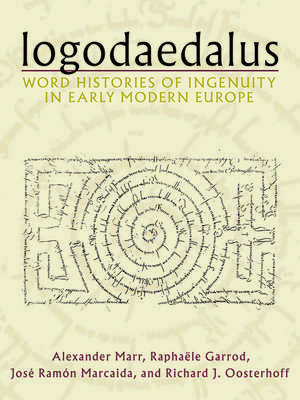
Logodaedalus: Word Histories of Ingenuity in Early Modern Europe
Autor Alexander Marr, Raphaele Garrod, Jose Ramon Marcaida, Richard J. Oosterhoffen Limba Engleză Hardback – 15 ian 2019
Structura lucrării Logodaedalus este fundamentată pe o metodologie riguroasă de lexicografie istorică comparată, urmărind evoluția semantică a conceptului de ingeniozitate în perioada pre-romantică. Autorii organizează materialul prin analiza sistematică a dicționarelor și textelor lexicale publicate între 1470 și 1750, acoperind un spectru lingvistic vast: latină, italiană, spaniolă, franceză, engleză, germană și neerlandeză. Această abordare permite cartografierea modului în care „ingeniozitatea” nu era doar o trăsătură a elitelor, ci un atribut definitoriu al naturii umane, utilizat pentru a clasifica aptitudinile și profesiile în epoca modernă timpurie.
Merită menționat că volumul completează perspectiva oferită de Dictionaries in Early Modern Europe de John Considine. În timp ce Considine se concentrează pe istoria socială și intelectuală a modului în care au fost produse dicționarele, Logodaedalus adaugă o dimensiune analitică specifică, demonstrând cum aceste instrumente lexicale au produs în mod activ sens în domenii precum mecanica, poetica și medicina. Totodată, lucrarea se distinge de The Age of Subtlety de Javier Patiño Loira; dacă acesta din urmă explorează metaforele complicate și retorica în Italia și Spania, volumul de față extinde cadrul geografic și conceptual, ancorând discuția în evoluția filozofiei naturale și a matematicii.
În contextul operei lui Alexander Marr, această lucrare rafinează temele explorate anterior în Ingenuity in the Making. Dacă volumul precedent se concentra pe manipularea materialelor și pe experiența practică, Logodaedalus mută accentul pe infrastructura lingvistică ce a permis teoretizarea acestor practici. Putem afirma că volumul reprezintă o sinteză erudită a modului în care limbajul a modelat înțelegerea talentului uman înainte ca termenul de „geniu” să capete conotațiile moderne de autoritate supraumană.
Preț: 431.73 lei
Carte disponibilă
Livrare economică 10-24 noiembrie
Specificații
ISBN-10: 082294541X
Pagini: 352
Dimensiuni: 140 x 216 x 33 mm
Greutate: 0.63 kg
Ediția:1
Editura: University of Pittsburgh Press
Colecția University of Pittsburgh Press
V-ar putea interesa
-
 Making Mathematical Culture: University and Print in the Circle of Lefèvre d'ÉtaplesRichard J. Oosterhoff-30%Preț: 664.89 lei955.89 lei
 -
 Journey Into the New CosmologyDavid P. JuddPreț: 56.95 lei
 -
 LifeconsciousAdrian Harrison ArvinPreț: 108.17 lei
 -
 The Scientific WorldviewGlenn BorchardtPreț: 149.16 lei
 -
 Beyond the Science/Religion DebateGuido O. PerezPreț: 83.77 lei
 -
 Preț: 472.18 lei
 -
 Human and Animal Cognition in Early Modern Philosophy and MedicineStefanie BuchenauPreț: 466.19 lei
 -
 Destined for the Stars: Faith, the Future, and America’s Final FrontierCatherine L. NewellPreț: 319.03 lei
 -
 The Charm of CreationJoseph KennedyPreț: 83.48 lei
 -
 Symmetry and the End of ProbabilityT. Tran Ph. D.Preț: 101.94 lei
 -
 Extraterrestrials - They Are Here. Now.Stephen H. Mather-LeesPreț: 80.33 lei
 -
 DoomsdayJ. D. FenrirPreț: 50.45 lei
 -
 Engenharia Genetica, Bioetica E ReligiaoDra Virginia MarecoPreț: 34.22 lei
 -
 The Evolution of Mister Newman IIM. H. BaslowPreț: 75.54 lei
 -
 Climate for the LaymanAnthony Bright-PaulPreț: 130.08 lei
 -
 Creating a Pagan TheocracyJefferson WhitePreț: 34.07 lei
 -
 Science Without BoundsArthur J. D'AdamoPreț: 126.86 lei
 -
 Beyond Intelligent DesignEfthimios HarokoposPreț: 91.11 lei
 -
 Preț: 189.90 lei
 -
 Reality, Science and the SupernaturalBrain, JohnPreț: 59.48 lei
 -
 Preț: 106.15 lei
De ce să citești această carte
Recomandăm această carte cercetătorilor și studenților interesați de istoria ideilor și de filozofia științei. Cititorul va câștiga o înțelegere profundă a modului în care termenii pe care îi folosim astăzi pentru a descrie creativitatea au fost forjați în dicționarele Europei moderne timpurii. Este o resursă esențială pentru a descifra tranziția de la „ingeniozitatea” ca natură înnăscută la conceptul modern de geniu.
Despre autor
Alexander Marr este un istoric al artei și al științei, recunoscut pentru cercetările sale asupra culturii intelectuale din perioada modernă timpurie. Opera sa, care include titluri precum Rubens’s Spirit și Curiosity and Wonder from the Renaissance to the Enlightenment, investighează intersecția dintre creativitatea artistică, curiozitatea științifică și epistemologie. Marr colaborează frecvent cu specialiști precum Raphaele Garrod, Jose Ramon Marcaida și Richard J. Oosterhoff, formând o echipă interdisciplinară ce reexaminează fundamentele gândirii europene prin prisma culturii materiale și a istoriei limbajului.
Descriere scurtă
Recenzii
“The careful discussions of dictionaries and the like within diverse linguistic contexts in early modern Europe make this book an important contribution to the burgeoning field of the history of information, as well as to the history of ingenuity itself.” —Isis
“Intertwining the literature, debates, and histories of a spread of European languages is a considerable asset to modern transnational scholarship, in the process re-opening our eyes to how such a crucial concept as genius is its own site of invention. I heartily recommend this book to anyone interested in models of intellectual exchange in the early modern period, lexicographical history, and pre-Romantic notions of ingenuity.”
—Renaissance Studies
“Logodaedalus is a book no student of early modern cultural history will have an excuse to miss . . . it succeeds in guiding us confidently through an incredibly broad and intricate panorama of early modern thought.” —Renaissance Quarterly
“It is a tour de force in comparative historical lexicography that lays bare the full extent of ingenuity's linguistic territory and the complexity of the dynamic vectors traversing it.” —Centaurus
Notă biografică
Raphaële Garrod is associate professor in early modern French at the University of Oxford and a fellow of Magdalen College. She is the author of Cosmographical Novelties: Dialectic and Discovery in French Renaissance Prose.
José Ramón Marcaida is Lecturer in Art History at the University of St Andrews. He is the author of Arte y ciencia en el Barroco español. Historia natural, coleccionismo y cultura visual.
Richard J. Oosterhoff is Lecturer in Early Modern History at the University of Edinburgh. His first book is Making Mathematical Culture: University and Print in the Circle of Lefèvre d’Étaples.