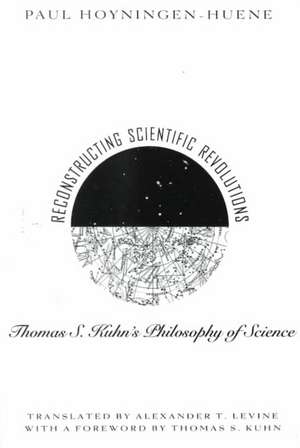
Reconstructing Scientific Revolutions: Thomas S. Kuhn's Philosophy of Science
Autor Paul Hoyningen-Huene Traducere de Alex Levineen Limba Engleză Paperback – 15 mai 1993
Considerăm că Reconstructing Scientific Revolutions reprezintă un reper fundamental pentru înțelegerea unuia dintre cei mai influenți filosofi ai științei din secolul XX. Autorul, Paul Hoyningen-Huene, director al Centrului pentru Filosofia și Etica Științei de la Universitatea din Hanovra, aduce o autoritate incontestabilă acestui demers, lucrarea fiind rezultatul unei lecturi enciclopedice și al unor consultări directe cu Thomas Kuhn însuși. Această proximitate față de sursă îi permite lui Hoyningen-Huene să depășească interpretările adesea trunchiate ale altor discipline și să ofere o reconstrucție riguroasă a evoluției gândirii kuhniene pe parcursul a patru decenii.
Putem afirma că volumul completează perspectiva oferită de Thomas Kuhn de Alexander Bird, adăugând o analiză mult mai tehnică și ancorată în istoriografia științei, dincolo de o simplă introducere biografică. În contextul operei sale, această lucrare anticipează preocuparea lui Hoyningen-Huene pentru rigoarea epistemologică pe care o va dezvolta ulterior în Systematicity, unde definește cunoașterea științifică prin caracterul său sistematic.
Structura cărții ghidează cititorul de la fundamentele istoriografice către cele mai complexe ramificații metafizice. Prima parte reconstruiește tranziția de la vechea la noua istoriografie internă a științei, oferind contextul necesar pentru a înțelege de ce Kuhn a simțit nevoia unei rupturi de modelul tradițional. A doua parte plonjează în ontologia lui Kuhn, explorând distincția dintre „lumea în sine” și „lumea fenomenală”. Este un parcurs dens, dar esențial pentru a înțelege de ce cercetătorii aflați de părți opuse ale unei revoluții științifice ajung să lucreze, în mod efectiv, în „lumi diferite”.
Preț: 335.81 lei
Carte tipărită la comandă
Livrare economică 28 noiembrie-12 decembrie
Specificații
ISBN-10: 0226355519
Pagini: 330
Ilustrații: black & white illustrations
Dimensiuni: 152 x 229 x 23 mm
Greutate: 0.46 kg
Ediția:1
Editura: University of Chicago Press
Colecția University of Chicago Press
V-ar putea interesa
-
 The Metaphysics of Quantum TheoryHenry Krips-22%Preț: 143.56 lei183.18 lei
 -
 -35%Preț: 441.66 lei682.78 lei
 -
 Preț: 104.83 lei
 -
 Preț: 402.50 lei
 -
 Counterfactuals and Scientific RealismMichael J ShafferPreț: 390.09 lei
 -
 Scientific Enquiry and Natural KindsP. MagnusPreț: 390.09 lei
 -
 What is This Thing Called Science?Alan Chalmers-27%Preț: 199.81 lei273.20 lei
 -
 Science Set FreeRupert SheldrakePreț: 103.51 lei
 -
 -13%Preț: 100.49 lei115.43 lei
 -
 The Singular Universe and the Reality of TimeRoberto Mangabeira UngerPreț: 391.67 lei
 -
 The Two CulturesC. P. SnowPreț: 115.40 lei
 -
 On Space and TimeShahn MajidPreț: 173.68 lei
 -
 -19%Preț: 428.60 lei529.14 lei
 -
 Naturalism and PragmatismJay SchulkinPreț: 407.21 lei
 -
 NewtonAndrew JaniakPreț: 147.40 lei
 -
 Preț: 97.04 lei
 -
 Genes, Cells, and BrainsHilary RosePreț: 103.84 lei
De ce să citești această carte
Recomandăm această carte cercetătorilor și studenților la filosofie care doresc să depășească clișeele despre „paradigm shift”. Cititorul câștigă o înțelegere profundă a modului în care istoria științei fundamentează teoria filosofică. Este un instrument critic indispensabil pentru a naviga între tradiția analitică și cea continentală, oferind o clarificare definitivă asupra conceptelor de incommensurabilitate și schimbare de lume.
Despre autor
Paul Hoyningen-Huene este un distins filosof al științei, ocupând funcția de director al Centrului pentru Filosofia și Etica Științei din cadrul Universității din Hanovra, Germania. Expertiza sa este recunoscută la nivel internațional, fiind unul dintre puținii specialiști care au colaborat direct cu Thomas Kuhn pentru a-i sistematiza gândirea. Opera sa se concentrează pe natura cunoașterii științifice și pe mecanismele schimbării teoretice, fiind autorul unor volume de referință precum Systematicity, unde explorează ce anume diferențiază știința de cunoașterea cotidiană.
Descriere scurtă
Scholars from disciplines as diverse as political science and art history have offered widely differing interpretations of Kuhn's ideas, appropriating his notions of paradigm shifts and revolutions to fit their own theories, however imperfectly. Hoyningen-Huene does not merely offer another interpretation—he brings Kuhn's work into focus with rigorous philosophical analysis. Through extended discussions with Kuhn and an encyclopedic reading of his work, Hoyningen-Huene looks at the problems and justifications of his claims and determines how his theories might be expanded. Most significantly, he discovers that The Structure of Scientific Revolutions can be understood only with reference to the historiographic foundation of Kuhn's philosophy.
Discussing the concepts of paradigms, paradigm shifts, normal science, and scientific revolutions, Hoyningen-Huene traces their evolution to Kuhn's experience as a historian of contemporary science. From here, Hoyningen-Huene examines Kuhn's well-known thesis that scientists on opposite sides of a revolutionary divide "work in different worlds," explaining Kuhn's notion of a world-change during a scientific revolution. He even considers Kuhn's most controversial claims—his attack on the distinction between the contexts of discovery and justification and his notion of incommensurability—addressing both criticisms and defenses of these ideas.
Destined to become the authoritative philosophical study of Kuhn's work, Reconstructing Scientific Revolutions both enriches our understanding of Kuhn and provides powerful interpretive tools for bridging Continental and Anglo-American philosophical traditions.
Cuprins
Foreword
Preface
Part I - Introduction
Chapter One - The Topic of Kuhn's Philosophy of Science
1.1. The Issue: Scientific Development
a. The Total Domain of Science
b. Permissible Units of Analysis within the Domain of Science
1.2. The Construction of the Target Issue: The Historiography of Science
a. The Old Internal Historiography of Science
b. The Critique of the Old Internal Historiography of Science
c. The New Internal Historiography of Science
Summary of Part I
Part II - Scientific Knowledge and Its Object
Chapter Two - The World Concept
2.1. The Double Meaning of "World" and "Nature" in SSR and the Plurality-of-Phenomenal-Worlds Thesis
a. World-in-Itself and Phenomenal World in SSR
b. The Plurality-of-Phenomenal-Worlds Thesis and Its Justification
2.2. Stimulus and Sensation in the 1969 Papers
a. The Transition from SSR
c. Contributions Credited to the Stimulus Ontology
d. Troubles with the Stimulus Ontology
e. The Modified Stimulus Ontology
Chapter Three - The Constitution of a Phenomenal World
3.1. The Learning Process
3.2. Similarity Relations
3.3. Ostension
3.4. Social Community
3.5. Perception
3.6. Empirical Concepts
a. Preliminary Remarks
b. Concept Learning without Use of Laws or Theories in Kuhn's Work up to 1969
c. Concept Learning without Use of Laws or Theories in Kuhn's Work after 1969
d. The Relationship between Earlier and Later Conceptions of Concept Learning without Use of Laws or Theories
e. Concept Learning with the Help of Laws and Theories
f. The Impossibility of Explicitly Defining Empirical Concepts
g. Consequences for the Theory of Meaning as Applied to Empirical Concepts
3.7. Knowledge of Nature
a. The Content of Such Knowledge
b. The Characteristics of Such Knowledge
3.8. The Nonneutrality of the Analyst's Viewpoint
Chapter Four - The Paradigm Concept
4.1. Reasons for Introducting the Original Paradigm Concept
4.2. The Development of the Paradigm Concept
a. From "Paradigm" to "Disciplinary Matrix"
4.3. The Disciplinary Matrix
a. Symbolic Generalizations
b. Models
c. Values
d. Exemplary Problem Solutions
e. The Relationship between "Components" of the Disciplinary Matrix
4.4. The Functions of Paradigms in the Sense of Exemplary Problem Solutions
a. The Lexicon of Empirical Concepts
b. The Identification of Research Problems
c. The Acceptability of Solutions to Research Problems
Summary of Part II
Part III - The Dynamic of Scientific Knowledge
Chapter Five - Normal Science
5.1. Normal Science: Provisional Characterization
5.2. Analogies to Puzzle-solving
a. The Existence of Regulations
b. Expectations of Solubility
d. Neither Test nor Confirmation
5.3. The Research Problems of Normal Science
5.4. Progress in Normal Science
5.5. What Makes Normal Science Possible?
a. Training Preparatory for Practicing Normal Science
b. The Emergence of Normal Science out of Prenormal Science
5.6. The Functional Role of the Quasi-dogmatic Element of Normal Science
Chapter Six - The Concept of a Scientific Revolution
6.1. Kuhn's Extension of the Concept of a Scientific Revolution
6.2. Change of World
6.3. Incommensurability
a. The Introduction of the Incommensurability Concept in SSR
e. The Second Misunderstanding: Incommensurability Implies Discontinuity
Chapter Seven - The Dynamic of Scientific Revolutions
7.1. The Dialectic of Normal Science: The Production of Significant Anomalies
7.2. Unexpected Discoveries
7.3. The Triggering of Revolutions in Theory
a. Anomalies and Crisis
b. Research in Times of Crisis: Extraordinary Science
7.4. Theory Comparison and Theory Choice
a. Theory Comparison, Not Theory Falsification
b. The Reasons behind Theory Choice
c. Context of Discovery and Context of Justification
7.5. The Discourse of Theory Choice
a. Persuasion
b. Circularity
d. Translation
e. Conversion, Not Choice
7.6. Scientific Progress through Revolutions
a. Scientific Progress as Increasing Problem-solving Capacity
c. Second Qualification: The Devaluation of the Loser's Perspective
d. Third Qualification: No "Drawing Closer to the Truth"
Summary of Part III
Epilogue: Reality as Understood by Kuhn's Philosophy of Science
Bibliography
Works of Thomas S. Kuhn
Secondary Literature
Additional Works of Thomas S. Kuhn
Index