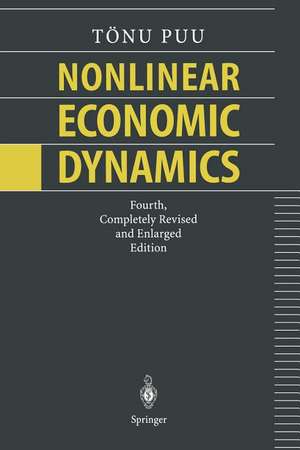
Nonlinear Economic Dynamics
Autor Tönu Puuen Limba Engleză Paperback – 23 sep 2011
Preț: 373.81 lei
Puncte Express: 561
Carte tipărită la comandă
Livrare economică 26 noiembrie-10 decembrie
Livrare prin curier în România Termenul estimat este afișat lângă disponibilitate.
Transport gratuit de la 400.00 lei Plată online sau ramburs, în funcție de opțiunile comenzii.
Retur gratuit în 14 zile Comandă securizată și suport în română.
Specificații
ISBN-13: 9783642645495
ISBN-10: 3642645496
Pagini: 304
Ilustrații: X, 288 p.
Dimensiuni: 155 x 235 x 17 mm
Greutate: 0.46 kg
Ediția:Fourth Edition 1997
Editura: Springer
Locul publicării:Berlin, Heidelberg, Germany
ISBN-10: 3642645496
Pagini: 304
Ilustrații: X, 288 p.
Dimensiuni: 155 x 235 x 17 mm
Greutate: 0.46 kg
Ediția:Fourth Edition 1997
Editura: Springer
Locul publicării:Berlin, Heidelberg, Germany
V-ar putea interesa
-
 -28%Preț: 359.82 lei501.32 lei
 -
 The Fatal Conceit: The Errors of SocialismF.A. HayekPreț: 144.02 lei
 -
 The Money GameAdam SmithPreț: 88.58 lei
 -
 A First Course in Optimization TheoryRangarajan K. SundaramPreț: 501.93 lei
 -
 Economic Theory in RetrospectMark Blaug-23%Preț: 780.16 lei1013.20 lei
 -
 The Cambridge Companion to HayekEdward FeserPreț: 267.11 lei
 -
 Multinational Enterprise 3edRichard E. CavesPreț: 376.27 lei
 -
 -23%Preț: 583.04 lei757.19 lei
 -
 Recursive Models of Dynamic Linear EconomiesLars Peter HansenPreț: 469.04 lei
 -
 Learning and Expectations in MacroeconomicsGeorge W. Evans-19%Preț: 625.49 lei772.20 lei
 -
 The Theory of IncentivesJean-Jacques LaffontPreț: 426.27 lei
 -
 Advances in Behavioral EconomicsColin F. Camerer-19%Preț: 578.39 lei714.06 lei
 -
 PareconMichael AlbertPreț: 123.08 lei
 -
 The Reformation in EconomicsPhilip PilkingtonPreț: 359.55 lei
 -
 Handbook of New Institutional EconomicsClaude Ménard-18%Preț: 728.59 lei888.52 lei
 -
 Economic DynamicsGiancarlo Gandolfo-18%Preț: 977.31 lei1191.84 lei
Public țintă
ResearchCuprins
1 Introduction.- 1.1 Dynamics Versus Equilibrium Analysis.- 1.2 Linear Versus Nonlinear Modelling.- 1.3 Perturbation Methods.- 1.4 Structural Stability.- 1.5 Chaos and Fractals.- 1.6 The Choice of Topics Included.- 2 Differential Equations.- 2.1 The Phase Portrait.- 2.2 Linear Systems.- 2.3 Structural Stability.- 2.4 Limit Cycles.- 2.5 The Hopf Bifurcation.- 2.5 The Saddle-Node Bifurcation.- 2.7 Perturbation Methods: Poincaré-Lindstedt.- 2.8 Perturbation Methods: Two-Timing.- 2.9 Forced Oscillators: van der Pol.- 2.10 Forced Oscillators: Duffing.- 2.11 Chaos.- 2.12 A Short History of Chaos.- 3 Iterated Maps.- 3.1 Introduction.- 3.2 The Logistic Map.- 3.3 The Lyapunov Exponent.- 3.4 Symbolic Dynamics.- 3.5 Sarkovskii’s Theorem and the Schwarzian Derivative.- 3.6 The Hénon Model.- 3.7 Lyapunov Exponents in 2D.- 3.8 Fractals and Fractal Dimension.- 3.9 The Mandelbrot Set.- 4 Monopoly.- 4.1 Introduction.- 4.2 The Model.- 4.3 Adaptive Search.- 4.4 Numerical Results.- 4.5 Fixed Points and Cycles.- 4.6 Chaos.- 4.7 A Case with Two Products.- 4.8 Discussion.- 5 Duopoly and Oligopoly.- 5.1 Introduction.- 5.2 The Cournot Model.- 5.3 Stackelberg Equilibria.- 5.4 The Iterative Process.- 5.5 Stability of the Cournot Point.- 5.6 Periodic Points and Chaos.- 5.7 Adaptive Expectations.- 5.8 Adjustments Including Stackelberg Points.- 5.9 Oligopoly with Three Firms.- 5.10 Stackelberg Action Reconsidered.- 5.11 The Iteration with Three Oligopolists.- 5.12 Back to “Duopoly”.- 5.13 Changing the Order of Adjustment.- 6 Business Cycles: Continuous Time.- 6.1 The Multiplier-Accelerator Model.- 6.2 The Original Model.- 6.3 Nonlinear Investment Functions and Limit Cycles.- 6.4 Limit Cycles: Existence.- 6.5 Limit Cycles: Asymptotic Approximation.- 6.6 Limit Cycles: Transients andStability.- 6.7 The Two-Region Model.- 6.8 The Persistence of Cycles.- 6.9 Perturbation Analysis of the Coupled Model.- 6.10 The Unstable Zero Equilibrium.- 6.11 Other Fixed Points.- 6.12 Properties of Fixed Points.- 6.13 The Arbitrary Phase Angle.- 6.14 Stability of the Coupled Oscillators.- 6.15 The Forced Oscillator.- 6.16 The World Market.- 6.17 The Small Open Economy.- 6.18 Stability of the Forced Oscillator.- 6.19 Catastrophe.- 6.20 Period Doubling and Chaos.- 6.21 Relaxation Cycles.- 6.22 Relaxation: The Autonomous Case.- 6.23 Relaxation: The Forced Case.- 6.24 Three Identical Regions.- 6.25 On the Existence of Periodic Solutions.- 6.26 Stability of Three Oscillators.- 6.27 Simulations.- 7 Business Cycles: Continuous Space.- 7.1 Introduction.- 7.2 Interregional Trade.- 7.3 The Linear Model.- 7.4 Coordinate Separation.- 7.5 The Square Region.- 7.6 The Circular Region.- 7.7 The Spherical Region.- 7.8 The Nonlinear Spatial Model.- 7.9 Dispersive Waves.- 7.10 Standing Waves.- 8 Business Cycles: Discrete Time.- 8.1 Introduction.- 8.2 Investments.- 8.3 Consumption.- 8.4 The Cubic Iterative Map.- 8.5 Fixed Points, Cycles, and Chaos.- 8.6 Formal Analysis of Chaotic Dynamics.- 8.7 Coordinate Transformation.- 8.8 The Three Requisites of Chaos.- 8.9 Symbolic Dynamics.- 8.10 Brownian Random Walk.- 8.11 Digression on Order and Disorder.- 8.12 The General Model.- 8.13 Relaxation Cycles.- 8.14 The Slow Feed Back.- 8.15 The Autonomous Term: Changes of Fixed Points.- 8.16 The Autonomous Term: Response of the Chaotic Process.- 8.17 Lyapunov Exponents and Fractal Dimensions.- 8.18 Non-Relaxation Cycles.- 8.19 Conclusion.- References.