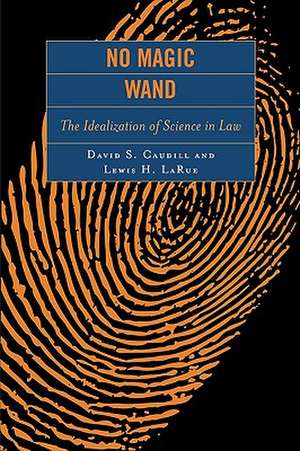
No Magic Wand: The Idealization of Science in Law
Autor David S. Caudill, Lewis H. LaRueen Limba Engleză Paperback – 29 iun 2006
Preț: 260.02 lei
Preț vechi: 343.66 lei
-24%
Puncte Express: 390
Carte tipărită la comandă
Livrare economică 03-17 decembrie
Livrare prin curier în România Termenul estimat este afișat lângă disponibilitate.
Transport gratuit de la 400.00 lei Plată online sau ramburs, în funcție de opțiunile comenzii.
Retur gratuit în 14 zile Comandă securizată și suport în română.
Specificații
ISBN-13: 9780742550230
ISBN-10: 0742550230
Pagini: 153
Dimensiuni: 167 x 226 x 11 mm
Greutate: 0.29 kg
Editura: Bloomsbury Publishing
Colecția Rowman & Littlefield
Locul publicării:New York, United States
ISBN-10: 0742550230
Pagini: 153
Dimensiuni: 167 x 226 x 11 mm
Greutate: 0.29 kg
Editura: Bloomsbury Publishing
Colecția Rowman & Littlefield
Locul publicării:New York, United States
V-ar putea interesa
-
 -30%Preț: 341.71 lei490.55 lei
 -
 The European Union and its Court of JusticeAnthony Arnull-20%Preț: 525.11 lei659.10 lei
 -
 International ProsecutorsLuc Reydams-30%Preț: 1099.72 lei1579.19 lei
 -
 -16%Preț: 332.77 lei396.10 lei
 -
 Disorder in the CourtCharles M. SevillaPreț: 82.42 lei
 -
 Judiciaries Within EuropeBell JohnPreț: 446.52 lei
 -
 Reflections on JudgingRichard Allen PosnerPreț: 297.75 lei
 -
 The Judge in a DemocracyAharon BarakPreț: 262.26 lei
 -
 On Circuit 1924 1937Frank Douglas MacKinnonPreț: 391.95 lei
 -
 The Steps to the Supreme CourtPeter IronsPreț: 141.20 lei
 -
 The NineJeffrey ToobinPreț: 130.56 lei
 -
 -27%Preț: 66.81 lei91.71 lei
 -
 Murder at the Supreme CourtMartin ClancyPreț: 163.77 lei
 -
 Sir William GarrowJohn HostettlerPreț: 199.92 lei
Cuprins
Chapter 1 Introduction
Chapter 2 1. What's the Problem?
Chapter 3 2. On Judges Who Are Too Strict
Chapter 4 3. On Judges Who Are Too Gullible
Chapter 5 4. The Idealizations of Legal Scholars
Chapter 6 5. Science is a Pragmatic Activity
Chapter 7 6. Science Studies for Law
Chapter 2 1. What's the Problem?
Chapter 3 2. On Judges Who Are Too Strict
Chapter 4 3. On Judges Who Are Too Gullible
Chapter 5 4. The Idealizations of Legal Scholars
Chapter 6 5. Science is a Pragmatic Activity
Chapter 7 6. Science Studies for Law
Recenzii
Legal actors' understanding of how scientific knowledge is produced is a matter of immense and increasing importance in contemporary society. Caudill and LaRue make a significant contribution to this debate by drawing on science studies research as a prophylactic against the temptation to adopt idealized or "romantic," as they call them, images of scientific activity. No Magic Wand demonstrates that bringing a science studies perspective to bear on legal problems leads, not to meaningless relativism, but to a profoundly pragmatic approach to assessing the value of knowledge claims that invoke the mantle of science.
No Magic Wand is a tour-de-force that bridges the gap between jurisprudence and science studies. Caudill and LaRue successfully illustrate how law idealizes science and the problems this causes for the courts as well as for science. In this "brave new world" after the Supreme Court's decision in Daubert, their solution-that courts view science as a pragmatic activity-will resonate both with scientists and lawyers. Every judge and lawyer grappling with scientific evidence, and every scientist testifying in court, should read this book.
Caudill and LaRue have written an erudite, deeply considered, and highly readable account of the tension between the two cultures of law and science, the tendency of lawyers and judges to oscillate between credulity and dismissiveness when confronted by scientific testimony, and the need in short for legal professionals to acquire a more accurate understanding of the strengths and limitations of science in the legal process.
On the whole, No Magic Wand is readable and interesting. It is useful in that it provides specific examples from cases to show how various judges have interpreted the Daubert criteria. The book will be more useful to those less familiar with the problems associated with using scientific evidence in the courtroom.
In No Magic Wand, Caudill and LaRue impart valuable wisdom for the beginner as well as the advanced legal scholar. Coverage ranges from the basics - the current tests for scientific and technical evidence - to the most sophisticated questions raised by commentators on forensic jurisprudence. The debate over how much courts should defer to experts is a key issue in the "science wars," and the treatment of it in Chapter Three is trenchant and profound. This book is a must read for lawyers, professors, or judges who are seeking to come to grips with the scientific processes in the courtroom.
No Magic Wand is a tour-de-force that bridges the gap between jurisprudence and science studies. Caudill and LaRue successfully illustrate how law idealizes science and the problems this causes for the courts as well as for science. In this "brave new world" after the Supreme Court's decision in Daubert, their solution-that courts view science as a pragmatic activity-will resonate both with scientists and lawyers. Every judge and lawyer grappling with scientific evidence, and every scientist testifying in court, should read this book.
Caudill and LaRue have written an erudite, deeply considered, and highly readable account of the tension between the two cultures of law and science, the tendency of lawyers and judges to oscillate between credulity and dismissiveness when confronted by scientific testimony, and the need in short for legal professionals to acquire a more accurate understanding of the strengths and limitations of science in the legal process.
On the whole, No Magic Wand is readable and interesting. It is useful in that it provides specific examples from cases to show how various judges have interpreted the Daubert criteria. The book will be more useful to those less familiar with the problems associated with using scientific evidence in the courtroom.
In No Magic Wand, Caudill and LaRue impart valuable wisdom for the beginner as well as the advanced legal scholar. Coverage ranges from the basics - the current tests for scientific and technical evidence - to the most sophisticated questions raised by commentators on forensic jurisprudence. The debate over how much courts should defer to experts is a key issue in the "science wars," and the treatment of it in Chapter Three is trenchant and profound. This book is a must read for lawyers, professors, or judges who are seeking to come to grips with the scientific processes in the courtroom.