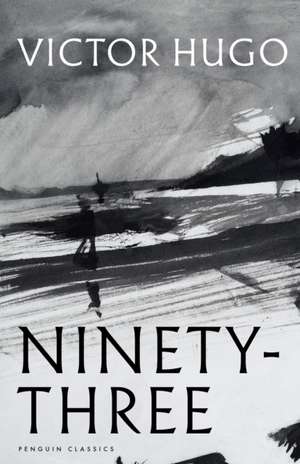
Ninety-Three
Autor Victor Hugoen Limba Engleză Hardback – 25 iun 2026
In the turmoil of the French Revolution, the year 1793 represented the peak of bloody revolutionary violence. Victor Hugo plunges into this tumultuous period with a story of courage and betrayal across the political classes. As the revolution rages, three characters - a nobleman turned revolutionary, a devoted mother, and a zealous commander - find their fates intertwined in a struggle that tests their convictions and loyalties. Hugo's last great novel was also his most political and prophetic - and is the equal of Les Misérables in drama, emotion, adventure and sacrifice.
Preț: 144.27 lei
Puncte Express: 216
Carte disponibilă
Livrare economică 06-20 noiembrie
Livrare express 22-28 octombrie pentru 36.78 lei
Livrare prin curier în România Termenul estimat este afișat lângă disponibilitate.
Transport gratuit de la 400.00 lei Plată online sau ramburs, în funcție de opțiunile comenzii.
Retur gratuit în 14 zile Comandă securizată și suport în română.
Specificații
ISBN-13: 9780241744055
ISBN-10: 0241744059
Pagini: 448
Dimensiuni: 138 x 204 x 44 mm
Greutate: 0.58 kg
Editura: Penguin Books
Colecția Penguin Classics
ISBN-10: 0241744059
Pagini: 448
Dimensiuni: 138 x 204 x 44 mm
Greutate: 0.58 kg
Editura: Penguin Books
Colecția Penguin Classics
V-ar putea interesa
-
 A Place of Greater SafetyHilary MantelPreț: 97.84 lei
 -
 The Gods Will Have BloodAnatole France-37%Preț: 58.20 lei92.60 lei
 -
 Notre-Dame de ParisVictor Hugo-24%Preț: 61.85 lei80.85 lei
 -
 Explosion in a CathedralAlejo CarpentierPreț: 99.27 lei
 -
 Personal Recollections of Joan of ArcMark TwainPreț: 71.67 lei
 -
 The Scarlet PimpernelEmmuska OrczyPreț: 36.11 lei
 -
 The Paris ExpressEmma Donoghue-33%Preț: 72.78 lei108.67 lei
 -
 -26%Preț: 80.96 lei108.70 lei
 -
 A Tale of Two Cities (Artisan Edition)Charles DickensPreț: 87.09 lei
 -
 Victor HugoBradley Stephens-17%Preț: 88.80 lei106.87 lei
 -
 The Last Day of a Condemned ManVictor HugoPreț: 45.77 lei
 -
 A Tale of Two CitiesCharles DickensPreț: 37.55 lei
 -
 Les Misérables Volume TwoVictor HugoPreț: 38.00 lei
 -
 Les Misérables Volume OneVictor HugoPreț: 31.55 lei
 -
 Classics Illustrated 7Victor HugoPreț: 57.23 lei
 -
 Les MisérablesVictor Hugo-33%Preț: 58.45 lei87.05 lei
 -
 The Man Who LaughsVictor HugoPreț: 57.30 lei
Notă biografică
Victor Hugo (Author)
Victor Hugo was born in Besançon, France in 1802. In 1822 he published his first collection of poetry and in the same year, he married his childhood friend, Adèle Foucher. In 1831 he published his most famous youthful novel, Notre-Dame de Paris. A royalist and conservative as a young man, Hugo later became a committed social democrat and was exiled from France as a result of his political activities. In 1862, he wrote his longest and greatest novel, Les Misérables. After his death in 1885, his body lay in state under the Arc de Triomphe before being buried in the Panthéon.
David Bellos (Translator)
David Bellos is Meredith Howland Pyne Professor of French Literature at Princeton University, where he also teaches Comparative Literature. He is the author of many books and articles on nineteenth-century fiction, alongside biographies of three icons of French culture in the twentieth century: Georges Perec, Jacques Tati and Romain Gary. He is also a well-known translator and the author of Is That a Fish in Your Ear? The Amazing Adventure of Translation. David Bellos was recently awarded the medal of Officier de l'ordre des Arts et des Lettres for his services to French culture.
Victor Hugo was born in Besançon, France in 1802. In 1822 he published his first collection of poetry and in the same year, he married his childhood friend, Adèle Foucher. In 1831 he published his most famous youthful novel, Notre-Dame de Paris. A royalist and conservative as a young man, Hugo later became a committed social democrat and was exiled from France as a result of his political activities. In 1862, he wrote his longest and greatest novel, Les Misérables. After his death in 1885, his body lay in state under the Arc de Triomphe before being buried in the Panthéon.
David Bellos (Translator)
David Bellos is Meredith Howland Pyne Professor of French Literature at Princeton University, where he also teaches Comparative Literature. He is the author of many books and articles on nineteenth-century fiction, alongside biographies of three icons of French culture in the twentieth century: Georges Perec, Jacques Tati and Romain Gary. He is also a well-known translator and the author of Is That a Fish in Your Ear? The Amazing Adventure of Translation. David Bellos was recently awarded the medal of Officier de l'ordre des Arts et des Lettres for his services to French culture.
Descriere
Descriere de la o altă ediție sau format:
A historical novel built upon the questions "Can a good action be a bad action? Does not he who spares the wolf kill the sheep?" centers on revolutionary France; just as the plot is an abstract judicial difficulty, the hero is an abstract historical force.
A historical novel built upon the questions "Can a good action be a bad action? Does not he who spares the wolf kill the sheep?" centers on revolutionary France; just as the plot is an abstract judicial difficulty, the hero is an abstract historical force.