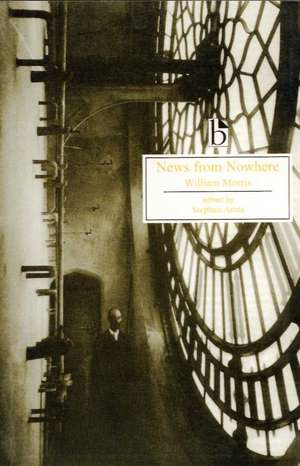
News from Nowhere
Autor William Morris Editat de Stephen Arataen Limba Engleză Paperback – 11 oct 2002
This Broadview edition includes a wide variety of contextualizing documents, including portions of Morris’s essays, lectures, and journalism; excerpts from precursor utopian texts; writings on Bloody Sunday, art, work, and revolution; and contemporary reviews.
Preț: 165.21 lei
Preț vechi: 213.13 lei
-22%
Puncte Express: 248
Carte disponibilă
Livrare economică 05-19 noiembrie
Livrare prin curier în România Termenul estimat este afișat lângă disponibilitate.
Transport gratuit de la 400.00 lei Plată online sau ramburs, în funcție de opțiunile comenzii.
Retur gratuit în 14 zile Comandă securizată și suport în română.
Specificații
ISBN-13: 9781551112671
ISBN-10: 1551112671
Pagini: 356
Ilustrații: Illustrations
Dimensiuni: 140 x 216 x 19 mm
Greutate: 0.45 kg
Editura: BROADVIEW PR
Colecția Broadview Press
Locul publicării:Peterborough, Canada
ISBN-10: 1551112671
Pagini: 356
Ilustrații: Illustrations
Dimensiuni: 140 x 216 x 19 mm
Greutate: 0.45 kg
Editura: BROADVIEW PR
Colecția Broadview Press
Locul publicării:Peterborough, Canada
V-ar putea interesa
-
 Preț: 29.76 lei
 -
 Brave New WorldAldous HuxleyPreț: 58.67 lei
 -
 England, EnglandJulian Barnes-26%Preț: 58.95 lei79.13 lei
 -
 News from Nowhere and Other WritingsWilliam Morris-24%Preț: 61.33 lei80.55 lei
 -
 Useful Work v. Useless ToilWilliam MorrisPreț: 55.56 lei
 -
 Looking Backward 2000-1887Edward Bellamy-12%Preț: 28.68 lei32.57 lei
 -
 Looking BackwardEdward BellamyPreț: 39.90 lei
 -
 AnthemAyn RandPreț: 52.26 lei
 -
 -25%Preț: 59.58 lei79.41 lei
 -
 The Conquest of BreadPeter KropotkinPreț: 56.82 lei
 -
 A Modern UtopiaH. G. WellsPreț: 51.18 lei
 -
 The ProphetKahlil GibranPreț: 27.21 lei
 -
 William MorrisE. P. ThompsonPreț: 250.88 lei
 -
 The Book of RevelationsJuliet NicolsonPreț: 159.06 lei
 -
 The Ragged Trousered PhilanthropistsRobert TressellPreț: 28.01 lei
 -
 Oliver TwistCharles DickensPreț: 37.41 lei
 -
 The Time MachineH. G. WellsPreț: 33.23 lei
 -
 UtopiaThomas MorePreț: 33.19 lei
 -
 Looking Backward, 2000 To 1887Edward BellamyPreț: 102.59 lei
Recenzii
Written in 1890, at the close of William Morris’s most intense period of political activism, News from Nowhere is a compelling articulation of his mature views on art, work, community, family, and the nature and structure of the ideal society. A utopian narrative of a future society, it is also an immensely entertaining novel.
This Broadview edition includes a wide variety of contextualizing documents, including portions of Morris’s essays, lectures, and journalism; excerpts from precursor utopian texts; writings on Bloody Sunday, art, work, and revolution; and contemporary reviews.
“Stephen Arata, through his insightful introduction and his careful selection of documents, has created an invaluable edition of News from Nowhere, one of the seminal texts of the nineteenth century.” — Peter Stansky, Stanford University
“This astute and long overdue reappraisal provides a lucid overview and a wealth of contextual information. An excellent resource.” — Shannon L. Rogers, Saint Joseph’s University, Editor, Newsletter of the William Morris Society in the United States
“Stephen Arata provides an especially informative account of the social here and now out of which an imagined Nowhere emerged. The rich selection of accompanying texts from British and continental radicals is particularly valuable and full of surprises. This is a fine edition for a new century that invites us to read Morris’s utopia freshly while it provides ample material to help us do so.” — Elizabeth Helsinger, University of Chicago
This Broadview edition includes a wide variety of contextualizing documents, including portions of Morris’s essays, lectures, and journalism; excerpts from precursor utopian texts; writings on Bloody Sunday, art, work, and revolution; and contemporary reviews.
“Stephen Arata, through his insightful introduction and his careful selection of documents, has created an invaluable edition of News from Nowhere, one of the seminal texts of the nineteenth century.” — Peter Stansky, Stanford University
“This astute and long overdue reappraisal provides a lucid overview and a wealth of contextual information. An excellent resource.” — Shannon L. Rogers, Saint Joseph’s University, Editor, Newsletter of the William Morris Society in the United States
“Stephen Arata provides an especially informative account of the social here and now out of which an imagined Nowhere emerged. The rich selection of accompanying texts from British and continental radicals is particularly valuable and full of surprises. This is a fine edition for a new century that invites us to read Morris’s utopia freshly while it provides ample material to help us do so.” — Elizabeth Helsinger, University of Chicago
Cuprins
Introduction
William Morris: A Brief Chronology
A Note on the Text
News from Nowhere
Appendix A: Morris on the Platform
William Morris: A Brief Chronology
A Note on the Text
News from Nowhere
Appendix A: Morris on the Platform
- From “Art and Socialism” (1884)
- From “How We Live and How We Might Live” (1884)
- From “The Society of the Future” (1887)
- Robert Owen, from Report to the County of Lanark (1820)
- John Ruskin, from “The Nature of Gothic” (1852)
- Karl Marx, from Das Kapital (1867)
- Henry George, from Progress and Poverty (1879)
- James MacNeill Whistler, from “Mr. Whistler’s Ten O’Clock” (1885)
- Eleanor Marx-Aveling and Edward Aveling, from “The Woman Question” (1886)
- Mona Caird, from “The Emancipation of the Family” (1890)
- Peter Kropotkin, from The Conquest of Bread (1892)
- Sir Thomas More, from Utopia (1516)
- Samuel Butler, from Erewhon; or, Over the Range (1872)
- Richard Jefferies, from After London; or, Wild England (1885)
- Jane Hume Clapperton, from Margaret Dunmore; or, A Socialist Home (1888)
- Edward Bellamy, from Looking Backward, 2000-1887 (1888)
- Oscar Wilde, from “The Soul of Man Under Socialism” (1891)
- Florence Dixie, from Gloriana; or, the Revolution of 1900 (1892)
- Karl Marx and Friedrich Engels, from Manifesto of the Communist Party (1848)
- John Stuart Mill, from “Chapters on Socialism” (1879)
- H.M. Hyndman, from England for All: The Text-Book of Democracy (1881)
- Sergius Stepniak, from Underground Russia (1883)
- E. Belfort Bax and William Morris, from “Manifesto of the Socialist League” (1885)
- Joseph Lane, from An Anti-Statist, Communist Manifesto (1887)
- George Bernard Shaw, from Fabian Essays in Socialism (1889)
- From The Times (London), November 14, 1887
- Queen Victoria, from her journal and correspondence (1887)
- R.B. Cunninghame Graham, from “Bloody Sunday” (1888)
- George Bernard Shaw, from a letter to William Morris, November 22, 1887
- William Morris, from “London in a State of Siege” (1887)
- Margaret Harkness, from Out of Work (1888)
- Lionel Johnson, from a review in Academy (May 23, 1891)
- Maurice Hewlett, from a review in National Review (August 1891)
- Peter Kropotkin, from an obituary notice in Freedom (November 1896)
- Walter Crane, from an obituary notice in Progressive Review (November 1896)
- J.W. Mackail, from The Life of William Morris (1899)
- May Morris, from The Collected Works of William Morris (1910-15)
Notă biografică
William Morris was born in 1834 in Walthamstow, England. He was one of the great all-rounders, such as a poet, painter, author, translator, political scholar, social reformer, designer, and publisher. The organisations and movements he established ranged from the Arts and Crafts Movement to the Socialist Federation to the Society for the Protection of Ancient Buildings. He started his writing career at Oxford University, where he contributed to and funded the Oxford and Cambridge Magazine. After the Socialist League moved too far from Morris's brand of freedom socialism for him to stay a part of it, he dedicated himself to writing. Initially, these were stories of ancient Germanic legends, and then "Here Be Dragons" became a series of completely fantasy novels, beginning with The Wood Beyond the World and also The Well at the World's End.