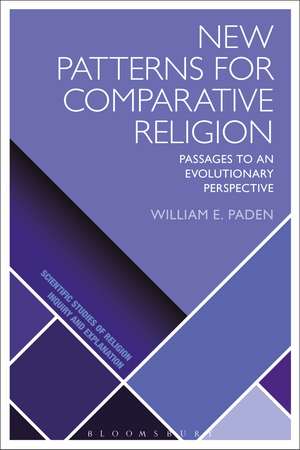
New Patterns for Comparative Religion: Passages to an Evolutionary Perspective: Scientific Studies of Religion: Inquiry and Explanation
Autor William E. Padenen Limba Engleză Hardback – 19 mai 2016
This volume brings together in one place key essays by professor emeritus William Paden, showing a progression of steps he has taken in exploring bridgeworks between comparative religion and evolutionary models of religious behavior. One of the leading scholars in religious studies, Paden shows ways that religion can be contextualized as part of the natural world and thus seen as reflecting the ingrained sociality and world-making drive of the human species.
Paden argues that although comparativism has been challenged as too culture-bound, too western, or too gendered, cross-over categories and concepts between religious traditions cannot be avoided. Arguing that there are recurrent patterns of human behavior common to our species and that thereby underlie all cultures, he proposes that the missing link in the Religion Evolution debate is comparative religion, a global, cross-cultural perspective on religious behaviours throughout time. Each article is contextualized within this overall trajectory of thought within Paden's work and the history of the discipline as a whole.
Din seria Scientific Studies of Religion: Inquiry and Explanation
- 22%
 Preț: 155.70 lei
 - 19%
 Preț: 209.30 lei
 - 25%
 Preț: 224.99 lei
 - 28%
 Preț: 208.89 lei
 - 27%
 Preț: 240.63 lei
 - 27%
 Preț: 236.32 lei
 - 27%
 Preț: 247.84 lei
 - 27%
 Preț: 257.24 lei
 - 33%
 Preț: 645.60 lei
 - 27%
 Preț: 235.86 lei
 - 27%
 Preț: 262.30 lei
 - 30%
 Preț: 196.16 lei
 - 27%
 Preț: 250.23 lei
 - 28%
 Preț: 205.93 lei
 - 28%
 Preț: 207.19 lei
 - 26%
 Preț: 210.57 lei
 - 27%
 Preț: 276.77 lei
 - 27%
 Preț: 243.20 lei
 - 27%
 Preț: 240.17 lei
 - 27%
 Preț: 257.03 lei
 - 28%
 Preț: 205.93 lei
 - 28%
 Preț: 210.57 lei
 - 27%
 Preț: 276.19 lei
 - 32%
 Preț: 553.43 lei
 - 27%
 Preț: 277.68 lei
 - 36%
 Preț: 552.03 lei
 - 33%
 Preț: 787.20 lei
Preț: 836.71 lei
Preț vechi: 1106.57 lei
-24%
Puncte Express: 1255
Carte tipărită la comandă
Livrare economică 18 noiembrie-02 decembrie
Livrare prin curier în România Termenul estimat este afișat lângă disponibilitate.
Transport gratuit pentru acest produs Plată online sau ramburs, în funcție de opțiunile comenzii.
Retur gratuit în 14 zile Comandă securizată și suport în română.
Specificații
ISBN-13: 9781474252102
ISBN-10: 1474252109
Pagini: 264
Dimensiuni: 156 x 234 x 19 mm
Greutate: 0.57 kg
Editura: Bloomsbury Publishing
Colecția Bloomsbury Academic
Seria Scientific Studies of Religion: Inquiry and Explanation
Locul publicării:London, United Kingdom
ISBN-10: 1474252109
Pagini: 264
Dimensiuni: 156 x 234 x 19 mm
Greutate: 0.57 kg
Editura: Bloomsbury Publishing
Colecția Bloomsbury Academic
Seria Scientific Studies of Religion: Inquiry and Explanation
Locul publicării:London, United Kingdom
V-ar putea interesa
-
 Peace Is Every StepThich Nhat Hanh-30%Preț: 73.91 lei106.22 lei
 -
 -28%Preț: 74.44 lei102.92 lei
 -
 Lost Icons: Reflections on Cultural BereavementThe Rt Hon Rowan Williams-16%Preț: 131.73 lei157.03 lei
 -
 Praying the AngelusJean FournéePreț: 57.01 lei
 -
 Is Jesus God?Michael MorwoodPreț: 102.12 lei
 -
 Preț: 112.68 lei
 -
 Los Ojos en la Cruz Una Guia para la ContemplacionMichael KennedyPreț: 187.71 lei
 -
 The Buddha in Your Mirror: Practical Buddhism and the Search for SelfWoody HochswenderPreț: 82.28 leiNou
 -
 In God's HandsDesmond Tutu-33%Preț: 65.31 lei97.24 lei
 -
 -27%Preț: 95.29 lei130.98 lei
Cuprins
Acknowledgements
Introduction
Part one - Rethinking and Redirecting Classical Resources
Chapter 1. Before 'The Sacred' Became Theological: Rereading the Durkheimian Legacy
Chapter 2. Durkheim's Reconciliation of the Social and the Religious
Chapter 3. Sacred Order
Chapter 4. World
Chapter 5. The Concept of World Habitation: Eliadean Linkages with a New Comparativism
Part two - Some New Levels for Cross-Cultural Patterns
Chapter 6. Elements of a New Comparativism
Chapter 7. Universals Revisited: Human Behaviors and Cultural Variations
Chapter 8. Theaters of Worldmaking Behaviors: Panhuman Contexts for Comparative Religion
Chapter 9. Comparison in the Study of Religion
Part 3 - Responses to Evolutionary Sciences
Chapter 10. Connecting with Evolutionary Models: New Patterns in Comparative Religion
Chapter 11. Reappraising Durkheim for the Study and Teaching of Religion
Chapter 12. The Prestige of the Gods: Evolutionary Continuities in the Formation of Sacred Objects
Chapter 13. The History of Religions and Evolutionary Models: Some Reflections on Framing a Mediating Vocabulary
Epilogue
Notes
Introduction
Part one - Rethinking and Redirecting Classical Resources
Chapter 1. Before 'The Sacred' Became Theological: Rereading the Durkheimian Legacy
Chapter 2. Durkheim's Reconciliation of the Social and the Religious
Chapter 3. Sacred Order
Chapter 4. World
Chapter 5. The Concept of World Habitation: Eliadean Linkages with a New Comparativism
Part two - Some New Levels for Cross-Cultural Patterns
Chapter 6. Elements of a New Comparativism
Chapter 7. Universals Revisited: Human Behaviors and Cultural Variations
Chapter 8. Theaters of Worldmaking Behaviors: Panhuman Contexts for Comparative Religion
Chapter 9. Comparison in the Study of Religion
Part 3 - Responses to Evolutionary Sciences
Chapter 10. Connecting with Evolutionary Models: New Patterns in Comparative Religion
Chapter 11. Reappraising Durkheim for the Study and Teaching of Religion
Chapter 12. The Prestige of the Gods: Evolutionary Continuities in the Formation of Sacred Objects
Chapter 13. The History of Religions and Evolutionary Models: Some Reflections on Framing a Mediating Vocabulary
Epilogue
Notes
Recenzii
This collection of essays, even if not representing a single, standardized theory of religion, offers a remarkably coherent whole which includes suggestive propositions for moving the comparative study of religion forward and to integrate divergent approaches.
A methodological goldmine, New Patterns for Comparative Religion offers a new paradigm for the comparative study of religions in which 'the enterprise of comparison.is perhaps our greatest claim to originality as an independent academic discipline' (139). This thought-provoking work is recommended for university and community college libraries with substantial holdings in the study of religion. Graduate students and professors of religion will find this title of interest as well.
Paden provides a valuable and nondogmatic glimpse into the current state of the scholarly domain of comparative religion
and succeeds in addressing some of the field's important hermeneutical tensions while offering inventive heuristic tools in an erudite and laudable manner.
The essays selected for this volume invite the readers to join a series of engaging conversations with key theoretical questions in the study of religion\s. These forays into various theoretical environments avoid hegemonic discourse, opening up interrelated perspectives on important aspects of the eco-sphere of religion.
This remarkable set of essays recounts Paden's efforts to renew the comparative study of religion by placing his earlier emphasis on world making on an evolutionary footing. In focusing on behavior as a bridge between disciplines and recasting "worlds" as environmental "niches," he points the way to a more robust comparativism.
A methodological goldmine, New Patterns for Comparative Religion offers a new paradigm for the comparative study of religions in which 'the enterprise of comparison.is perhaps our greatest claim to originality as an independent academic discipline' (139). This thought-provoking work is recommended for university and community college libraries with substantial holdings in the study of religion. Graduate students and professors of religion will find this title of interest as well.
Paden provides a valuable and nondogmatic glimpse into the current state of the scholarly domain of comparative religion
and succeeds in addressing some of the field's important hermeneutical tensions while offering inventive heuristic tools in an erudite and laudable manner.
The essays selected for this volume invite the readers to join a series of engaging conversations with key theoretical questions in the study of religion\s. These forays into various theoretical environments avoid hegemonic discourse, opening up interrelated perspectives on important aspects of the eco-sphere of religion.
This remarkable set of essays recounts Paden's efforts to renew the comparative study of religion by placing his earlier emphasis on world making on an evolutionary footing. In focusing on behavior as a bridge between disciplines and recasting "worlds" as environmental "niches," he points the way to a more robust comparativism.