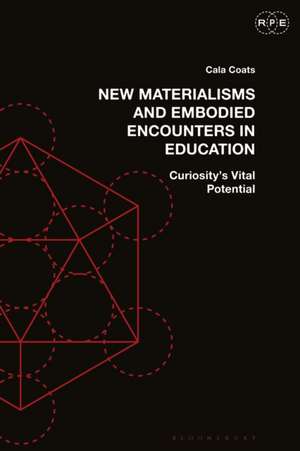
New Materialisms and Embodied Encounters in Education: Radical Politics and Education
Autor Cala Coatsen Limba Engleză Paperback – 24 iul 2025
| Toate formatele și edițiile | Preț | Express |
|---|---|---|
| Paperback (1) | 281.44 lei 6-8 săpt. | |
| BLOOMSBURY ACADEMIC – 24 iul 2025 | 281.44 lei 6-8 săpt. | |
| Hardback (1) | 554.61 lei 6-8 săpt. | |
| Bloomsbury Publishing – 10 ian 2024 | 554.61 lei 6-8 săpt. |
Preț: 281.44 lei
Nou
Puncte Express: 422
Preț estimativ în valută:
49.82€ • 57.93$ • 43.53£
49.82€ • 57.93$ • 43.53£
Carte tipărită la comandă
Livrare economică 22 ianuarie-05 februarie 26
Preluare comenzi: 021 569.72.76
Specificații
ISBN-13: 9781350278783
ISBN-10: 1350278785
Pagini: 194
Dimensiuni: 156 x 234 x 11 mm
Greutate: 0.3 kg
Editura: BLOOMSBURY ACADEMIC
Seria Radical Politics and Education
ISBN-10: 1350278785
Pagini: 194
Dimensiuni: 156 x 234 x 11 mm
Greutate: 0.3 kg
Editura: BLOOMSBURY ACADEMIC
Seria Radical Politics and Education
Caracteristici
Develops a theory of curiosity as a powerful connective and collective force in education through narratives in and out of institutional settings
Notă biografică
Cala Coats is Associate Professor of Art Education in the Herberger Institute for Design and the Arts at Arizona State University, USA.
Cuprins
AcknowledgementsPrelude: Ghostly Palimpsests and Locust TransformationsIntroduction: Vital Curiosity's Disruptive, Connective, and Collective ForcePart I: Disruptive Curiosity: Unsettling Education's Neoliberal Monoculture 1. What can GMOs teach Us about curriculum reform? Coding Pedagogical Vitality through Neoliberal Logics 2. What did the Cafeteria Just Become? Educational Fundraising's Affective Intensity 3. What can a Body Earn? School Fundraising as Immaterial Labor and Affective Currency Part II: Connective Curiosity: Permeating Thresholds through Transcorporeal Movement4. What if we Dig it Ourselves? Mapping a Transcorporeal Inquiry Across the Composition of Clay Bodies 5. What Else Could we Create by Suspending Our Reality? Traveling Isolation's Intensity as Frictions of Potential 6. Is this Land Just Layers of Bodies? Mapping Spectral Flows Across Skeletal Forms Part III: Collective Curiosity: Affirming our Ethico-Aesthetic Potential 7. What can a Body Express? Nesting as Collective Sociality 8. How Might we Live as Pollinators? The Joyful, Strange, and Vital Uncertainty of a Pedagogical Life 9. What if we Learn This Together? Composing Collective Ecologies through Curiosity's Radical Interconnectedness References Index
Recenzii
This book makes an important contribution to the fields of art education and curriculum studies. It draws upon cutting edge theory in art education and curriculum through the use of highly readable narratives articulating alternative images and approaches to curriculum and pedagogy.