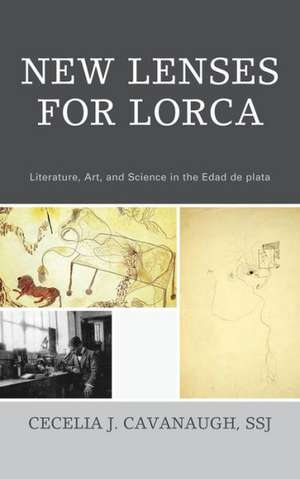
New Lenses For Lorca: Literature, Art, and Science in the Edad de plata
Autor Cecelia Cavanaughen Limba Engleză Paperback – 9 oct 2013
By reading particular texts among Lorca's lectures, letters, poetry, theater, and drawings through the lens of the memoirs, lectures, and drawings of scientists such as Santiago Ramón y Cajal and Pío del Río-Hortega, a working poetics is established for each and comparisons are drawn. References to science in Lorca's work open a new reading of some of his texts. At the same time, Ramón y Cajal and del Río-Hortega's drawing and writing are analyzed as plastic and rhetorical works of art. The result is a study of the creative process in artist and scientist alike and their mutual influence.
Preț: 184.16 lei
Preț vechi: 436.91 lei
-58%
Puncte Express: 276
Carte disponibilă
Livrare economică 06-18 noiembrie
Livrare prin curier în România Termenul estimat este afișat lângă disponibilitate.
Transport gratuit de la 400.00 lei Plată online sau ramburs, în funcție de opțiunile comenzii.
Retur gratuit în 14 zile Comandă securizată și suport în română.
Specificații
ISBN-13: 9781611485523
ISBN-10: 1611485525
Pagini: 201
Ilustrații: 32 BW Illustrations
Dimensiuni: 152 x 228 x 18 mm
Greutate: 0.38 kg
Editura: Bloomsbury Publishing
Colecția Bucknell University Press
Locul publicării:New York, United States
ISBN-10: 1611485525
Pagini: 201
Ilustrații: 32 BW Illustrations
Dimensiuni: 152 x 228 x 18 mm
Greutate: 0.38 kg
Editura: Bloomsbury Publishing
Colecția Bucknell University Press
Locul publicării:New York, United States
V-ar putea interesa
-
 BlueprintsMarcus Du SautoyPreț: 123.84 lei
 -
 Selected PoemsFederico Garcia Lorca-20%Preț: 74.17 lei92.17 lei
 -
 Jorge Luis Borges: A Very Short IntroductionIlan Stavans-20%Preț: 56.92 lei71.00 lei
 -
 Selected Poems: with parallel Spanish textFederico García LorcaPreț: 57.62 lei
 -
 Cicada!Federico García LorcaPreț: 42.68 lei
 -
 Collected PoemsFederico García LorcaPreț: 277.66 lei
 -
 The Immense JourneyLoren EiseleyPreț: 69.52 lei
 -
 The Dehumanization of Art and Other Essays on Art, Culture, and LiteratureJosé Ortega Y. GassetPreț: 90.47 lei
 -
 In Search of DuendeFederico Garcia LorcaPreț: 63.73 lei
 -
 MEMORYDorothea LaskyPreț: 98.51 lei
 -
 -26%Preț: 58.43 lei78.89 lei
 -
 Finding Duende: Duende: Play and Theory | Imagination, Inspiration, EvasionFederico García LorcaPreț: 154.83 lei
 -
 Southernmost: SonnetsLeo BoixPreț: 90.63 lei
 -
 ForetokensSarah HowePreț: 91.54 lei
 -
 Deep Song - The Life and Work of Federico García LorcaStephen Roberts-15%Preț: 208.08 lei245.18 lei
 -
 The Ways of ParadisePeter CornellPreț: 78.92 lei
 -
 Preț: 68.85 lei
 -
 Gaston Bachelard: An Intellectual BiographySteven ConnorPreț: 191.46 lei
 -
 Lorca, Buñuel, Dalí: Forbidden Pleasures and Connected LivesProf Gwynne Edwards-21%Preț: 374.84 lei475.54 lei
Cuprins
Acknowledgments
Introduction: Reading Lorca through the Microscope
1. Literature, Art, and Science in the Edad de plata
2. Microscopic and Macroscopic Imagery: "A la ciencia no van más que los artistas"
3. Scientists and Artists: Finding an "Ecstatic Rhythm"
4. Cells and Cells: "estructuras y conexiones"
5. Saints, Science, and Suffering
6. "The eternal and congenial site of true poetry": Saint Sebastian and the Witness to Aesthetic Emotion
By Way of . . . Conclusion
Bibliography
Studies
Introduction: Reading Lorca through the Microscope
1. Literature, Art, and Science in the Edad de plata
2. Microscopic and Macroscopic Imagery: "A la ciencia no van más que los artistas"
3. Scientists and Artists: Finding an "Ecstatic Rhythm"
4. Cells and Cells: "estructuras y conexiones"
5. Saints, Science, and Suffering
6. "The eternal and congenial site of true poetry": Saint Sebastian and the Witness to Aesthetic Emotion
By Way of . . . Conclusion
Bibliography
Studies
Recenzii
This is a beautifully written, tightly argued exploration of the role of science in the work of Federico García Lorca, his poetry, prose, and drawings. Building on the work of Xon de Ros, Paul Julian Smith, Dennis Perri, and Candelas Gala, Cavanaugh (Chestnut Hill College) situates García Lorca within the historical and scientific context of his time-looking at his exposure to study of the human anatomy and physiology and his application of the ideas of Santiago Ramón y Cajal and Pío del Río-Hortega. In these the author discovered new ways to think about literary and pictorial art, and to develop a range of metaphors often described as surreal and naïve. In side-by-side comparison of García Lorca's drawings and theoretical writings with those of Ram^d'on y Cajal and Río-Hortega, Cavanaugh "extract[s] a common poetics," transforming understanding of how, in García Lorca's words (as translated by Cavanaugh) "the inexpressible begins to be expressed." Cavanaugh demonstrates that García Lorca's grasp of fractals expresses his understanding of "this essential relationship between the microscopic and the macroscopic," and transforms his arguments about representational art. This important book adds to understanding not only of García Lorca but also of the intellectual fabric of Madrid in the early decades of the twentieth century. Summing Up: Recommended. All readers.