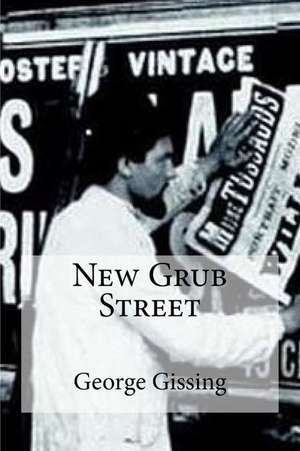
New Grub Street
Autor George Gissing Editat de Edibooksen Limba Engleză Paperback
Preț: 139.75 lei
Puncte Express: 210
Carte tipărită la comandă
Livrare economică 05-19 decembrie
Livrare prin curier în România Termenul estimat este afișat lângă disponibilitate.
Transport gratuit de la 400.00 lei Plată online sau ramburs, în funcție de opțiunile comenzii.
Retur gratuit în 14 zile Comandă securizată și suport în română.
Specificații
ISBN-13: 9781534731363
ISBN-10: 1534731369
Pagini: 522
Dimensiuni: 152 x 229 x 27 mm
Greutate: 0.69 kg
ISBN-10: 1534731369
Pagini: 522
Dimensiuni: 152 x 229 x 27 mm
Greutate: 0.69 kg
V-ar putea interesa
-
 Keep the Aspidistra FlyingGeorge Orwell-27%Preț: 52.63 lei71.65 lei
 -
 The Way We Live NowAnthony Trollope-12%Preț: 67.69 lei76.95 lei
 -
 The Diary of a NobodyGeorge and Weedon Grossmith-20%Preț: 45.80 lei56.93 lei
 -
 The Grapes of WrathJohn Steinbeck-25%Preț: 55.22 lei73.18 lei
 -
 The Picture of Dorian GrayOscar WildePreț: 35.93 lei
 -
 Pride and PrejudiceJane AustenPreț: 44.28 lei
 -
 New Grub Street - A NovelGeorge GissingPreț: 164.00 lei
 -
 -12%Preț: 536.42 lei613.02 lei
 -
 The Nether WorldGeorge GissingPreț: 60.98 lei
 -
 The Ragged Trousered PhilanthropistsRobert TressellPreț: 28.01 lei
 -
 -10%Preț: 62.73 lei70.00 lei
 -
 Oliver TwistCharles DickensPreț: 38.00 lei
 -
 DublinersJames JoycePreț: 28.01 lei
 -
 Preț: 34.20 lei
 -
 The Great Gatsby: 100th Anniversary Edition (The Original 1925 Classic)F. Scott Fitzgerald-13%Preț: 19.85 lei22.82 lei
 -
 The Odd WomenGeorge GissingPreț: 59.90 lei
Descriere
Descriere de la o altă ediție sau format:
New Grub Street is the only one of George Gissing’s two dozen novels never to have gone out of print, and has long been recognized as the most important novel of the nineteenth century on the subject of the writing professions. Indeed, no novel in the English tradition even remotely approximates the thoroughness, sophistication, and clear-sightedness with which New Grub Street explores the social and economic contexts in which writing, publishing, and reading take place. The critical introduction to this edition gives an account of Gissing’s life and times and an overview of the most important stylistic and thematic features of New Grub Street; special attention is given to the writing and publishing professions in late-Victorian England, emphasizing the range of social and economic positions that writers occupied during the period.
This Broadview edition also includes a rich selection of historical material on the literary world of London through the centuries, authorship as a profession, and Gissing’s life and work.
New Grub Street is the only one of George Gissing’s two dozen novels never to have gone out of print, and has long been recognized as the most important novel of the nineteenth century on the subject of the writing professions. Indeed, no novel in the English tradition even remotely approximates the thoroughness, sophistication, and clear-sightedness with which New Grub Street explores the social and economic contexts in which writing, publishing, and reading take place. The critical introduction to this edition gives an account of Gissing’s life and times and an overview of the most important stylistic and thematic features of New Grub Street; special attention is given to the writing and publishing professions in late-Victorian England, emphasizing the range of social and economic positions that writers occupied during the period.
This Broadview edition also includes a rich selection of historical material on the literary world of London through the centuries, authorship as a profession, and Gissing’s life and work.
Recenzii
New Grub Street is the only one of George Gissing’s two dozen novels never to have gone out of print, and has long been recognized as the most important novel of the nineteenth century on the subject of the writing professions. Indeed, no novel in the English tradition even remotely approximates the thoroughness, sophistication, and clear-sightedness with which New Grub Street explores the social and economic contexts in which writing, publishing, and reading take place. The critical introduction to this edition gives an account of Gissing’s life and times and an overview of the most important stylistic and thematic features of New Grub Street; special attention is given to the writing and publishing professions in late-Victorian England, emphasizing the range of social and economic positions that writers occupied during the period.
This Broadview edition also includes a rich selection of historical material on the literary world of London through the centuries, authorship as a profession, and Gissing’s life and work.
“Few novels detail with such sparkling, bitter intelligence the emotional and financial toll that creating and publishing fiction can take on a writer’s life. Yet, for all its bleakness, Gissing’s satire remains a compelling read and a bracing book to teach, because it captures, like no other Victorian novel, the strains of innovation and enervation that alternately inspire and beleaguer its weary idealists and cunning pragmatists. New Grub Street has fresh relevance for us, as Stephen Arata’s skilful introduction makes clear, because all its major themes—the pressures of commerce, financial precariousness, dwindling interest in literature and print journalism, and concern about maintaining a serious forum for art and ideas—are, if anything, even more urgent matters today.” — Christopher Lane, Northwestern University, author of Hatred and Civility: The Antisocial Life in Victorian England (2004)
This Broadview edition also includes a rich selection of historical material on the literary world of London through the centuries, authorship as a profession, and Gissing’s life and work.
“Few novels detail with such sparkling, bitter intelligence the emotional and financial toll that creating and publishing fiction can take on a writer’s life. Yet, for all its bleakness, Gissing’s satire remains a compelling read and a bracing book to teach, because it captures, like no other Victorian novel, the strains of innovation and enervation that alternately inspire and beleaguer its weary idealists and cunning pragmatists. New Grub Street has fresh relevance for us, as Stephen Arata’s skilful introduction makes clear, because all its major themes—the pressures of commerce, financial precariousness, dwindling interest in literature and print journalism, and concern about maintaining a serious forum for art and ideas—are, if anything, even more urgent matters today.” — Christopher Lane, Northwestern University, author of Hatred and Civility: The Antisocial Life in Victorian England (2004)
Notă biografică
Gissing was born on November 22, 1857, in Wakefield, West Yorkshire, the eldest of five children to Thomas Waller Gissing, a chemist, and Margaret. His siblings included William, who died at the age of twenty, Algernon, who later became a writer, Margaret, and Ellen. The Gissing Trust maintains his childhood house in Thompson's Yard, Wakefield. Gissing attended Back Lane School in Wakefield, where he excelled academically. His real interest in reading began when he was ten years old, when he read Charles Dickens' The Old Curiosity Shop, and it expanded over time, thanks to his father's encouragement and the family library. Juvenilia written at this time was published in 1995 as The Poetry of George Gissing. After returning to England, Gissing and Nell lived in London, where he wrote novels and worked as a private instructor. When his debut novel, Workers in the Dawn, was rejected by a publisher, he self-published it using funds from an inheritance. Gissing married Nell on October 27, 1879. Their marriage was marred by poverty, and they were frequently separated while Nell was in the hospital due to ill health. Morley Roberts, a fellow novelist and Owens College alumni, published The Private Life of Henry Maitland, a novel inspired by Gissing's life, in 1912. He was acquaintances with Eduard Bertz, a German socialist whom he met in 1879.
Cuprins
Introduction
A Note on Victorian Publishing
A Note on Incomes
George Gissing: A Brief Chronology
A Note on the Text
New Grub Street
Appendix A: Gissing on Writing
A Note on Victorian Publishing
A Note on Incomes
George Gissing: A Brief Chronology
A Note on the Text
New Grub Street
Appendix A: Gissing on Writing
- From George Gissing’s Diary
- From Charles Dickens:A Critical Study (1898)
- From The Private Papers of Henry Ryecroft (1903)
- From Samuel Johnson, A Dictionary of the English Language (1755)
- From Nathaniel Bailey, A Universal Etymological Dictionary (1782)
- From Samuel Johnson, An Account of the Life of Mr. Richard Savage (1748)
- From Isaac D’Israeli, The Calamities of Authors (1812)
- Thomas Macaulay on Samuel Johnson (1831)
- From Henri Murger, Scènes de la vie de Bohème (1851)
- A Description of the Reading Room at the British Museum (1867)
- From Walter Thornbury, Old and New London (1872)
- From James Payn, Some Literary Recollections (1884)
- From H.D. Traill, “Author and Critic,” Literature (1897)
- Differing views of Grub Street and New Grub Street, from The Author (1891)
- From Thomas Carlyle, “The Hero as Man of Letters” (1841)
- From Anthony Trollope, An Autobiography (1883)
- Walter Besant and the Society of Authors
- Edmund Gosse Writes a Book Review
- From Leopold Wagner, How to Publish a Book or Article and How to Produce a Play. Advice to Young Authors (1898)
- Arnold Bennett on the Writing Profession
- Contradictory notices from the Saturday Review (1891)
- Anonymous, Court Journal (25 April 1891)
- L.F. Austin, Illustrated London News (2 May 1891)
- Anonymous, Spectator (30 May 1891)